

AB 802 compliance comes down to one annual task: if you own a large commercial or multifamily building in California, you must benchmark its energy use in ENERGY STAR Portfolio Manager and report it to the California Energy Commission (CEC) by June 1 each year. This guide explains who must comply with AB 802, how to get whole-building data from your utility, how to submit the report step by step, what happens if you miss the deadline, and how the state’s draft building performance strategy could raise the stakes in the coming years.
Quick summary
- Covered buildings: commercial buildings over 50,000 sq ft of gross floor area, and multifamily buildings over 50,000 sq ft with 17 or more residential utility accounts.
- Deadline: June 1 every year, for the previous calendar year. The next deadline is June 1, 2027 for calendar-year 2026 data.
- You report through ENERGY STAR Portfolio Manager using the CEC’s reporting link. The CEC charges no fee to report.
- Buildings in seven approved local programs (Berkeley, Brisbane, Chula Vista, Los Angeles, San Diego, San Francisco and San José) report to their city instead.
- The CEC can fine owners who do not report, after a 30-day period to correct the violation.
What is AB 802?
Assembly Bill 802 (2015) created California’s Building Energy Benchmarking Program, run by the CEC. It requires owners of large buildings to report annual energy use so the state, owners and tenants can compare how buildings perform. Commercial buildings began reporting in 2018 and multifamily buildings in 2019. The law also requires utilities to give owners whole-building energy data on request, which is what makes reporting possible in buildings where tenants pay their own bills.
Benchmarking itself does not require you to cut energy use. There are no penalties for high energy use under AB 802; the obligation is to report accurate data on time. That may change in the future (see the SB 48 section below), which is one more reason to get your data right now.
Who must comply with AB 802?
According to the CEC, you must report if your building has more than 50,000 square feet of gross floor area and is either:
- Commercial: a building with no residential units (offices, retail, hotels, warehouses, distribution centers, schools and so on).
- Multifamily: a building with 17 or more residential utility accounts. For this rule, every residential unit counts as a utility account, whether it is metered separately or served by a master meter.
Buildings of 50,000 sq ft or less generally do not have to report, unless one meter serves several buildings whose combined floor area is over 50,000 sq ft. Historic buildings are covered. Federally owned buildings and buildings on tribal land are outside the state program.
AB 802 exemptions
The CEC lists these situations as exempt or eligible for an exemption:
- Condominiums as defined in the California Civil Code.
- Buildings with 1 to 16 residential utility accounts.
- Buildings where more than half of the floor area is used for manufacturing, industrial purposes, or scientific experiments that need a controlled environment.
- Buildings without a certificate of occupancy (temporary or permanent) for more than half of the reporting year.
- Buildings scheduled for demolition within one year of the reporting date.
- Buildings substantially destroyed by unforeseen circumstances.
Exemptions are not automatic or permanent. You request them through the CEC’s form, the request is due by June 1, and it must be renewed every year.
State or local reporting?
If your building is covered by one of the seven local programs the CEC has approved, you report to the city, and that local filing counts as state compliance. The approved programs are Berkeley BESO, Brisbane, Chula Vista, Los Angeles EBEWE, San Diego, San Francisco and San José. Local programs often cover smaller buildings and some have earlier deadlines.
Watch for one trap: if your city ordinance exempts your building but the building still meets the state thresholds, the CEC says you may still have to report directly to the state.
AB 802 deadline and key dates
| Item | Requirement |
|---|---|
| Annual report due | June 1, covering the previous calendar year |
| Next deadline | June 1, 2027 (calendar-year 2026 data) |
| Exemption and extension requests | Through the CEC’s online forms, by June 1; exemptions renewed every year |
| Data needed | 12 months of whole-building energy use (electricity, natural gas, steam, fuel oil) |
| Penalty | CEC may fine owners after a 30-day period to correct the violation |
| Fee to report | None |
Our tip: request utility data in February or March. Utilities need time to compile aggregated whole-building data, and tenant authorizations can take weeks to collect.
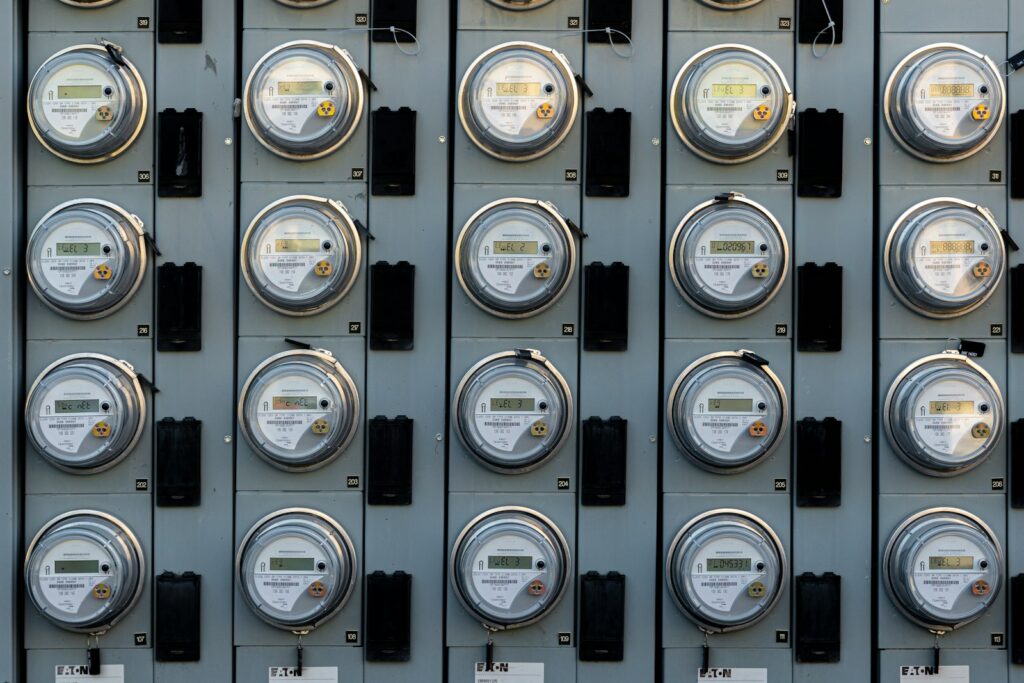
How to request whole-building data from your utility
The hardest part of AB 802 compliance is usually getting complete data, especially when tenants hold their own electric or gas accounts. Here is how the rules work, based on the CEC’s benchmarking FAQ:
- Who can ask: the owner or anyone the owner authorizes, such as a property manager or a benchmarking consultant.
- What you provide: an attestation that you are the owner or authorized to act for the owner. Proof of ownership is not required. Each utility (PG&E, SCE, SDG&E, SoCalGas, municipal utilities and others) has its own request process.
- Three-customer rule: if the building has three or more utility customers, the utility must provide whole-building data without tenant permission. With fewer than three, you need authorization from the tenants (or the prior owner).
- What you receive: monthly building-level data, including tenant spaces, with the last four characters of each meter number so you can check that every meter is included.
If your utility has not delivered data by June 1, the CEC lets you submit with the option for buildings where energy data is unavailable, then resubmit once the data arrives. The later submission replaces the first one.
How to comply with AB 802: step by step
- Confirm where you report. Check whether the building falls under a local program or reports to the state. Our free compliance finder can help you check.
- Set up the property in Portfolio Manager. Create or update the property in ENERGY STAR Portfolio Manager with the address, gross floor area, occupancy, year built and property use details.
- Add your Benchmarking Reference Number (BRN). Buildings that report to the state need a BRN, which you look up at benchmarkingca.com and enter in Portfolio Manager under Details, Unique Identifiers, Standard ID(s), choosing “California Benchmarking Reference Number.” Buildings in local programs use their local ID instead.
- Enter 12 months of energy data. Electricity, natural gas, steam and fuel oil are required. Water and waste are optional, and an ENERGY STAR score is not required to comply.
- Run the Data Quality Checker. The regulations require it before you submit. Fix any flagged gaps, overlaps or unusual values.
- Submit through the CEC’s reporting link. Open the CEC’s Report Benchmarking Data page, select the link for the correct reporting year, log in to Portfolio Manager and send the report.
- Save your confirmation. Portfolio Manager sends a confirmation email. Keep it with your records.
A note on cost: the CEC does not charge anything to report, and it warns that companies offering to file on an owner’s behalf are not associated with the CEC. Owners who hire help, including Energy Fave, are paying for an independent service such as data collection, quality review and filing, not for a state fee.
What happens if you miss the AB 802 deadline?
The CEC has the authority to fine owners for noncompliance, after allowing 30 days to correct the violation. If you missed June 1, the CEC’s advice is to report as soon as possible, even after the deadline. If something outside your control is holding you up, such as a utility that has not delivered data, you can request an extension through the CEC’s form, showing that you took timely steps to comply.
Late or missing reports also show up in other ways. From the second year of reporting for each building group, the CEC publishes selected data for reported buildings, including address, floor area, ENERGY STAR score where eligible, energy use intensity and greenhouse gas emissions. Buyers, lenders and tenants increasingly look at this data.
Proposed rule changes and SB 48: what’s coming next
2025 proposed amendments to the benchmarking regulations
In fall 2025 the CEC proposed changes to the benchmarking regulations (docket 25-OIR-01) after the January 2025 Los Angeles-area wildfires. The proposal adds an exemption for buildings substantially destroyed by fires, floods, earthquakes or declared emergencies, requires exemption requests to include the building’s BRN and a statement under penalty of perjury, and sets out a formal process for approving local benchmarking programs. Check the CEC program page for the current status before relying on these changes.
A possible statewide building performance standard
Senate Bill 48 (2023) required the CEC to develop a Building Energy Performance Strategy. In July 2026 the CEC published a draft strategy report for public comment. It is a draft, not law, and the CEC notes that putting a statewide standard in place would likely require new legislation. Its draft recommendations include:
- Applying a building performance standard to commercial and residential buildings over 50,000 sq ft that already report under AB 802.
- Five-year compliance periods with final performance targets in 2045 for each property type.
- Energy use and direct building greenhouse gas emissions as the main metrics.
- Baselines built from several years of benchmarking data, and verification of benchmarking data by a licensed professional.
- Possible penalties for missing targets.
The practical takeaway: your AB 802 reports from the next few years could become the baseline for future targets. Complete, accurate data now protects you later. If verification becomes part of the program, a licensed third-party verification process will already be familiar to owners who have used it under other city laws.
Frequently asked questions
Do I have to comply with AB 802 if my building is under 50,000 sq ft?
Usually not. The state program covers buildings over 50,000 sq ft of gross floor area. The exception is when a single meter serves several buildings that together exceed 50,000 sq ft. Your city may still have its own lower threshold, so check local rules too.
When is the AB 802 report due?
June 1 every year, for the previous calendar year. The next deadline is June 1, 2027, covering calendar-year 2026 energy use.
Do I need an ENERGY STAR score to comply with AB 802?
No. You need 12 months of whole-building energy data and the required property details, but an ENERGY STAR score is not required. Many owners still use the score to track performance or pursue ENERGY STAR certification.
How do I get energy data for spaces my tenants pay for?
Request whole-building data from each utility. If the building has three or more utility customers, the utility must provide aggregated data without tenant permission. With fewer than three, you need the tenants’ authorization.
Is there a penalty for not reporting under AB 802?
Yes. The California Energy Commission can fine owners who do not report, after allowing 30 days to correct the violation. If you missed the deadline, submit as soon as possible.
Get help with AB 802 compliance
Energy Fave handles California benchmarking from start to finish: confirming whether you report to the state or a city, requesting utility data, setting up Portfolio Manager, running quality checks and filing on time. We support energy benchmarking for buildings in all 50 states. For the full requirements, see our California building energy benchmarking (AB 802) guide.
Ready to get your June 1, 2027 filing off your list? Request a quote and we will get started on your utility data requests early.
Sources: CEC Building Energy Benchmarking Program; CEC benchmarking FAQ; CEC Report Benchmarking Data; Draft California Building Energy Performance Strategy Report (SB 48), July 2026. This article reflects CEC guidance as of November 2026; check the CEC’s website for later updates.