
Los Angeles Energy Benchmarking (EBEWE)
What is the Los Angeles EBEWE program?
The Los Angeles Existing Buildings Energy and Water Efficiency (EBEWE) program (LAMC Division 97) requires owners of larger buildings to benchmark their energy and water use every year and report it to the Los Angeles Department of Building and Safety (LADBS).
EBEWE has two parts:
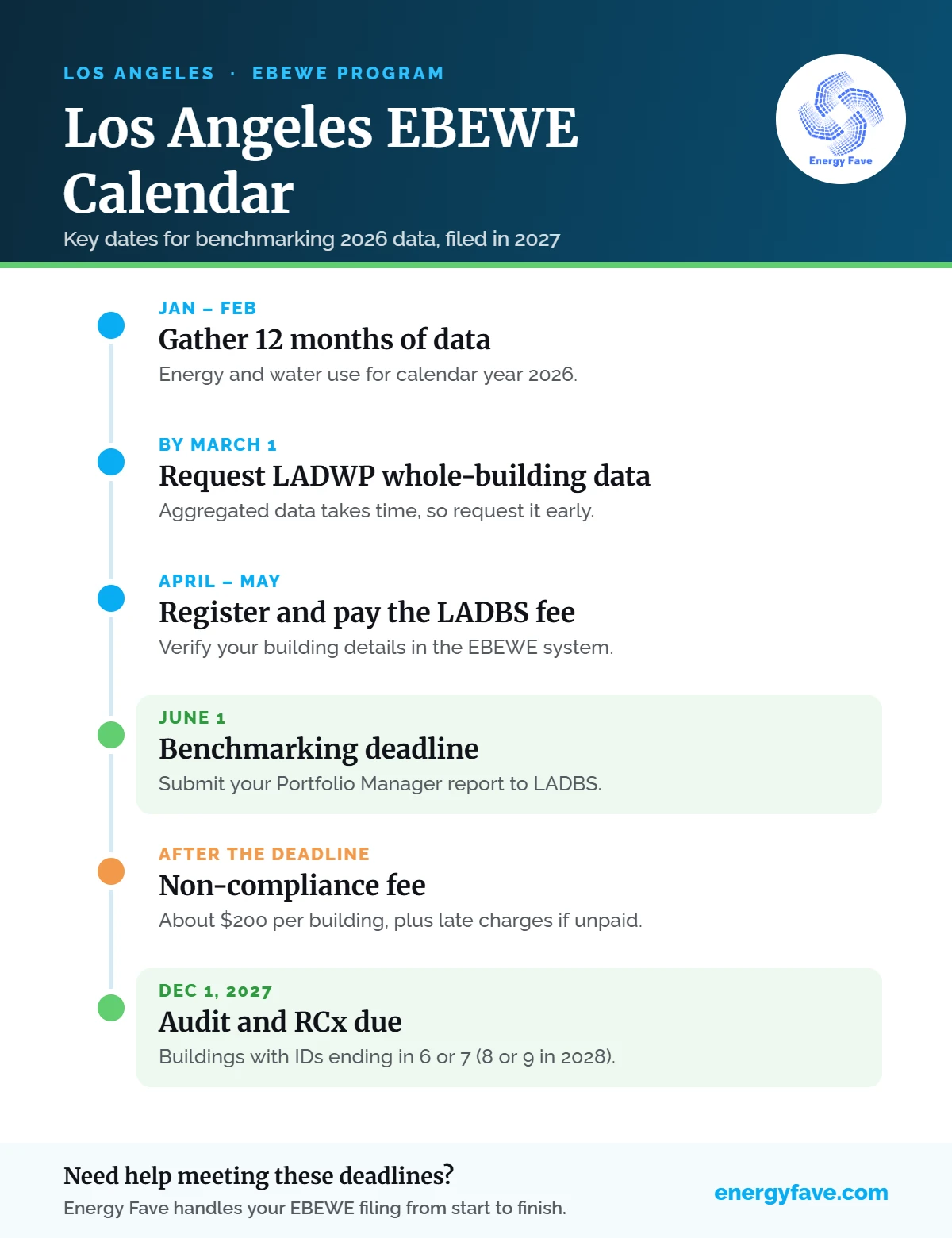
- Annual benchmarking: covered buildings register with LADBS, pay a filing fee and submit a Portfolio Manager report by June 1.
- Audits and retro-commissioning (A/RCx): every five years, buildings must complete an energy and water audit and retro-commissioning, or show they qualify for an exemption, by December 1 of their assigned year.
LADBS publishes benchmarking results, so tenants, buyers and lenders can compare buildings across the city.

What buildings must comply with LA EBEWE?
- Privately owned buildings: 20,000 sq ft or more
- City-owned buildings: 7,500 sq ft or more
Your building may be exempt from benchmarking for a given year if it did not have a Certificate of Occupancy or Temporary Certificate of Occupancy for the entire calendar year being reported. For A/RCx, buildings that already perform well, such as those with a qualifying ENERGY STAR score or recent upgrades, can file an exemption instead of a full audit.
What is the penalty for non-compliance?
LADBS enforces EBEWE through non-compliance fees rather than daily fines:
- Missed benchmarking or A/RCx deadline: LADBS issues a non-compliance fee (about $200) for each building.
- Unpaid invoice: if the fee is not paid within 30 days, a late charge of up to 250% can be added.
- Still out of compliance: paying the fee does not satisfy the requirement, so you still need to file.
What is the compliance process?
EBEWE filings run through both LADBS and ENERGY STAR Portfolio Manager. A typical benchmarking filing looks like this:
- First, find your LADBS Building ID and confirm your building is on the EBEWE list.
- Next, register the building in the LADBS EBEWE system, verify the property details and pay the annual filing fee.
- Then enter 12 months of whole-building energy and water data in Portfolio Manager. Request aggregated whole-building data from LADWP and SoCalGas by early March.
- Submit the report to LADBS through Portfolio Manager by June 1.
- Finally, check the last digit of your Building ID to see when your next five-year audit and retro-commissioning is due.
What is the deadline for LA EBEWE benchmarking?
EBEWE benchmarking reports are due June 1 every year and cover the previous calendar year’s energy and water use.
Next deadlineJune 1, 2027 for calendar-year 2026 data
Audits and retro-commissioning follow a separate five-year schedule, with each deadline on December 1. Your year depends on the last digit of your LADBS Building ID (see the table below).
EBEWE audit and retro-commissioning schedule
Every covered building completes an energy and water audit and retro-commissioning (or files an exemption) once every five years. Your due year depends on the last digit of your LADBS Building ID:
| Building ID ends in | Current cycle due | Next cycle due |
|---|---|---|
| 0 or 1 | Dec 1, 2024 | Dec 1, 2029 |
| 2 or 3 | Dec 1, 2025 | Dec 1, 2030 |
| 4 or 5 | Dec 1, 2026 | Dec 1, 2031 |
| 6 or 7 | Dec 1, 2027 | Dec 1, 2032 |
| 8 or 9 | Dec 1, 2028 | Dec 1, 2033 |
Tip: audits and retro-commissioning take several months. If your Building ID ends in 6 or 7, start planning now for the December 1, 2027 deadline.
What utilities are required for benchmarking reporting?
- Water
- Electricity
- Natural Gas
- District Energy
- Any other purchased fuel
What is the purpose of the EBEWE program?
Existing buildings use most of the energy and much of the water in Los Angeles, so the City uses EBEWE to measure and improve how they perform. The program serves two main goals:
Cut energy and water use. Annual benchmarking shows owners where they waste resources, and the five-year audits turn that data into specific upgrades.
Make performance transparent. Because LADBS publishes the results, tenants and buyers can compare buildings, and owners have a clear reason to improve. Many owners then go further and pursue ENERGY STAR certification.
To see how other cities handle benchmarking, visit our energy benchmarking compliance guide.
This program includes an energy audit, assessment or tune-up requirement. Compare it with other cities in our energy audit compliance guide.
Los Angeles EBEWE FAQs
Do I have to pay a fee to file my LA benchmarking report?
Yes. LADBS charges an annual filing fee when you register and submit your benchmarking report, and a separate fee for each A/RCx filing.
How do I find my LADBS Building ID?
Your Building ID appears on LADBS notices and in the EBEWE online system. You can also search for your property by address in the LADBS EBEWE lookup.
Can my building skip the audit and retro-commissioning?
Possibly. Buildings that already perform well, for example with a qualifying ENERGY STAR score or recent upgrades, can file an exemption instead of a full audit.
Do I also need to report to the State of California?
Generally no. California’s statewide benchmarking program (AB 802) exempts buildings that report under a qualifying local ordinance such as EBEWE. Check with the California Energy Commission if you are unsure.
Can Energy Fave handle my EBEWE filing?
Yes. Energy Fave can register your building, collect LADWP and SoCalGas data, submit your benchmarking report, and coordinate your audit and retro-commissioning.
Interested in benchmarking help?
LA EBEWE at a Glance
- Who's covered
- Private 20,000+ sq ft; City-owned 7,500+ sq ft
- Next deadline
- June 1, 2027The 2026 report was due June 1, 2026. Not filed yet? We can file it now →
- Late penalty
- Non-compliance fee (about $200)
- Audit & RCx
- Every 5 years, due Dec 1
- Reporting tool
- Portfolio Manager + LADBS