
San Diego Building Energy Benchmarking Ordinance
What is San Diego's Building Energy Benchmarking Ordinance?
San Diego’s Building Energy Benchmarking Ordinance (Municipal Code Chapter 14, Article 12) requires owners of commercial, multifamily and mixed-use buildings over 50,000 square feet to benchmark their energy use every year and report it to the City of San Diego.
The City Council passed the ordinance in February 2019 as part of its Climate Action Plan. It mirrors California’s AB 802 benchmarking rules, so covered buildings in the city report to the City instead of the California Energy Commission. Reports are due every June 1.

What buildings must comply in San Diego?
- Commercial buildings over 50,000 sq ft
- Multifamily and mixed-use buildings over 50,000 sq ft with 17 or more residential utility accounts
Covered parking counts toward floor area, but open, uncovered parking does not. Warehouses and distribution centers are covered.
Automatically exempt: condominiums, buildings with 1–16 residential utility accounts, buildings where more than half the floor area is lab, industrial or manufacturing space, and buildings owned by the County, State, federal government, MTS or San Diego Unified School District.
Exempt with City approval: buildings without a certificate of occupancy for more than six months of the year, buildings being demolished, buildings where disclosure would reveal trade secrets, and owners who could not get utility or tenant data.
What is the penalty for non-compliance?
- Administrative and civil penalties: the City can enforce the ordinance through administrative remedies or civil penalties under the Municipal Code.
- Misdemeanor: violations can also be prosecuted as a misdemeanor.
- Public disclosure: the City shares data with the California Energy Commission, and building energy data and compliance status can be made public.
Enforcement is tightening. The City has focused on education so far, but in October 2025 its Sustainable Energy Advisory Board recommended starting fines and updating the ordinance. Plan to file on time.
What is the compliance process?
San Diego owners report through ENERGY STAR Portfolio Manager. A typical filing looks like this:
- First, check the City’s Covered Building List and note your San Diego Building ID.
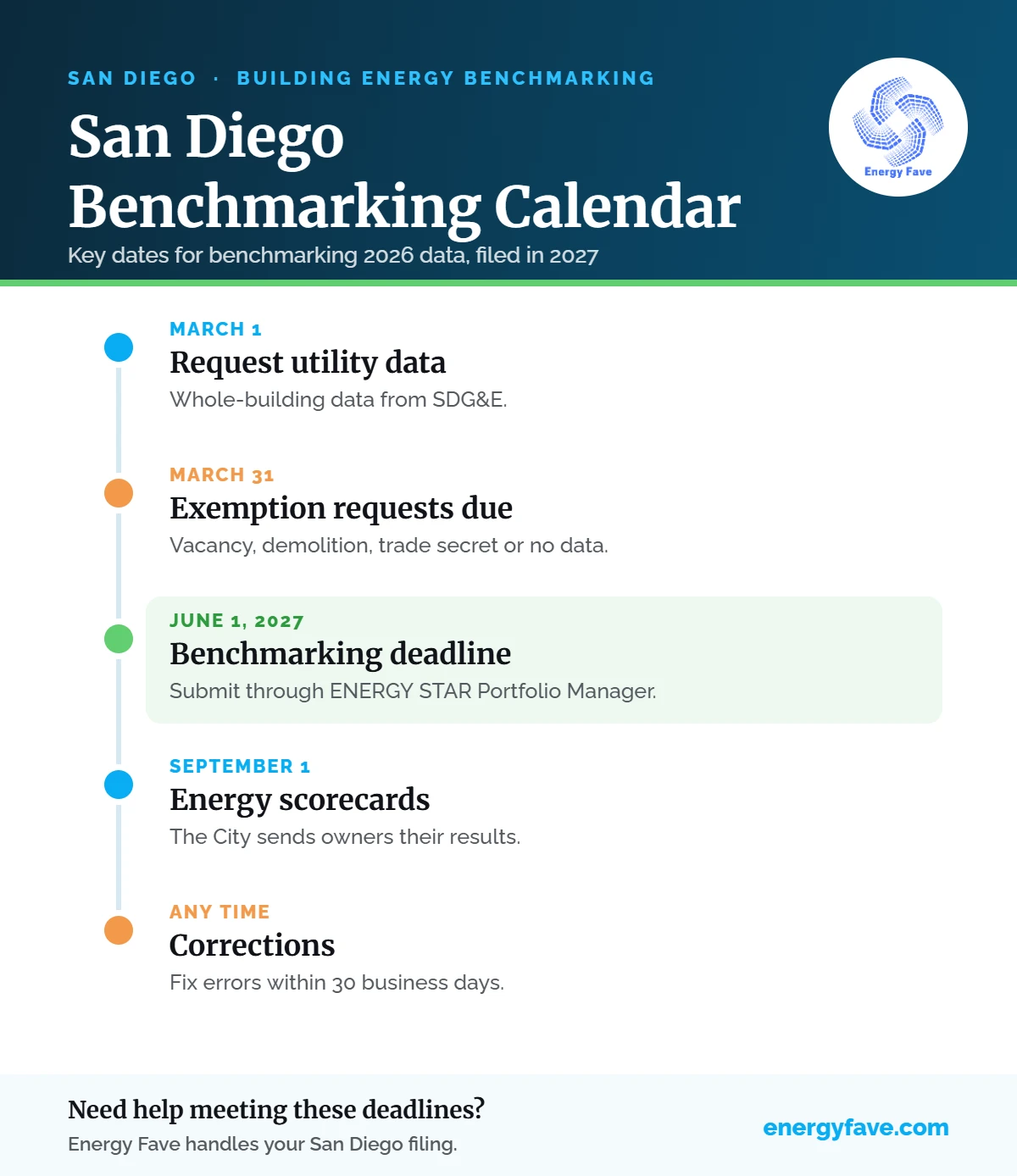
- Next, request whole-building energy data from SDG&E through its benchmarking portal by March 1.
- If you need an exemption, submit your request with documentation by March 31.
- Then enter 12 full months of data for the previous calendar year and run Portfolio Manager’s data quality checker.
- Finally, submit your report to the City through Portfolio Manager by June 1.
Owners must keep energy bills and tenant or utility records for at least three years. If you find an error after submitting, you must correct it within 30 business days.
What is the deadline for San Diego benchmarking?
San Diego benchmarking reports are due June 1 every year and cover the previous calendar year.
Next deadlineJune 1, 2027 for calendar-year 2026 data
The City sends energy scorecards to building owners around September 1 each year.
San Diego ordinance vs. California AB 802
San Diego’s ordinance is aligned with the statewide California Building Energy Benchmarking Program (AB 802). Here is how they compare:
| Requirement | City of San Diego | California AB 802 |
|---|---|---|
| Who’s covered | Buildings over 50,000 sq ft (multifamily with 17+ residential accounts) | Same thresholds, statewide |
| Reporting deadline | June 1 every year | June 1 every year |
| Report to | City of San Diego | California Energy Commission |
| Exemption requests | By March 31 | Through the Energy Commission |
| Do I file twice? | No. Buildings in the City of San Diego file with the City, which shares data with the state. | |
Outside city limits? Buildings elsewhere in San Diego County still report to the state under AB 802, and some nearby cities have their own rules.
What utilities are required for benchmarking reporting?
- Electricity
- Natural Gas
- District Steam
- District Chilled Water
- Any other purchased fuel
Water reporting is not required under the San Diego ordinance.
What is the purpose of San Diego's benchmarking ordinance?
Buildings are a major source of energy use and greenhouse gas emissions in San Diego. The ordinance supports the City’s Climate Action Plan in two main ways:
Help owners save energy. Yearly benchmarking and City scorecards show how a building compares with similar buildings and where savings are possible.
Make performance transparent. Public data helps buyers, tenants and owners make informed decisions. Buildings scoring 75 or higher may qualify for ENERGY STAR certification.
See our California AB 802 guide or our full energy benchmarking compliance guide.
See our guides for California, Chula Vista and Los Angeles, or our full energy benchmarking compliance guide.
Frequently asked questions
Do I need to report to both San Diego and California?
No. Covered buildings in the City of San Diego report to the City, and the City shares the data with the California Energy Commission.
Are condominiums covered?
No. Condominiums are automatically exempt, as are buildings with 1 to 16 residential utility accounts.
When is the San Diego benchmarking deadline?
June 1 every year. The next deadline is June 1, 2027 for 2026 data. Exemption requests are due by March 31.
Is an ENERGY STAR score required?
No. You must report whole-building energy use. A score is calculated when your building type is eligible, but a minimum score is not required.
Can Energy Fave file my San Diego report?
Yes. Energy Fave can request SDG&E data, set up Portfolio Manager, file exemptions and submit your San Diego report on time.
Interested in benchmarking help?
San Diego Benchmarking at a Glance
- Who's covered
- Buildings over 50,000 sq ft
- Next deadline
- June 1, 2027The 2026 report was due June 1, 2026. Not filed yet? We can file it now →
- Exemptions due
- March 31
- Penalty
- Administrative, civil or misdemeanor
- Reporting tool
- ENERGY STAR Portfolio Manager