
Indianapolis Thriving Buildings Energy Benchmarking
What is Indianapolis's Thriving Buildings program?
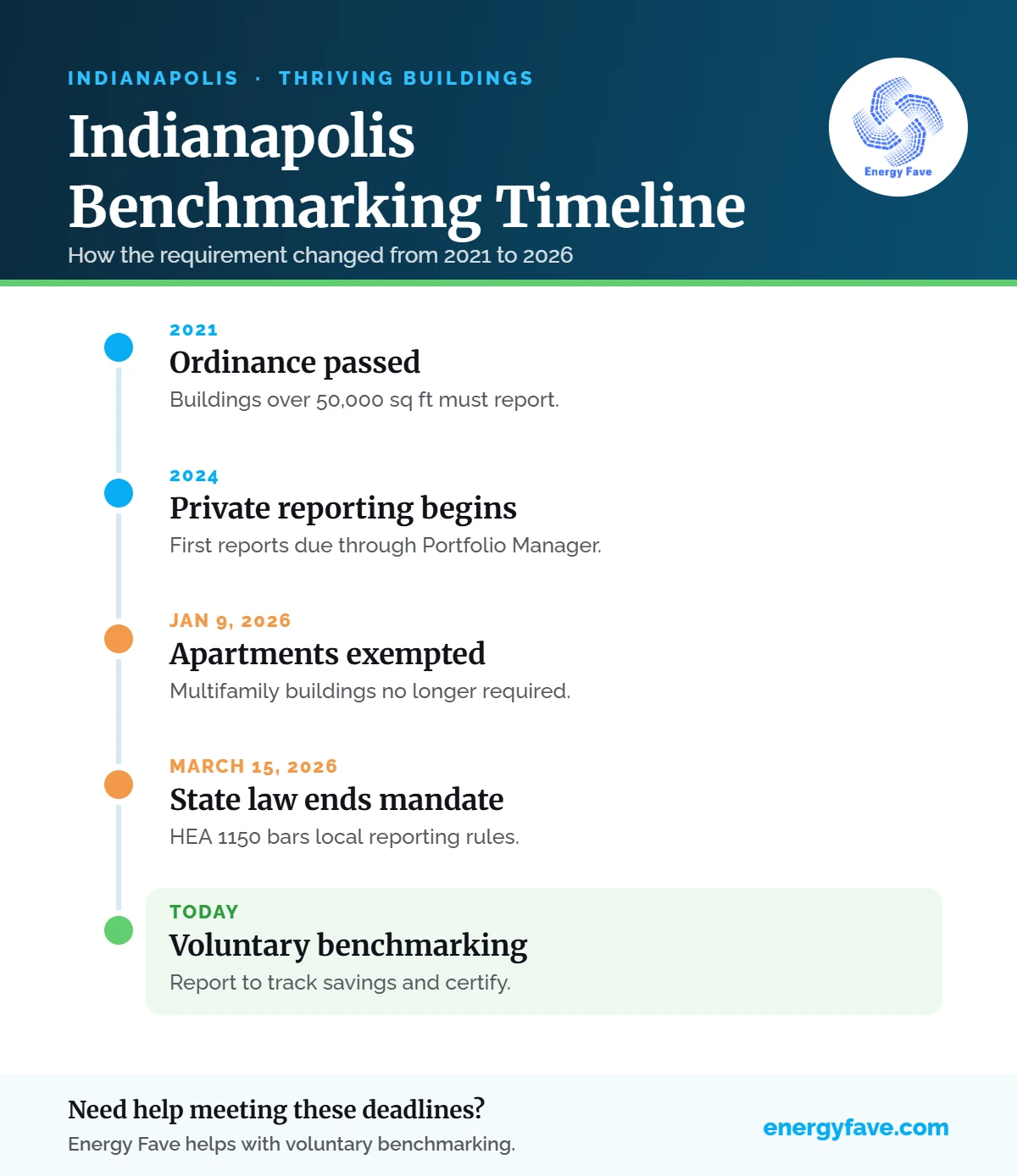
Indianapolis benchmarking runs through Thriving Buildings, a program of the City’s Office of Sustainability. A 2021 City-County ordinance required owners of buildings over 50,000 square feet to benchmark their energy use in ENERGY STAR Portfolio Manager and report it to the City each year.
2026 update: Indiana House Enrolled Act 1150 bars cities and counties from adopting or enforcing ordinances that require building owners to report utility data after March 15, 2026. Benchmarking in Indianapolis is now voluntary.

What buildings were covered in Indianapolis?
- Private buildings over 50,000 sq ft in Marion County
- Publicly owned buildings over 25,000 sq ft
The City identified more than 2,200 buildings in this group. Apartment buildings were made automatically exempt in January 2026, shortly before the state law ended the mandate.
These buildings are no longer required to report, but the City still welcomes voluntary reports, and it plans to open the program to smaller buildings as well.
Is there a penalty for not reporting?
- No penalties now: since March 15, 2026, the City cannot enforce mandatory benchmarking.
- Fines that never started: the ordinance set fines of $100 for the first year and $250 for later years, but the City had not issued any before the state law took effect.
- Voluntary reports welcome: owners can still share data with the City through Thriving Buildings.
How do I benchmark voluntarily?
Voluntary reporting uses the same steps as before, through ENERGY STAR Portfolio Manager:
- First, set up your property in Portfolio Manager with accurate floor area and use details.
- Next, request whole-building data from AES Indiana for electricity and Citizens Energy Group for natural gas, steam and water.
- Then enter 12 full months of data for the previous calendar year and run the Data Quality Checker.
- Review your ENERGY STAR score to see how your building compares with similar buildings nationwide.
- Finally, share your results with the City’s Thriving Buildings program if you want to take part.
Is there still a benchmarking deadline in Indianapolis?
No. The City used June 1 as its annual reporting date for the prior year’s data, but there is no required deadline now that reporting is voluntary.
Current statusVoluntary since March 15, 2026 no required filing date
Many owners still benchmark every year to track costs, qualify for ENERGY STAR certification, and meet tenant or investor requests.
What changed in 2026?
Here is how Indianapolis benchmarking changed under the 2026 state law:
| Topic | Before March 2026 | Now |
|---|---|---|
| Requirement | Mandatory for buildings over 50,000 sq ft | Voluntary |
| Deadline | June 1 each year | None required |
| Penalties | $100 first year, $250 after | None |
| Apartments | Exempt from January 2026 | Voluntary |
| City support | Help desk and outreach | Outreach, resources and incentives |
Own buildings in other cities? The Indiana law only affects Indiana cities and counties. Benchmarking laws in other states still apply. See our full list of benchmarking laws.
What utilities are used for benchmarking?
- Electricity
- Natural Gas
- District Steam
- District Chilled Water
- Water
Citizens Energy Group provides natural gas, steam, chilled water and water service in Indianapolis.
Why benchmark if it is voluntary?
Benchmarking is still one of the simplest ways to cut operating costs. It gives owners two main benefits:
Find savings. Comparing your building with similar buildings shows where you use more energy than you should.
Prove performance. Tenants, buyers and lenders increasingly ask for energy data. Buildings scoring 75 or higher can earn ENERGY STAR certification.
See our guides for nearby Columbus and Chicago, or our full energy benchmarking compliance guide.
Frequently asked questions
Is energy benchmarking still required in Indianapolis?
No. Since March 15, 2026, Indiana law stops cities and counties from enforcing mandatory utility data reporting. Benchmarking in Indianapolis is now voluntary.
Which state law ended the requirement?
House Enrolled Act 1150 (2026). It bars local “utility usage data ordinances” but still allows programs that support voluntary reporting.
Were any fines ever issued?
No. Fines of $100 and $250 were set to begin in 2026, but none had been issued before the mandate ended.
Can I still share my data with the City?
Yes. The Thriving Buildings program still accepts voluntary reports and offers resources to owners.
Can Energy Fave help me benchmark voluntarily?
Yes. Energy Fave can set up Portfolio Manager, collect utility data, and help you pursue ENERGY STAR certification.
Interested in benchmarking help?
Indianapolis at a Glance
- Status
- Voluntary since March 2026
- Was covered
- Buildings over 50,000 sq ft
- Deadline
- None required
- Penalty
- None
- Reporting tool
- ENERGY STAR Portfolio Manager