
Columbus Energy and Water Benchmarking and Transparency Policy
What is Columbus's benchmarking policy?
Columbus benchmarking is required by the City’s Energy and Water Benchmarking and Transparency Policy (City Code Chapter 4117). It requires owners of commercial and multifamily buildings over 50,000 square feet to benchmark their energy and water use every year and report it to the City.
City Council passed the ordinance in 2020, making Columbus the first city in Ohio with a benchmarking law. Reports are due every June 1, and the City shares building results on a public Transparency Map.

What buildings must comply in Columbus?
- Commercial buildings over 50,000 sq ft
- Multifamily buildings with four or more units over 50,000 sq ft, including apartment complexes with several buildings that add up to the threshold
- City-owned buildings over 25,000 sq ft
Single-family homes, duplexes and triplexes are not covered. Owners can request a one-year exemption if the building lacked a certificate of occupancy for the full year, received a demolition permit, had average occupancy below 50%, would reveal trade secrets, or is mainly industrial or manufacturing space. Exemptions must be requested again each year.
What is the penalty for non-compliance?
- Notice of violation: issued if your report is not filed within 30 days of the June 1 deadline.
- Late fees and penalties: apply if you still have not filed within 60 days of the notice, as set in the City’s fee schedule.
- False information: knowingly reporting false data can also bring a notice of violation and penalties.
Owners can appeal to the Columbus Building Commission.
What is the compliance process?
Columbus owners report through ENERGY STAR Portfolio Manager. A typical filing looks like this:
- First, look up your 8-character Columbus Building ID (CBUSID) with the City’s lookup tool and add it to your property in Portfolio Manager.
- Next, request whole-building data: AEP Ohio for aggregated electricity, Columbus Water & Power automated benchmarking for water and city electric, and Columbia Gas for natural gas.
- Ask non-residential tenants for their data. They must respond within 45 days.
- Then enter 12 full months of data for the previous calendar year and run the Data Quality Checker.
- Finally, submit your report to the City through Portfolio Manager by June 1.
Keep your records for three years. If you find an error later, correct it and notify the City within 30 days.
What is the deadline for Columbus benchmarking?
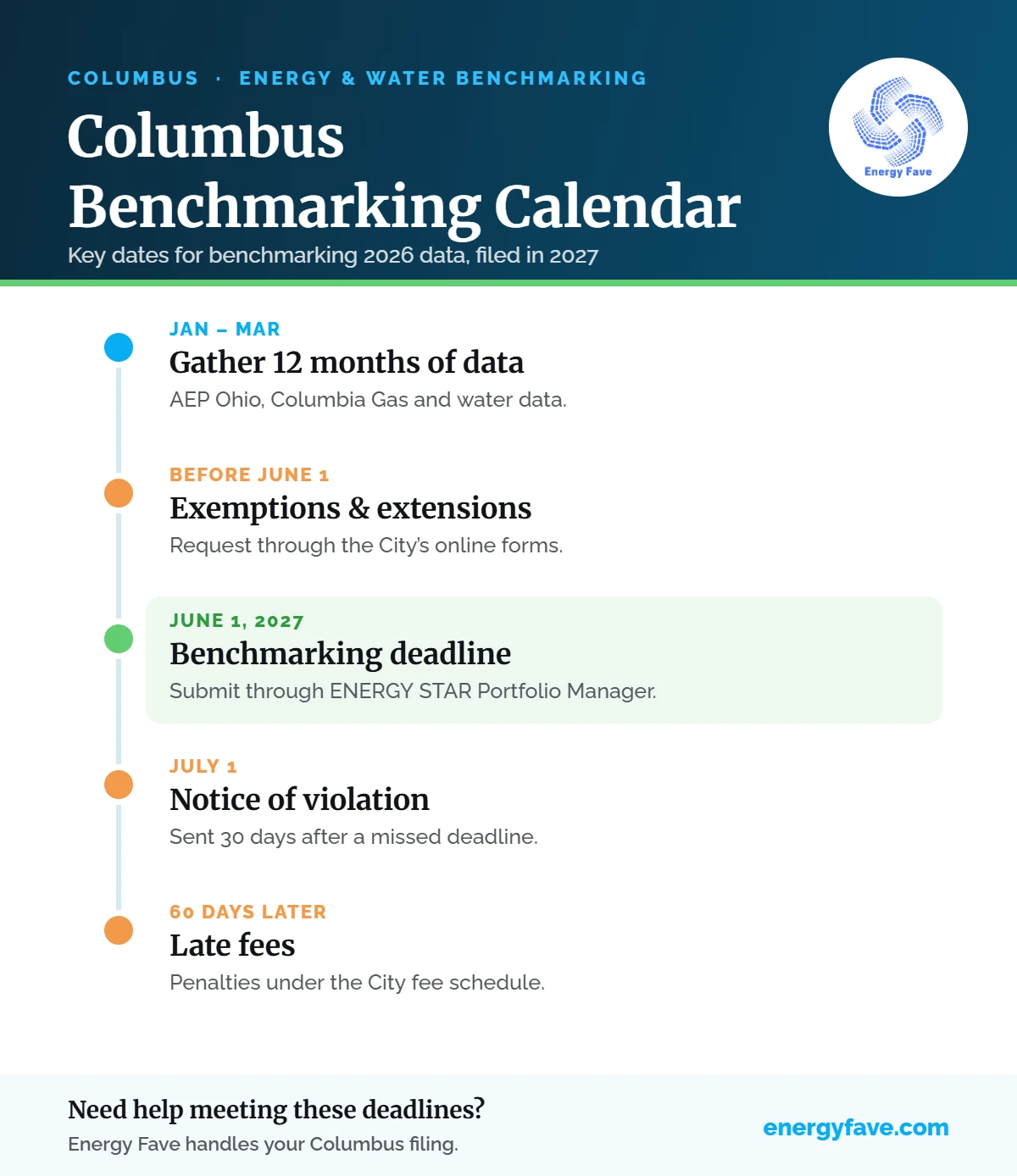
Columbus benchmarking reports are due June 1 every year and cover the previous calendar year.
Next deadlineJune 1, 2027 for calendar-year 2026 data
If you need more time, for example while waiting on aggregated gas data from Columbia Gas, file an extension request with the City before the deadline.
Columbus enforcement timeline
Here is what happens if a covered building misses the deadline:
| Stage | When | What happens |
|---|---|---|
| Deadline | June 1 | Report due through Portfolio Manager |
| Notice of violation | 30 days after the deadline | The City notifies owners who have not filed |
| Late fees | 60 days after the notice | Fees and penalties apply under the City fee schedule |
| Appeal | After a penalty | Owners can appeal to the Building Commission |
Coming next: Columbus is developing a Building Performance Standard (BPS) that would set energy targets for existing buildings. A draft has gone through public comment but has not been adopted yet. Benchmarking data will be the starting point.
What utilities are required for benchmarking reporting?
- Water
- Electricity
- Natural Gas
- District Steam
- District Chilled Water
- Fuel Oil & Diesel
What is the purpose of Columbus's benchmarking policy?
Buildings are one of the largest sources of energy use and greenhouse gas emissions in Columbus. The policy supports the City’s Climate Action Plan in two main ways:
Help owners save energy and water. Yearly benchmarking shows how a building compares with similar buildings and where savings are possible.
Make performance transparent. The public Transparency Map helps tenants, buyers and investors compare buildings. Many owners also pursue ENERGY STAR certification.
See our guides for nearby Pittsburgh and Detroit, or our full energy benchmarking compliance guide.
Frequently asked questions
When is the Columbus benchmarking deadline?
June 1 every year. The next deadline is June 1, 2027 for 2026 data.
Are apartment buildings covered?
Yes. Multifamily buildings with four or more units over 50,000 sq ft must report, including complexes with several buildings that add up to the threshold.
Where do I find my Columbus Building ID?
Use the City’s Building ID Lookup Tool. The CBUSID has 8 characters in the format CBUSxxxx and goes in Portfolio Manager under Unique Identifiers.
Does Columbus have a Building Performance Standard?
Not yet. The City is developing one and has taken public comment on a draft, but it has not been adopted.
Can Energy Fave file my Columbus report?
Yes. Energy Fave can request AEP Ohio, Columbia Gas and water data, set up Portfolio Manager and submit your Columbus report on time.
Interested in benchmarking help?
Columbus at a Glance
- Who's covered
- Commercial & multifamily over 50,000 sq ft
- Next deadline
- June 1, 2027The 2026 report was due June 1, 2026. Not filed yet? We can file it now →
- Late penalty
- Notice at 30 days, fees after 60 more
- Public data
- Transparency Map
- Reporting tool
- Portfolio Manager + CBUSID