
Chicago Energy Benchmarking Ordinance
What is Chicago's Energy Benchmarking Ordinance?
Chicago’s Energy Benchmarking Ordinance requires owners of commercial, institutional and residential buildings of 50,000 square feet or more to benchmark their energy use every year, verify the data every three years, and report it to the City.
Since 2019, covered buildings also receive a Chicago Energy Rating of 0 to 4 stars, which owners must post in the building and share when they list it for sale or lease. With more than 3,500 covered buildings, Chicago runs one of the largest benchmarking programs in the country.

What buildings must comply with Chicago benchmarking?
- Commercial, institutional and residential buildings of 50,000 sq ft or more
- Municipal buildings covered by the ordinance
- Multiple buildings under common ownership on one property that together meet the threshold
Third-party data verification by a licensed professional is required every three years. Your March notification letter tells you whether this is a verification year. Exemptions are limited, for example to financial distress, certain ownership changes, or buildings with more than 10% of space in specific industrial or hazardous uses.
What is the penalty for non-compliance?
Chicago holds owners, managers and their agents responsible for compliance:
- Initial violation: a fine of up to $100.
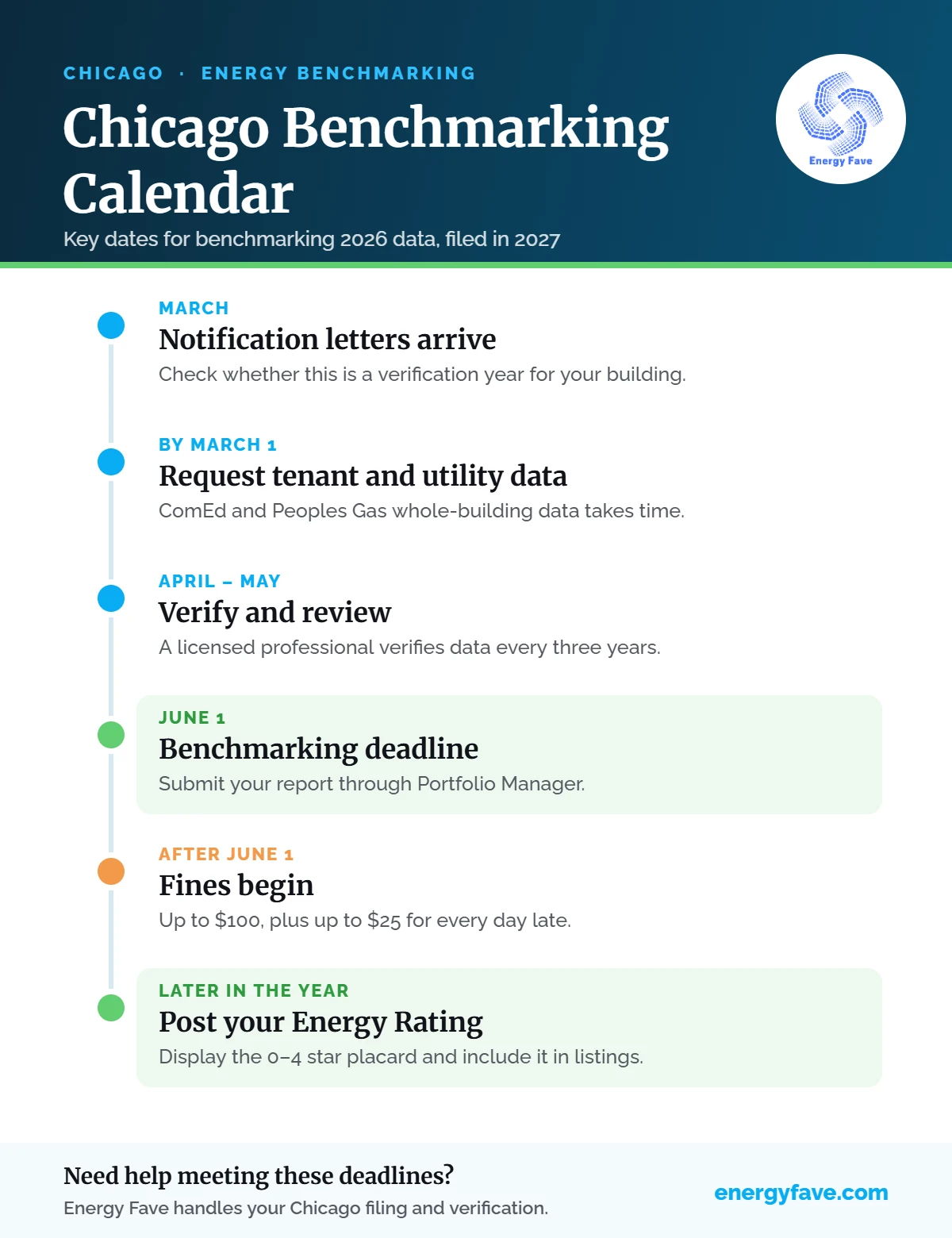
- Continuing violation: up to $25 per day until you comply, which can add up to thousands of dollars in a year.
- Zero-star rating: buildings that do not report receive a 0-star Chicago Energy Rating, which must still be disclosed to buyers and tenants.
What is the compliance process?
Chicago owners report through ENERGY STAR Portfolio Manager. A typical filing looks like this:
- First, read your March notification letter for your Chicago Building ID and whether verification is due this year.
- Next, request tenant and utility data from ComEd and Peoples Gas by March 1 and set up or update the property in Portfolio Manager.
- Then enter 12 months of whole-building energy data for the previous calendar year.
- In verification years, have a licensed professional verify the data.
- Finally, submit your report through Portfolio Manager by June 1, then post your Chicago Energy Rating placard when the City issues it.
Do I need to post my Chicago Energy Rating?
Yes. Covered buildings must post their Chicago Energy Rating placard in a prominent public location, such as the main entrance, lobby or elevator bank. You must also include the rating in sale and lease listings and share it with prospective buyers and tenants.
What is the deadline for Chicago energy benchmarking?
Chicago benchmarking reports are due June 1 every year and cover the previous calendar year.
Next deadlineJune 1, 2027 for calendar-year 2026 data
Verification years need extra time, so we recommend starting in February and booking your verifier early.
Chicago benchmarking requirements at a glance
Chicago combines reporting, verification and public ratings:
| Requirement | Who must comply | When |
|---|---|---|
| Annual benchmarkingEvery year | Buildings of 50,000+ sq ft | June 1 each year |
| Data verificationEvery 3 years | Covered buildings in their verification year | With the June 1 report |
| Chicago Energy Rating0–4 stars | All covered buildings | Post the placard once the City issues it |
| DisclosureSales and leases | Owners listing a building for sale or lease | In listings and to prospective buyers and tenants |
What utilities are required for benchmarking reporting?
- Electricity
- Natural Gas
- District Energy
- Any other purchased fuel
How is the Chicago Energy Rating calculated?
The City converts your ENERGY STAR score into a rating from 0 to 4 stars:
- 1 to 4 stars: based on how your ENERGY STAR score compares with similar buildings nationwide. Higher scores earn more stars.
- Bonus star: buildings that improve their ENERGY STAR score by 10 points or more over two reporting years earn an extra star.
- 0 stars: given to buildings that do not submit a benchmarking report.
A building that scores 75 or higher can also earn ENERGY STAR certification, a strong selling point in Chicago’s leasing market.
What is the purpose of Chicago's benchmarking ordinance?
Buildings account for most of Chicago’s greenhouse gas emissions, so the City uses benchmarking to measure and improve how they perform. The ordinance serves two main goals:
Cut energy use and emissions. Annual data shows owners where they waste energy and helps the City track progress toward its climate goals.
Make performance transparent. The Chicago Energy Rating gives tenants and buyers a simple way to compare buildings, so efficient buildings stand out.
To see how other cities handle benchmarking, visit our energy benchmarking compliance guide.
See our guides for Evanston, Indianapolis, Madison and Milwaukee, or our full energy benchmarking compliance guide.
Need a verifier? Our Professional Engineers and Certified Energy Managers provide third-party verification services.
Chicago energy benchmarking FAQs
How do I know if I need third-party verification this year?
Verification is required every three years. Your March notification letter from the City states whether your building must verify its data this year.
What are the fines for missing the Chicago deadline?
Up to $100 for the initial violation and up to $25 for each day the violation continues.
Do condo and apartment buildings have to benchmark?
Yes. Residential buildings of 50,000 sq ft or more, including condominiums and apartment buildings, must benchmark every year.
Where do I post my Chicago Energy Rating placard?
In a prominent public location such as the main entrance, lobby or elevator bank, and you must include the rating in sale and lease listings.
Can Energy Fave handle my Chicago report and verification?
Yes. Energy Fave can collect ComEd and Peoples Gas data, provide verification and submit your report on your behalf.
Interested in benchmarking help?
Chicago at a Glance
- Who's covered
- Buildings 50,000+ sq ft
- Next deadline
- June 1, 2027The 2026 report was due June 1, 2026. Not filed yet? We can file it now →
- Late penalty
- Up to $100 + $25 per day
- Verification
- Every 3 years
- Energy Rating
- 0–4 stars, posted and disclosed