
California Building Energy Benchmarking (AB 802)
What is California's building energy benchmarking program?
California’s Building Energy Benchmarking Program, created by Assembly Bill 802, requires owners of large commercial and multifamily buildings to benchmark their energy use every year and report it to the California Energy Commission (CEC).
Commercial reporting began in 2018 and multifamily reporting in 2019. Buildings in cities with their own approved programs, such as Los Angeles EBEWE, San Francisco and Berkeley BESO, report locally instead, and the city shares the data with the state.
California is also preparing for statewide building performance standards: under SB 48, the CEC must deliver its Building Energy Performance Strategy to the Legislature by August 1, 2026.

What buildings must comply with California AB 802?
- Commercial buildings over 50,000 sq ft of gross floor area
- Multifamily buildings over 50,000 sq ft with 17 or more residential utility accounts of each energy type
Buildings are excluded if more than 50% of their floor area is used for manufacturing, industrial or controlled-environment scientific purposes. You may also qualify for an exemption if the building lacked a certificate of occupancy for more than half the year, is scheduled for demolition within a year, was largely destroyed, or reports through an approved local program.
What is the penalty for non-compliance?
The CEC can fine owners who fail to report, after a 30-day period to correct the violation:
- Civil penalty: $500 to $2,000 per day for each category of data not provided.
- Separate categories: each missing category accrues penalties separately.
- Formal proceedings: if the violation is not corrected within 30 days, the CEC can begin administrative action.
What is the compliance process?
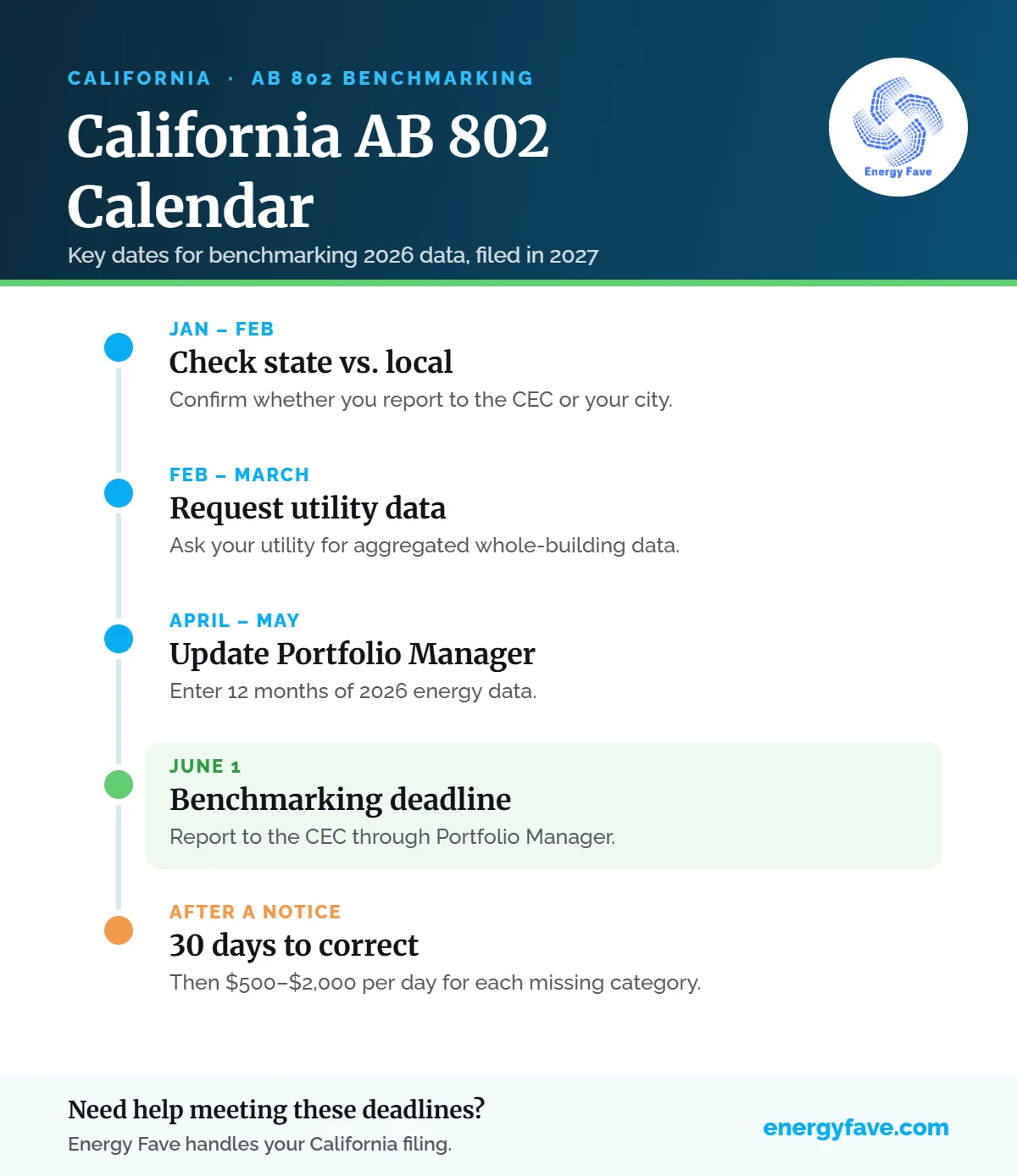
California owners report through ENERGY STAR Portfolio Manager and the CEC’s reporting link. A typical filing looks like this:
- First, check whether your building reports to the state or to a local program such as LA, San Francisco or Berkeley.
- Next, set up or update the property in Portfolio Manager with accurate floor area and use details.
- Then request aggregated whole-building data from your utility (PG&E, SCE, SDG&E, SoCalGas or others) and enter 12 months of data.
- Open the CEC’s Report Benchmarking Data page and use the reporting link to share your data.
- Finally, submit by June 1 and keep the confirmation.
What is the deadline for California benchmarking?
California benchmarking reports are due June 1 every year and cover the previous calendar year.
Next deadlineJune 1, 2027 for calendar-year 2026 data
Utilities need time to provide aggregated data, so we recommend requesting it in February or March.
State vs. local benchmarking in California
Buildings in an approved local program report to their city instead of the state. Local thresholds are usually lower:
| Program | Who must comply | Deadline |
|---|---|---|
| California AB 802Statewide | Commercial and multifamily over 50,000 sq ft | June 1 |
| Los Angeles EBEWELocal | Private buildings 20,000+ sq ft | June 1 |
| San FranciscoLocal | Non-residential 10,000+ sq ft; multifamily 50,000+ sq ft | May 1 |
| Berkeley BESOLocal | Buildings 15,000+ sq ft | See our Berkeley guide |
What utilities are required for benchmarking reporting?
- Electricity
- Natural Gas
- District Energy
- Any other purchased fuel
What is the purpose of California's benchmarking law?
Buildings use a large share of California’s energy, so the State uses benchmarking to measure and improve how they perform. AB 802 serves three goals:
Transparency. The CEC publishes building data, so owners, tenants and the public can compare performance.
Efficiency. Benchmarking shows owners where to save energy and money.
Climate progress. The data lays the groundwork for future building performance standards. Many owners also pursue ENERGY STAR certification.
To see how other cities handle benchmarking, visit our energy benchmarking compliance guide.
See our guides for San Diego, San José and Chula Vista, or our full energy benchmarking compliance guide.
California AB 802 FAQs
Do I report to the state if my building is in Los Angeles or San Francisco?
No. Buildings in an approved local program, such as LA EBEWE, San Francisco or Berkeley BESO, report to the city, and the city shares the data with the CEC.
How much are the AB 802 penalties?
$500 to $2,000 per day for each category of data not provided, after a 30-day period to correct the violation.
Are condos covered by AB 802?
Multifamily buildings are covered only if they exceed 50,000 sq ft and have 17 or more residential utility accounts of each energy type. Check the CEC rules for condominium exemptions.
Is California adopting building performance standards?
The CEC is developing a Building Energy Performance Strategy, due to the Legislature by August 1, 2026. Standards have not yet been adopted statewide.
Can Energy Fave file my California report?
Yes. Energy Fave can request utility data, set up Portfolio Manager and submit your report to the CEC or your local program.
Interested in benchmarking help?
California at a Glance
- Who's covered
- Commercial & multifamily 50,000+ sq ft
- Next deadline
- June 1, 2027The 2026 report was due June 1, 2026. Not filed yet? We can file it now →
- Penalty
- $500–$2,000 per day, per category
- Local programs
- LA, SF and Berkeley report locally
- Reporting tool
- Portfolio Manager + CEC link