
Salt Lake City Energy Benchmarking and Transparency Ordinance
What is Salt Lake City's benchmarking ordinance?
Salt Lake City benchmarking is required by the Energy Benchmarking and Transparency Ordinance (City Code Chapter 18.94), part of the City’s Elevate Buildings program. It requires owners of commercial buildings of 25,000 square feet or more to benchmark their energy use every year and report it to the City.
The City Council passed the ordinance in August 2017. Reports are due every May 1. Buildings with low ENERGY STAR scores must also complete a tune-up evaluation once every five years.
What buildings must comply in Salt Lake City?
- Commercial (non-residential) buildings of 25,000 sq ft or more
- City-owned buildings of 3,000 sq ft or more
Several property types are exempt, including apartments and other residential buildings, houses of worship, heavy manufacturing, agricultural storage and greenhouses. Buildings are also exempt if they are new (certificate of occupancy less than two years old), did not have occupancy for the full year, are being demolished, had no utility service, or are not assessed county property tax.
Owners can request a waiver for average occupancy below 60%, financial hardship, special circumstances, or when a utility or tenant fails to provide data.
What is the penalty for non-compliance?
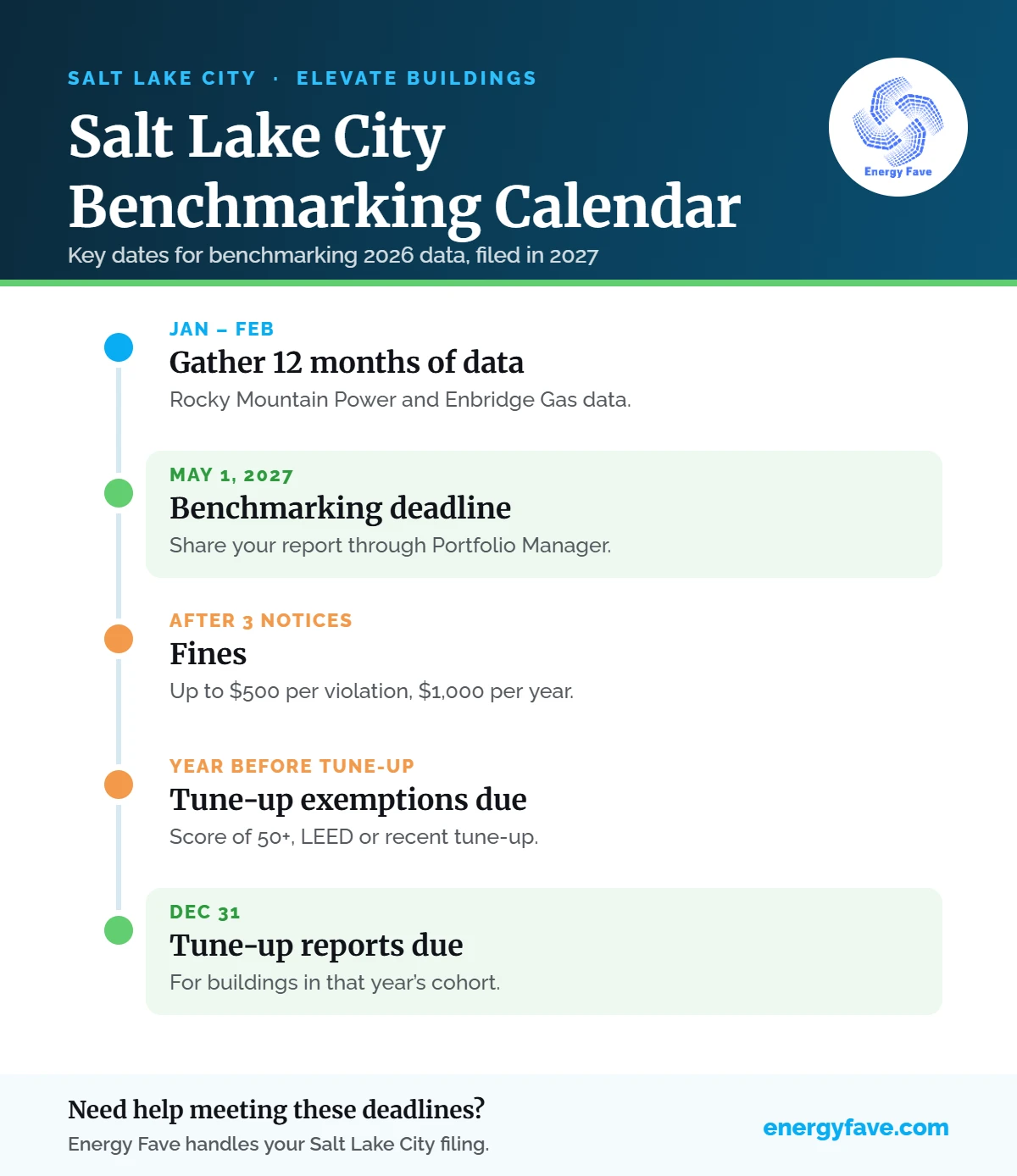
- Written notices: the City can send up to three notices, each giving the owner 90 days to comply.
- Fines: after the third notice, up to $500 per violation.
- Annual cap: fines are capped at $1,000 per year.
- Public disclosure: the City publishes building energy data each year.
What is the compliance process?
Salt Lake City owners report through ENERGY STAR Portfolio Manager. A typical filing looks like this:
- First, look up your Salt Lake City Building ID at buildingbenchmark.slc.gov and add it to your property.
- Next, request whole-building data through the free automated benchmarking services from Rocky Mountain Power and Enbridge Gas.
- Then enter 12 full months of energy data (January 1 to December 31) for the previous year.
- If you need a waiver, contact the City’s Sustainability Department before the deadline.
- Finally, share your report with the City through Portfolio Manager by May 1.
What is the deadline for Salt Lake City benchmarking?
Salt Lake City benchmarking reports are due May 1 every year and cover the previous calendar year.
Next deadlineMay 1, 2027 for calendar-year 2026 data
Tune-up evaluation reports are due by December 31 of your building’s tune-up year.
Salt Lake City tune-up evaluation schedule
Buildings with an ENERGY STAR score of 49 or below that are eligible for a utility tune-up incentive must complete a tune-up evaluation of base building systems every five years. The year depends on building size and the last digit of the property’s tax ID number:
| Tax ID ends in | 50,000+ sq ft | 25,000–49,999 sq ft |
|---|---|---|
| 0 or 1 | 2021, then 2026 | 2022, then 2027 |
| 2 or 3 | 2022, then 2027 | 2023, then 2028 |
| 4 or 5 | 2023, then 2028 | 2024, then 2029 |
| 6 or 7 | 2024, then 2029 | 2025, then 2030 |
| 8 or 9 | 2025, then 2030 | 2026, then 2031 |
Who can skip it? Buildings under five years old, buildings with an ENERGY STAR score of 50 or higher, LEED or equivalent certified buildings, buildings with a tune-up in the past five years, and buildings with a persistent commissioning program. Exemption documents are due the year before your tune-up year. Making the recommended fixes is encouraged but not required.
What utilities are required for benchmarking reporting?
- Electricity
- Natural Gas
- District Steam
- District Chilled Water
- Any other purchased fuel
Water reporting is optional under the Salt Lake City ordinance.
What is the purpose of Salt Lake City's ordinance?
Buildings are one of the largest sources of energy use and air pollution along the Wasatch Front. The ordinance supports the City’s air quality and climate goals in two main ways:
Help owners cut waste. Benchmarking and tune-ups show owners where their buildings use more energy than they should, often with low-cost fixes.
Make performance transparent. Public data helps tenants and buyers compare buildings. Many owners also pursue ENERGY STAR certification.
See our Energize Denver guide for another Mountain West city, or our full energy benchmarking compliance guide.
See our guides for Energize Denver, Reno and Colorado, or our full energy benchmarking compliance guide.
This program includes an energy audit, assessment or tune-up requirement. Compare it with other cities in our energy audit compliance guide.
Frequently asked questions
When is the Salt Lake City benchmarking deadline?
May 1 every year. The next deadline is May 1, 2027 for 2026 data.
Are apartment buildings covered?
No. The ordinance covers commercial (non-residential) buildings of 25,000 sq ft or more. Apartments are exempt.
What is a tune-up evaluation?
A qualified professional reviews base building systems such as HVAC, lighting and controls and recommends low-cost fixes. It is required every five years for eligible buildings with an ENERGY STAR score of 49 or below.
How much are the fines?
After three written notices, up to $500 per violation, capped at $1,000 per year.
Can Energy Fave handle my Salt Lake City compliance?
Yes. Energy Fave can set up automated utility data, submit your report, and plan your tune-up evaluation or exemption.
Interested in benchmarking help?
Salt Lake City at a Glance
- Who's covered
- Commercial buildings 25,000+ sq ft
- Next deadline
- May 1, 2027The 2026 report was due May 1, 2026. Not filed yet? We can file it now →
- Late penalty
- Up to $500 per violation
- Tune-ups
- Every 5 years if score is 49 or below
- Reporting tool
- Portfolio Manager + SLC Building ID