
Minnesota Large Building Energy Benchmarking
What is Minnesota's Large Building Energy Benchmarking program?
Minnesota’s Large Building Energy Benchmarking program (Minn. Stat. 216C.331), passed in 2023 and run by the Minnesota Department of Commerce, requires owners of buildings of 50,000 square feet or more in the Twin Cities metro area and larger cities to benchmark their energy use every year and report it to the State.
Buildings of 100,000 sq ft or more began reporting in 2025, and buildings of 50,000–99,999 sq ft joined in 2026. The State publishes each building’s results every December, including a one-to-four star rating.
What buildings must comply with Minnesota benchmarking?
A property is covered if its buildings total 50,000 gross sq ft or more and it is located in either:
- the seven-county Twin Cities metro area (Anoka, Carver, Dakota, Hennepin, Ramsey, Scott and Washington counties) and served by an investor-owned utility, or
- a city outside the metro with more than 50,000 residents, such as Rochester.
The program has two classes: Class 1 (100,000 sq ft or more) and Class 2 (50,000–99,999 sq ft). Homes with fewer than five units, manufacturing, power generation, mining and agricultural buildings are excluded. Owners can request a one-year exemption for financial distress, occupancy under 50%, no certificate of occupancy, a demolition permit, or no energy service for 30 days. Properties already covered by an equivalent local program may also be exempt, as determined by Commerce.
What is the penalty for non-compliance?
Commerce gives owners time to fix a missed report before fining them:
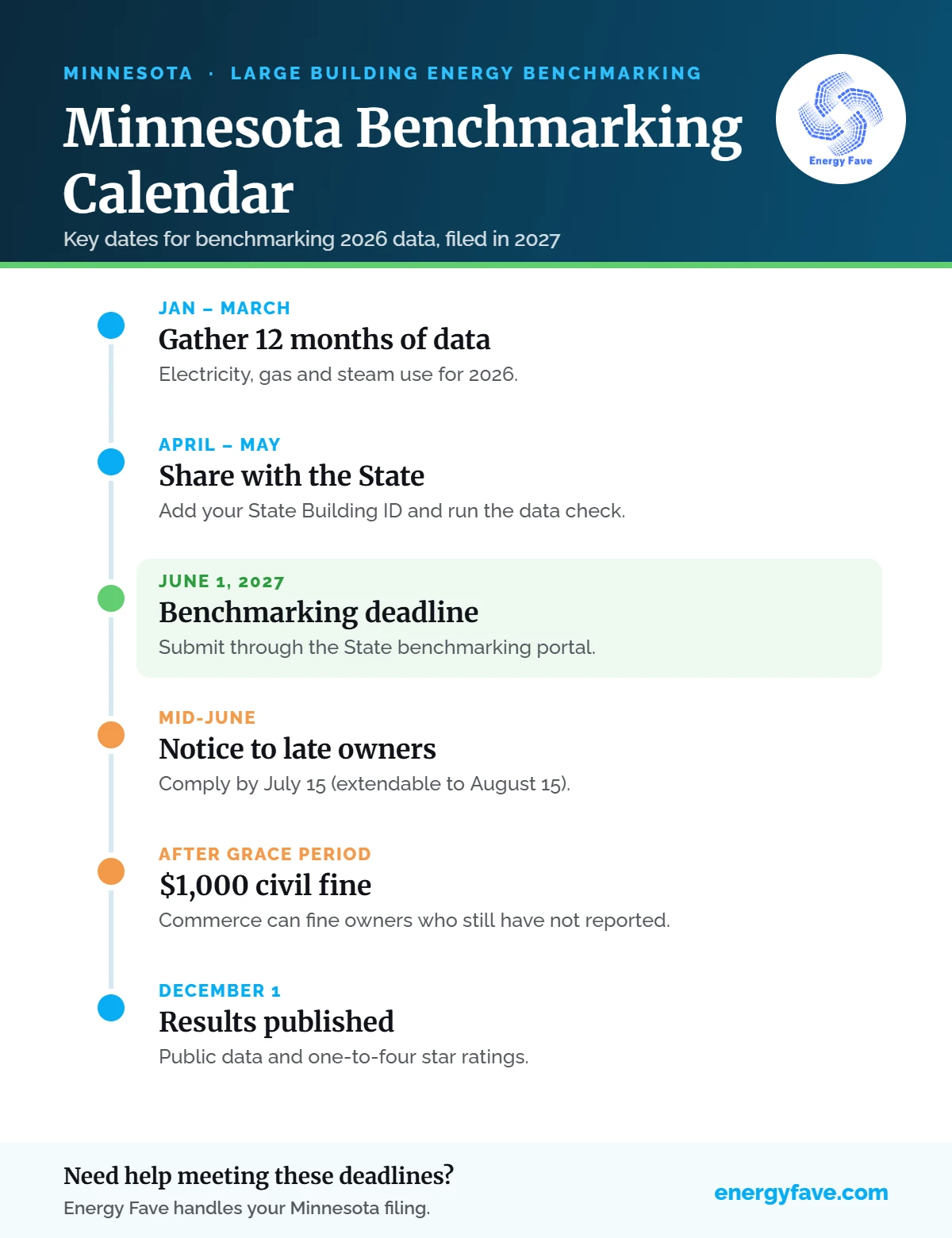
- Notice: owners who miss June 1 receive a notice around June 15.
- Grace period: owners then have until July 15 to comply, which can be extended to August 15.
- Fine: after that, Commerce can impose a civil fine of $1,000.
What is the compliance process?
Minnesota owners benchmark in ENERGY STAR Portfolio Manager and submit through the State’s Large Building Energy Benchmarking Portal. A typical filing looks like this:
- First, find your State Building ID and add it to your property in Portfolio Manager.
- Next, upload 12 full months of whole-building energy data. Request aggregated data from Xcel Energy or CenterPoint Energy where tenants are separately metered.
- Then run Portfolio Manager’s Data Quality Checker and share the property with the State.
- Create an account in the benchmarking portal and complete the Energy Reporting Form.
- Finally, submit your annual report by June 1.
What is the deadline for Minnesota benchmarking?
Minnesota benchmarking reports are due June 1 every year and cover the previous calendar year. Both classes now report every year.
Next deadlineJune 1, 2027 for calendar-year 2026 data
The State posts benchmarking results publicly each December 1. If you sell a covered building, you must also give the buyer its benchmarking information.
Minnesota benchmarking phase-in
The program phased in by building size:
| Class | Building size | First report | Public posting |
|---|---|---|---|
| Class 1 | 100,000+ sq ft | June 1, 2025 | December 1, 2025 |
| Class 2 | 50,000–99,999 sq ft | June 1, 2026 | December 1, 2026 |
| Both classes | 50,000+ sq ft | Every June 1 | Every December 1 |
Local programs: cities like Minneapolis run their own stricter benchmarking ordinances, which the state law allows.
What utilities are required for benchmarking reporting?
- Electricity
- Natural Gas
- Steam
- District Energy
- Any other purchased fuel
What is the purpose of Minnesota's benchmarking law?
Large buildings use a major share of Minnesota’s energy. The law serves two main goals:
Help owners save energy. Benchmarking shows owners how their building compares with similar buildings, so they can find cost-effective upgrades.
Make performance transparent. Public star ratings let tenants and buyers compare buildings, and owners can display their rating. Many owners also pursue ENERGY STAR certification.
See our energy benchmarking compliance guide for every city and state.
See our guides for Minneapolis, Saint Paul and Edina, or our full energy benchmarking compliance guide.
Minnesota benchmarking FAQs
Which Minnesota buildings must benchmark?
Buildings totaling 50,000 sq ft or more in the seven-county Twin Cities metro area (served by an investor-owned utility) or in cities outside the metro with more than 50,000 residents.
What is the fine for not reporting?
After a notice and a grace period to July 15 (extendable to August 15), Commerce can impose a $1,000 civil fine.
Do I need to report water use?
No. The state law covers energy use: electricity, natural gas, steam and other fuels.
What if my building is in Minneapolis?
Minneapolis has its own benchmarking ordinance. Properties covered by an equivalent local program may be exempt from state reporting, as determined by Commerce.
Can Energy Fave handle my Minnesota reporting?
Yes. Energy Fave can collect your utility data, set up Portfolio Manager and submit your report through the State portal.
Interested in benchmarking help?
Minnesota at a Glance
- Who's covered
- Buildings 50,000+ sq ft (metro + large cities)
- Next deadline
- June 1, 2027The 2026 report was due June 1, 2026. Not filed yet? We can file it now →
- Late penalty
- $1,000 after a grace period
- Public results
- December 1, with star ratings
- Reporting tool
- Portfolio Manager + State portal