
Brisbane Building Efficiency Program (BBEP)
What is Brisbane's Building Efficiency Program?
Brisbane benchmarking is required by the Brisbane Building Efficiency Program (BBEP), created by Ordinance No. 644, adopted by the Brisbane City Council in December 2019 (Brisbane Municipal Code Chapter 15.77). City-owned buildings began benchmarking in 2020 and private buildings in 2021.
BBEP requires owners of buildings of 10,000 square feet or more to report whole-building energy and water use through ENERGY STAR Portfolio Manager by May 15 each year. Every five years, buildings must also complete 'Beyond Benchmarking' requirements: show high performance (Performance Path) or complete an energy audit plus retrocommissioning, efficiency measures or a green lease (Prescriptive Path).
Owners use ENERGY STAR Portfolio Manager to benchmark their energy use. Not sure if your building is covered? Check it in our compliance finder.
What buildings must comply in Brisbane?
- Privately owned commercial buildings (including warehouses and distribution centers) of 10,000+ sq ft
- Industrial buildings of 10,000+ sq ft
- Multifamily buildings with five or more units, 10,000+ sq ft
- Other government-owned buildings of 10,000+ sq ft that must follow City building codes
- City-owned buildings of 2,000+ sq ft (those under 10,000 sq ft are exempt from Beyond Benchmarking)
- Multiple same-owner buildings on a single meter totaling 10,000+ sq ft
Exemptions:
- Excluded entirely: one- and two-family dwellings; multifamily with four or fewer units; condominium projects; broadcast antennas; utility pumping stations
- Annual benchmarking exemption: no certificate of occupancy, vacant, or no energy/water service for more than half the year; or a full demolition permit issued
- Beyond Benchmarking exemption (request by April 1 of that year): scheduled demolition; building for sale with a recent appraisal; certificate of occupancy within the last five years; 50%+ vacant
- Time extensions: up to three 60-day extensions for financial or legal distress, substantial hardship, or 50%+ tenant turnover
What is the penalty for non-compliance?
- Infraction: any violation is an infraction enforced under Brisbane Municipal Code Chapters 1.14, 1.16 and 1.18 (Chapter 15.77 does not state dollar amounts)
- Public nuisance: non-compliant buildings are declared a public nuisance, and the City Attorney may seek abatement or an injunction
- Tenants: non-residential tenants who fail to authorize release of their data are subject to penalties
What is the compliance process?
A typical filing looks like this:
- Check the City's Master Buildings List and get the building's Unique Building Identifier (UBID)
- Create or update the property in ENERGY STAR Portfolio Manager and add the UBID as a Standard ID plus required Custom IDs
- Enter 12 months of whole-building energy (through the PG&E Benchmarking Portal) and water data
- Run the Portfolio Manager Data Quality Checker and fix errors
- Submit the report to the City of Brisbane through the Portfolio Manager reporting link by May 15
Verification: annual data does not need third-party verification. For the Beyond Benchmarking Performance Path, ENERGY STAR performance documentation must be certified by a Qualified Auditor or Qualified Retro-Commissioning Professional, and audits and retrocommissioning must be done by qualified professionals. Energy Fave provides ASHRAE energy audits and third-party verification.
What is the deadline for Brisbane benchmarking?
Brisbane benchmarking reports are due May 15 every year and cover the previous calendar year.
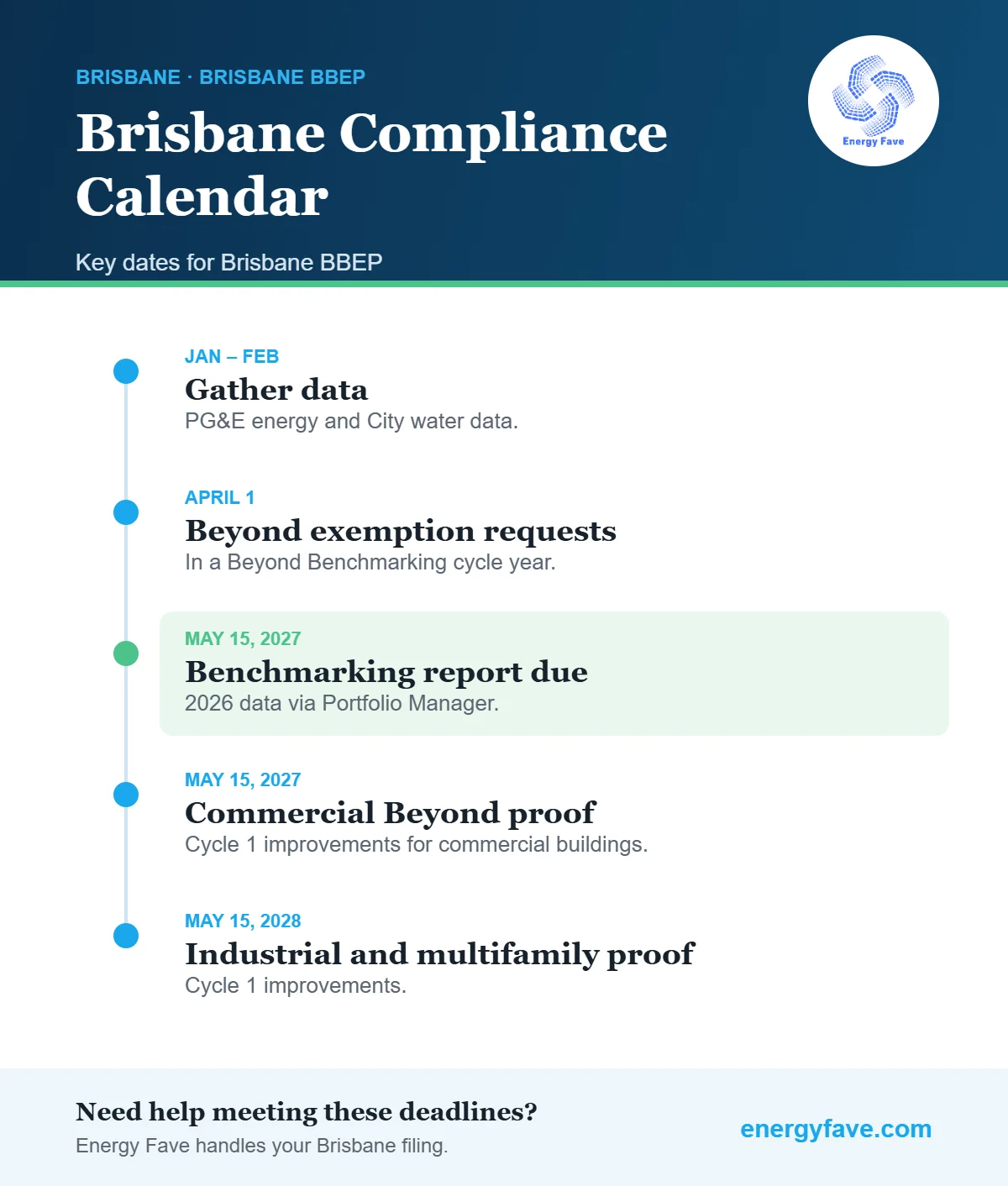
Next deadlineMay 15, 2027 for calendar-year 2026 data
May 15, 2027 for calendar-year 2026 data. Commercial buildings in Beyond Benchmarking Cycle 1 must also show proof of improvements by May 15, 2027.
Brisbane Beyond Benchmarking requirements
Every five years, covered buildings choose one path:
- Performance Path: meet one energy standard (for example an ENERGY STAR score of 80+, a 20-point score improvement, or a 20% GHG intensity reduction from baseline) and one water standard (Water Score 80+, 20-point improvement, or 20% WUI reduction).
- Prescriptive Path: an Asset Score Full assessment (10,000–39,999 sq ft) or an ASHRAE Level II audit (40,000+ sq ft), plus retrocommissioning, one energy and one water improvement measure, or a green lease.
Cycle 1: commercial buildings reported in 2023 with proof of improvements due May 15, 2027; industrial and multifamily buildings reported May 15, 2024 with proof due May 15, 2028. The City has shown Cycle 2 reporting for commercial buildings in 2028 (ordinance) or 2029 (City information session), so confirm your date with the City.
| When | What | Details |
|---|---|---|
| Jan-Feb | Gather data | Pull prior-year PG&E energy data and City of Brisbane water bills. |
| April 1 | Beyond exemption requests | Deadline for Beyond Benchmarking exemption requests in a cycle year. |
| May 15 | Benchmarking report due | Submit via the City's Portfolio Manager reporting link. |
| May 15, 2027 | Commercial Beyond proof | Proof of completed improvements for Cycle 1 commercial buildings. |
| May 15, 2028 | Industrial and multifamily Beyond proof | Proof of completed improvements for Cycle 1. |
What utilities are required for benchmarking reporting?
- Electricity
- Natural Gas
- Water
- Any other fuel used in the building
In Brisbane, energy data comes from PG&E (with Peninsula Clean Energy generation) and water data from the City of Brisbane.
What is the purpose of Brisbane's program?
The ordinance implements Brisbane's Climate Action Plan by reducing greenhouse gas emissions, energy use and water use in existing buildings, aligned with California AB 802. The City says the program aims to make buildings more efficient, lower owners' costs, and improve building safety and comfort.
Frequently asked questions
Which buildings must benchmark under BBEP?
Privately owned commercial, industrial and multifamily (5+ units) buildings of 10,000 sq ft or more, and City-owned buildings of 2,000 sq ft or more. Condominiums and small residential buildings are excluded.
When is the annual report due?
May 15 each year, covering the prior calendar year's energy and water data.
Does BBEP include water?
Yes. Brisbane requires both energy and water use in Portfolio Manager, and Beyond Benchmarking includes water standards.
What is Beyond Benchmarking?
A five-year cycle where buildings either show high performance (Performance Path) or complete an audit plus retrocommissioning, efficiency measures or a green lease (Prescriptive Path).
Do I also report to the State of California?
No. The California Energy Commission lists Brisbane as an exempted local ordinance, so buildings complying with BBEP do not report separately under AB 802.
What happens if I don't comply?
Violations are infractions under the City's general penalty chapters, and non-compliant buildings can be declared a public nuisance.
Can Energy Fave help with Brisbane compliance?
Yes. Energy Fave sets up Portfolio Manager, collects utility data, checks data quality, performs Beyond Benchmarking audits and files your Brisbane report on time.
Official sources:
Interested in benchmarking help?
Brisbane BBEP at a Glance
- Who's covered
- Buildings 10,000+ sq ft
- Next deadline
- May 15, 2027The 2026 report was due May 15, 2026. Not filed yet? We can assist with your compliance submission →
- Penalty
- Infraction; public nuisance
- Beyond Benchmarking
- Every 5 years
- Reporting tool
- ENERGY STAR Portfolio Manager