
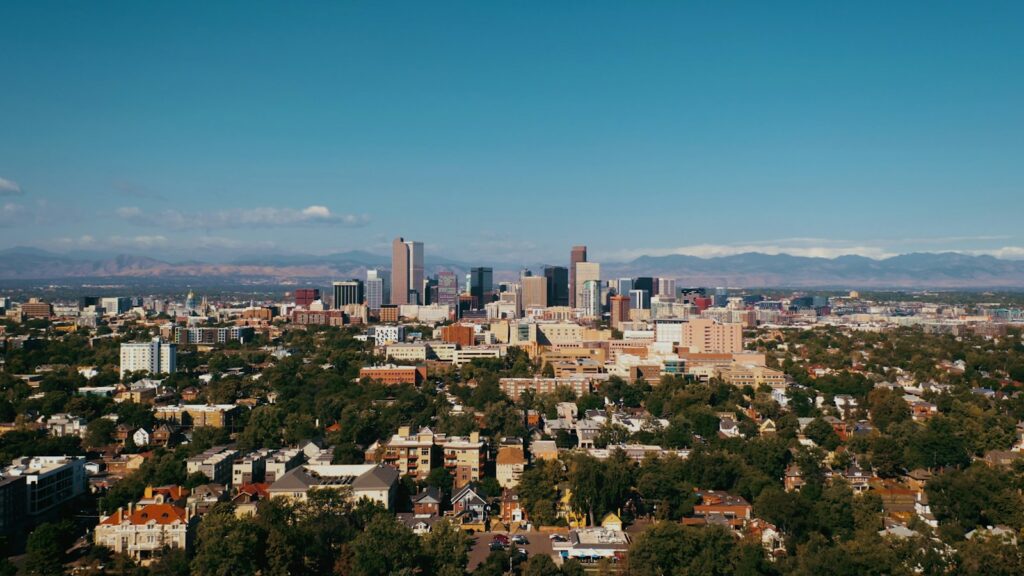
Energize Denver requirements changed again in 2026. Updated rules took effect on August 27, 2026, and most large buildings now work toward an interim energy target in 2028 and a final target in 2032. Smaller buildings follow their own step-by-step deadlines, the first of which arrives on December 31, 2026. This guide covers who is covered, what large and small buildings must do, when energy audits are required, how enforcement and penalties work, and what to do next.
Quick summary
- Energize Denver applies to commercial and multifamily buildings of 5,000 sq ft and larger, with separate rules for 5,000–24,999 sq ft and 25,000+ sq ft buildings.
- Large buildings submit an ENERGY STAR Portfolio Manager benchmarking report by June 1 every year. The next one is due June 1, 2027.
- Large buildings must meet an energy use intensity (EUI) target. For most buildings the interim target year is 2028 and the final target year is 2032.
- Small buildings (5,000–24,999 sq ft) meet requirements mainly through LED lighting or renewable energy. Buildings of 20,000–24,999 sq ft are due December 31, 2026.
- Noncompliance starts with a Notice of Violation and a 90-day cure period. Unresolved violations lead to civil penalties, which can become a lien on the property.

What is Energize Denver?
Energize Denver is the City and County of Denver’s building performance policy. The ordinance was passed in 2021 and is run by Denver’s Office of Climate Action, Sustainability and Resiliency (CASR). According to the city’s Energize Denver page, it is an energy efficiency requirement. It does not require owners to electrify heating or cooling, and it does not force owners to replace HVAC equipment before the end of its useful life.
The policy works in three layers. The ordinance sets the legal framework. The Rules and Regulations fill in the details. Technical guidance explains how to comply. The rules can change after public notice and comment, and the latest version went into effect on August 27, 2026, replacing the version adopted in April 2025. If you read about Energize Denver before late 2026, check your dates again, because several older articles still describe the earlier timeline.
For a building-by-building overview of the law, see our Energize Denver ordinance page.
Which buildings are covered?
Energize Denver applies to commercial and multifamily buildings in Denver of 5,000 sq ft and larger, split into two groups:
- Small buildings: 5,000 to 24,999 sq ft. These follow a prescriptive path, such as LED lighting or renewable energy.
- Large buildings: 25,000 sq ft and larger. These benchmark every year and must meet an energy performance target.
The city publishes lookup tools for large buildings and small buildings, where you can confirm whether your property is covered and see its deadlines and targets.
Energize Denver requirements for large buildings (25,000+ sq ft)
1. Annual benchmarking by June 1
Every large building must submit a benchmarking report by June 1 each year. The report is prepared in ENERGY STAR Portfolio Manager, shared with Energize Denver, and then submitted through the Energize Denver Management Portal. The city’s compliance overview notes that the reports for your interim and final target years are the ones used to decide whether you met your performance target.
Common errors the city flags include wrong gross floor area, parking that should be entered as its own property type, missing secondary uses such as a ground-floor restaurant, and incorrect operating hours. Getting these right matters, because your EUI and your target depend on them. Benchmarking exemptions are available for buildings that were unoccupied, under renovation or in qualifying financial distress, and owners can request an extension with supporting documents.
2. Third-party data verification
All covered large buildings had to verify their 2024 or 2025 benchmarking data by June 1, 2026. That verified report is used to confirm each building’s energy efficiency target. The next verification is due after your final target year, by June 1. For a 2032 final target, that means June 1, 2033. If you missed the 2026 verification, address it now, because missing verification is an enforceable violation. Our third-party verification service can help.
3. Interim and final EUI targets
Each large building has an energy efficiency target based on site energy use intensity (EUI), which is the energy used per square foot each year. Under the current timeline:
- Interim target year: 2028 for most buildings. You show that you are on track toward your final target.
- Final target year: 2032 for most buildings. You show that you have met your target.
After the final year, you keep showing compliance through annual benchmarking reports. Some buildings have different assigned years, so confirm yours in the lookup tool. Forms to claim renewable energy credits or exclude transportation energy (such as EV charging) are due by December 31 of the year they apply to. If you need more time, a timeline extension request must be filed before the end of the target year.
4. Target adjustments and alternate compliance options
The city offers several ways to tailor a target or timeline, including a Custom Target, a 30% Energy Use Reduction Target, a Historical and Unique Building target adjustment, timeline extensions, a restaurant target adjustment, a residential condominium path, and a separate path for manufacturing, agricultural and industrial (MAI) buildings. Equity Priority Buildings such as qualifying nonprofits and affordable housing may get extra help through the city’s Compliance Assistance Program.
When does Energize Denver require an energy audit?
Energy audits are not required for every large building. According to the city’s audit guidance, an audit is required when you pursue:
- A customized target adjustment (Custom Target, 30% Energy Use Reduction Target, or Historical and Unique Building target adjustment), or
- An alternate compliance option, specifically a Timeline Extension or the prescriptive pathway of the MAI option.
Required audits must follow ANSI/ASHRAE/ACCA Standard 211-2018 and be at least an ASHRAE Level 2 audit. They must be done by a third party holding a recognized credential, such as a U.S.-licensed Professional Engineer, Certified Energy Auditor, Certified Energy Manager or ASHRAE Building Energy Assessment Professional. Audits for custom targets need more depth, including life-cycle cost analysis and at least two contractor bids per measure. Audits are submitted through the U.S. Department of Energy’s Audit Template tool using the “Denver Report” format.
Even when an audit is optional, it is the fastest way to find the upgrades that will get you to your 2028 and 2032 targets. Learn more in our guide to ASHRAE energy audit levels or see our energy audit services.
Energize Denver requirements for small buildings (5,000–24,999 sq ft)
Small buildings do not have EUI targets. Instead, owners of buildings that received a certificate of occupancy on or before November 22, 2021 claim their building and complete one compliance pathway by a deadline based on size, as listed on the city’s small buildings page:
| Building size | Compliance deadline |
|---|---|
| 20,000–24,999 sq ft | December 31, 2026 |
| 15,000–19,999 sq ft | December 31, 2027 |
| 10,000–14,999 sq ft | December 31, 2028 |
| 5,000–9,999 sq ft | December 31, 2029 |

You only need to complete one pathway:
- Lighting: at least 97% of the building’s light fixtures must be LED (the rules also accept LEDs providing at least 90% of the lighting load, or lighting that meets the 2019 Denver code for lighting power density). You can work with a lighting professional or self-verify if your lighting already qualifies.
- Renewable energy: at least 20% of the building’s energy needs must come from onsite or offsite renewable generation.
If neither fits, alternate options include a 15% energy use reduction, a residential condominium option (LEDs plus occupancy sensors in common areas), an electrification option (replacing at least one fossil-fuel space heating unit with a heat pump), and a restaurant option. If your building is 20,000–24,999 sq ft and you have not finished, you have less than six weeks before the December 31, 2026 deadline.
Key Energize Denver dates at a glance
| Date | What is due |
|---|---|
| December 31, 2026 | Small buildings of 20,000–24,999 sq ft complete a compliance pathway; renewable energy and transportation exclusion forms for 2026 |
| December 31, 2026 | Last day to request a pre-compliance decision review for city decisions dated before August 27, 2026 |
| June 1, 2027 | Annual benchmarking report for large buildings |
| December 31, 2027 | Small buildings of 15,000–19,999 sq ft |
| 2028 | Interim target year for most large buildings (shown in the June 1, 2029 report) |
| 2032 | Final target year for most large buildings; data verification follows by June 1, 2033 |
Enforcement and penalties
Denver’s enforcement page lays out a step-by-step process:
- Notice of Violation (NOV). A formal warning, not a fine. It starts a 90-calendar-day cure period.
- Cure period. Fix the problem (file the report, complete the upgrade or verification) or apply for a timeline extension, alternate compliance option or corrective action plan. A complete application pauses the 90-day clock while the city reviews it.
- Administrative citation. If the issue is not resolved, the city issues a citation assessing civil penalties. You have 30 days to appeal.
- Payment or reinvestment. Reporting and data violations are due in 30 days. Energy efficiency violations are due in 180 days, and owners can apply to reinvest 40% to 80% of the penalty in efficiency upgrades instead, depending on how quickly they submit a letter of intent.
- Lien. Unpaid penalties or defaulted reinvestment plans 180 days after the citation become a lien on the property.
Penalty amounts are set in Denver Revised Municipal Code Section 10-408. The code allows a $2,000 civil penalty each year for benchmarking violations, such as not submitting, not correcting errors, providing inaccurate data or skipping required third-party verification. For missed performance targets, it allows up to $0.15, $0.23 or $0.35 per kBtu of required reduction not achieved, depending on how many target years the building has, plus up to $0.10 per kBtu if a required timeline extension is not filed by the deadline. A building with no approved benchmarking report in a target year can face up to $5.00 per square foot, and a small building that does not certify compliance by its deadline can face up to $1.60 per square foot. The same amounts appear in the Rules and Regulations effective August 27, 2026. Note that the code and rules text still refer to a 2030 final target, while the current rules set 2032 for most buildings, so confirm your amounts and years with the city.
Selling a covered building? Owners must disclose its Energize Denver compliance status to buyers, for example with a screenshot from the lookup tool or a compliance status letter, which the city issues within 10 calendar days of a request.
How to get ready for 2027
- Confirm your status and assigned target years in the city’s lookup tool.
- Clean up your Portfolio Manager data now so the June 1, 2027 report goes in on time and accurately.
- Compare your current EUI to your 2028 interim target. The city’s Performance Forecasting Calculator can help.
- Get an ASHRAE Level 2 audit if you need a custom target or timeline extension, or simply want a clear upgrade plan.
- Small building owners: check your size band and finish your LED or renewable pathway before your December 31 deadline.
Not sure which laws apply to your other properties? Try our compliance finder, or see our energy benchmarking services.
Frequently asked questions
When is the next Energize Denver benchmarking deadline?
June 1, 2027. Large buildings (25,000 sq ft and up) submit a benchmarking report through ENERGY STAR Portfolio Manager and the Energize Denver Management Portal by June 1 every year.
Did Energize Denver change its target years?
Yes. Under the current rules, most large buildings have an interim target year of 2028 and a final target year of 2032. Some buildings have different assigned years, so check the city’s lookup tool for yours.
Do I need an energy audit for Energize Denver?
Only in certain cases. An audit of at least ASHRAE Level 2 is required when you apply for a customized target adjustment, a timeline extension, or the prescriptive MAI pathway. Otherwise it is optional but recommended.
What do small buildings need to do?
Buildings of 5,000 to 24,999 sq ft usually comply by making at least 97% of light fixtures LED or by meeting at least 20% of energy needs with renewable energy. Deadlines run from December 31, 2026 (20,000–24,999 sq ft) to December 31, 2029 (5,000–9,999 sq ft).
What happens if I miss an Energize Denver requirement?
The city sends a Notice of Violation and gives you 90 days to fix the issue or apply for more time. If it is not resolved, the city issues a citation with civil penalties, which can become a lien if left unpaid.
Need help with Energize Denver requirements? Energy Fave handles benchmarking, third-party data verification, ASHRAE Level 2 audits and compliance planning for Denver buildings. Request a quote and we will review your building’s deadlines and targets.
Sources: City and County of Denver, Energize Denver Building Performance Policy; Energize Denver Rules and Regulations; Energize Denver Enforcement Details; Energize Denver Navigation Center; Denver Revised Municipal Code, Chapter 10. Rules can change, so confirm details with the Energize Denver Help Desk (844-536-4528) before filing.