
Newton BERDO: Building Energy Reporting and Disclosure
What is Newton's BERDO?
Newton benchmarking is required by the city’s Building Emissions Reduction and Disclosure Ordinance (BERDO), adopted by City Council on December 16, 2024. It requires owners of buildings of 20,000 square feet or more to benchmark their energy use and emissions every year and report it to the City.
Newton modeled BERDO on Boston’s program. Reports are due every September 15, and non-residential buildings must also meet declining emissions limits starting in 2027.
What buildings must comply in Newton?
- Non-residential buildings of 20,000 sq ft or more must report every year and meet emissions limits.
- Residential buildings of 20,000 sq ft or more must report every year, but are not subject to the emissions limits.
- Non-profits such as houses of worship, schools and community centers are covered if they meet the size threshold.
Qualifying existing hospitals with two independent power sources are exempt from the emissions limits. Emergency backup power can be deducted when reported.
What is the penalty for non-compliance?
- Daily fines: up to $300 per day for each day a violation continues.
- Emissions limits: fines for missing emissions limits are not charged until the third year after each limit takes effect.
- Alternative Compliance Payment: owners can pay $234 per metric ton of CO2e over their limit instead of meeting it directly.
- Public disclosure: the City publishes building energy and emissions data each year.
What is the compliance process?
Newton owners report through ENERGY STAR Portfolio Manager. A typical filing looks like this:
- First, confirm your building is covered and return the City’s contact form.
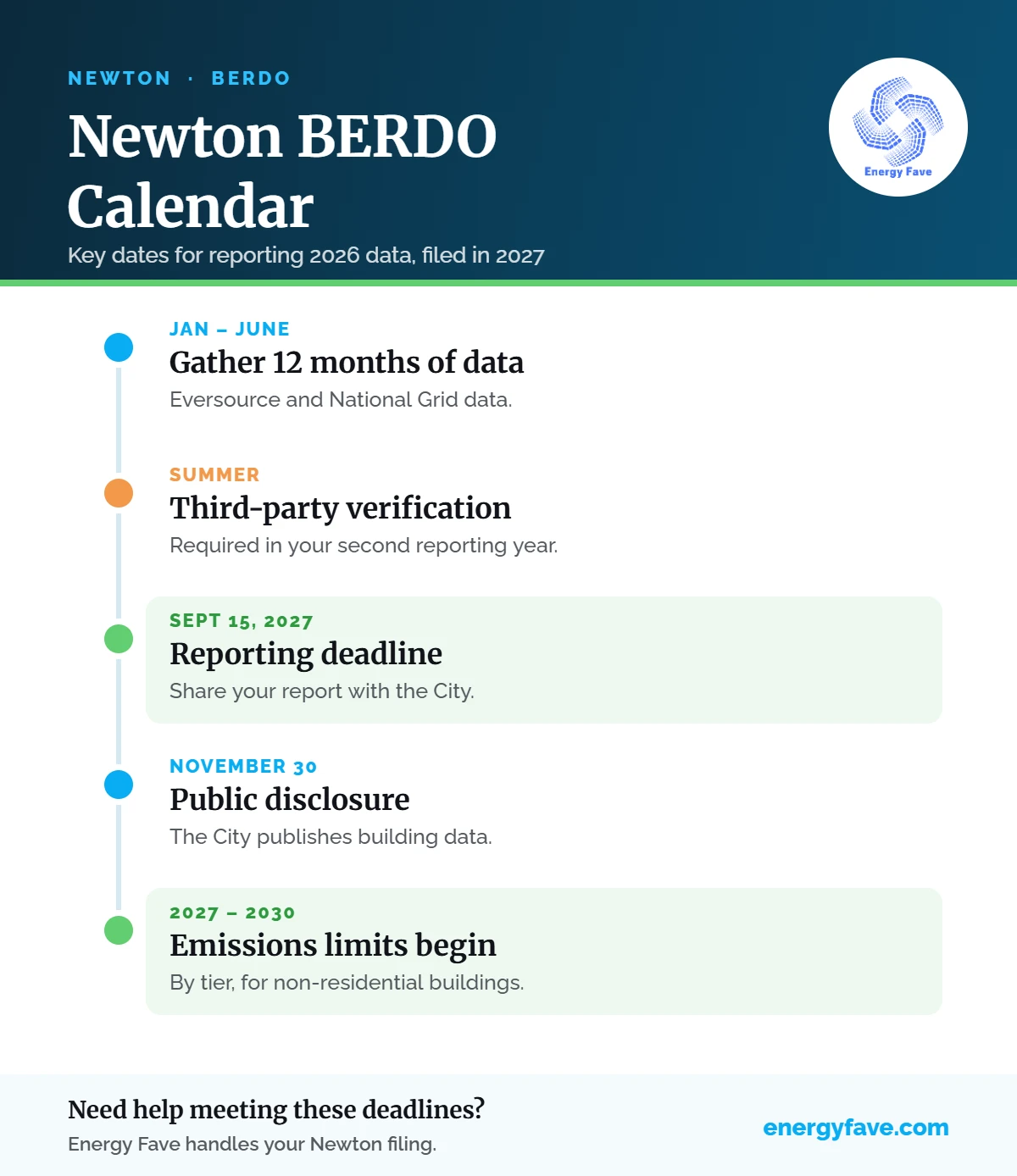
- Next, request whole-building energy data from Eversource and National Grid, including tenant-metered spaces.
- Then enter 12 full months of energy data for the previous calendar year and run the Data Quality Checker.
- In your second reporting year, and every five years after, have your data verified by a qualified third party.
- Finally, share your report with the City by September 15. A one-time six-month extension is available on request.
What is the deadline for Newton BERDO reporting?
Newton BERDO reports are due September 15 every year and cover the previous calendar year.
Next deadlineSeptember 15, 2027 for calendar-year 2026 data
For most buildings, the 2027 report is the second reporting year, which means it needs third-party verification. The City publishes data each year by November 30.
Newton BERDO reporting and emissions schedule
Non-residential buildings are grouped into four tiers by size:
| Tier | Building size | First report | Emissions limits begin |
|---|---|---|---|
| Tier 1 | 100,000+ sq ft | Sept 15, 2025 | 2027 |
| Tier 2 | 50,000–99,999 sq ft | Sept 15, 2026 | 2028 |
| Tier 3 | 35,000–49,999 sq ft | Sept 15, 2026 | 2029 |
| Tier 4 | 20,000–34,999 sq ft | Sept 15, 2026 | 2030 |
| Residential | 20,000+ sq ft | Sept 15, 2026 | Reporting only |
How the limits work: limits are set in kg CO2e per square foot by building use, decline every five years or so, and reach zero in 2050. Electricity is exempt from the emissions limit, so electrification helps buildings comply.
What utilities are required for benchmarking reporting?
- Electricity
- Natural Gas
- Fuel Oil
- District Steam
- Propane & other fuels
Water reporting is not required under Newton’s BERDO.
What is the purpose of Newton's BERDO?
Newton’s roughly 400 large buildings produce about 27% of the city’s greenhouse gas emissions. BERDO targets net zero by 2050 in two main ways:
Track performance. Annual benchmarking shows owners how their buildings use energy and where to improve.
Cut emissions over time. Declining limits give owners a long runway to plan upgrades. Efficient buildings can also earn ENERGY STAR certification.
See our guides for Boston BERDO, Cambridge BEUDO and Massachusetts, or our full energy benchmarking compliance guide.
Need a verifier? Our Professional Engineers and Certified Energy Managers provide third-party verification services.
Frequently asked questions
When is the Newton BERDO deadline?
September 15 every year. The next deadline is September 15, 2027 for 2026 data.
Do apartment buildings have to report?
Yes. Residential buildings of 20,000 sq ft or more must report every year, but they are not subject to the emissions limits.
When is third-party verification required?
In your second reporting year and every five years after. For most buildings that report first in 2026, verification is due with the 2027 report.
What are the fines?
Up to $300 per day for each day a violation continues. Owners over their emissions limit can make an Alternative Compliance Payment of $234 per metric ton instead.
Can Energy Fave handle my Newton BERDO compliance?
Yes. Energy Fave can benchmark your building, arrange third-party verification and plan for your emissions limits.
Interested in benchmarking help?
Newton BERDO at a Glance
- Who's covered
- Buildings 20,000+ sq ft
- Next deadline
- Sept 15, 2027The 2026 report was due Sept 15, 2026. Not filed yet? We can file it now →
- Late penalty
- Up to $300 per day
- Verification
- Year 2, then every 5 years
- Reporting tool
- ENERGY STAR Portfolio Manager