
BERDO 2.0 Reporting & Third-Party Verification
What is BERDO 2.0?
Boston’s Building Emissions Reduction and Disclosure Ordinance (BERDO 2.0) requires owners of large buildings to report their energy and water use every year and to cut greenhouse gas emissions steadily until buildings reach net zero by 2050.
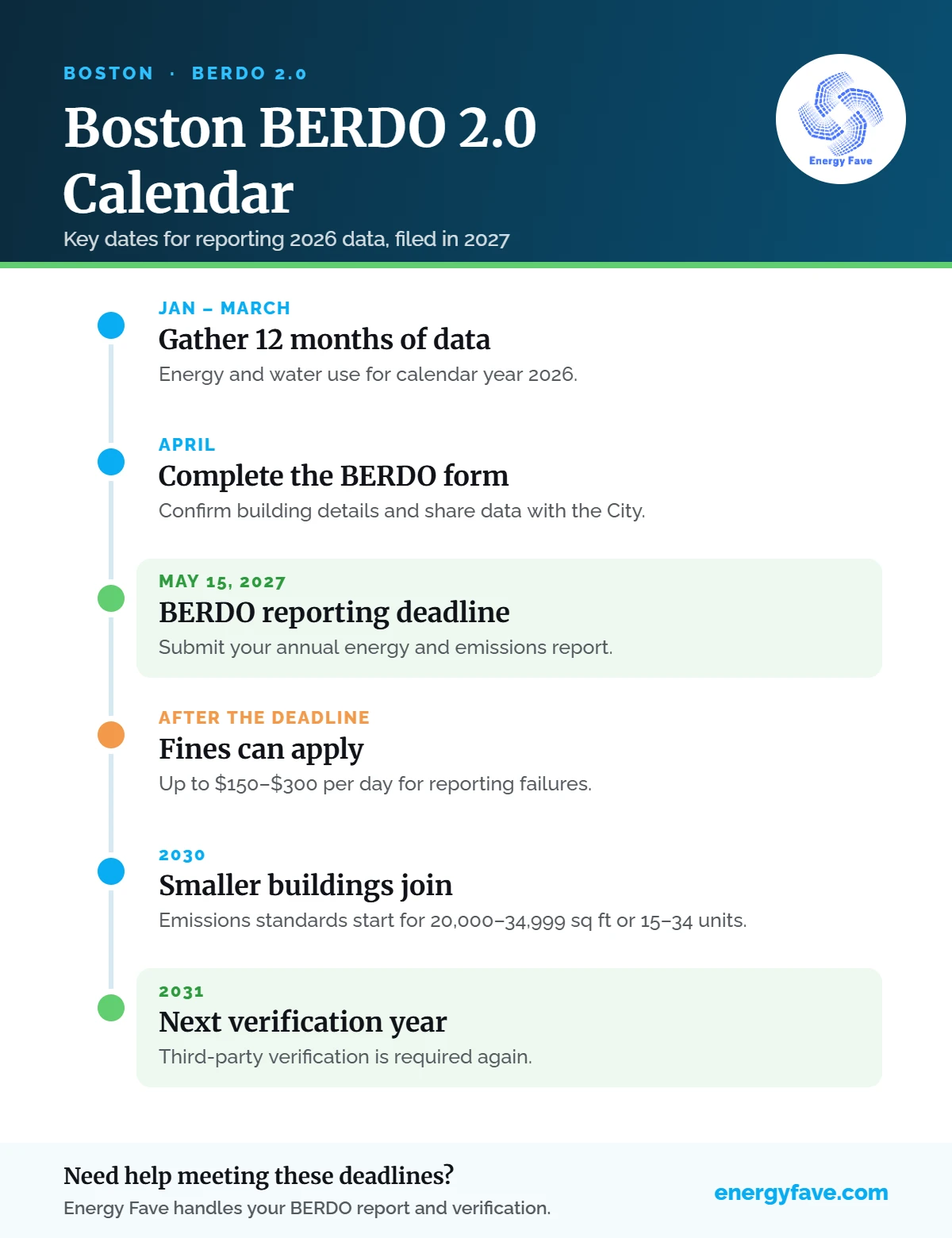
BERDO covers non-residential buildings of 20,000 sq ft or more, residential buildings with 15 or more units, and parcels with multiple buildings that together meet those thresholds. Buildings of 35,000+ sq ft or 35+ units have had emissions standards since 2025; buildings of 20,000–34,999 sq ft or 15–34 units start in 2030.
Every five years, BERDO also requires third-party verification of your reported data, and 2026 was a verification year.

What buildings must comply with BERDO?
- Non-residential buildings of 20,000 sq ft or more
- Residential buildings with 15 or more units
- Parcels with multiple buildings that together meet either threshold
Emissions standards phase in by size: buildings of 35,000+ sq ft or 35+ units have been covered since 2025, and buildings of 20,000–34,999 sq ft or 15–34 units start in 2030. Owners facing difficulty can apply for flexibility, such as a Hardship Compliance Plan or an Individual Compliance Schedule.
What is the penalty for non-compliance?
- Larger non-residential buildings: up to $1,000 per day for missing emissions standards and $300 per day for reporting failures.
- Smaller non-residential buildings: up to $300 and $150 per day, respectively.
- Inaccurate reporting: fines of $1,000–$5,000 for any property.
- Excess emissions: owners can make an Alternative Compliance Payment of $234 per metric ton of CO2e over their cap.
What is the compliance process?
BERDO reporting runs through ENERGY STAR Portfolio Manager and the City’s BERDO reporting form. A typical filing looks like this:
- First, confirm your building is covered and note its BERDO ID.
- Next, enter 12 months of whole-building energy and water data in Portfolio Manager. Request aggregated data from Eversource and National Grid where tenants are separately metered.
- Then complete the BERDO reporting form and share your data with the City of Boston.
- In verification years, have a qualified third party, such as a licensed Professional Engineer outside your organization, review your Portfolio Manager data and utility bills and approve the report.
- Finally, submit by May 15 and keep your verification records.

What is the deadline for BERDO reporting?
BERDO reports are normally due May 15 each year. For 2026, the BERDO Review Board extended the deadline for all owners to August 15, 2026.
Next deadlineMay 15, 2027 for calendar-year 2026 data
The next third-party verification year is 2031, followed by 2036 and 2041. Buildings with emissions standards must also show they meet their cap for each year.
BERDO 2.0 emissions standards timeline
BERDO 2.0 combines annual reporting with emissions caps that tighten every five years:
| Milestone | Who it applies to | When |
|---|---|---|
| Annual reportingEvery year | All covered buildings | May 15 each year |
| Emissions standardsPhase 1 | 35,000+ sq ft or 35+ units | Since 2025 |
| Emissions standardsPhase 2 | 20,000–34,999 sq ft or 15–34 units | From 2030 |
| Third-party verificationEvery 5 years | All covered buildings | 2026, then 2031, 2036, 2041 |
| Net zeroFinal | All covered buildings | 2050 |
Over your cap? Owners can make an Alternative Compliance Payment of $234 per metric ton of CO2e above their limit.
What utilities are required for benchmarking reporting?
- Water
- Electricity
- Natural Gas
- District Energy
- Any other purchased fuel
What is the purpose of BERDO 2.0?
Buildings produce most of Boston’s greenhouse gas emissions, so the City uses BERDO to measure and cut them. The ordinance serves two main goals:
Reach net zero buildings by 2050. Emissions caps that tighten every five years move large buildings step by step.
Make performance transparent and accurate. Public data and third-party verification help owners, tenants and buyers trust the numbers. Many owners also pursue ENERGY STAR certification.
Cambridge owners should see our BEUDO guide, or visit our energy benchmarking compliance guide.
See our guides for Massachusetts LBER, Cambridge, Newton and Providence, or our full energy benchmarking compliance guide.
Need a verifier? Our Professional Engineers and Certified Energy Managers provide third-party verification services.
BERDO 2.0 FAQs
When is the next BERDO verification year?
Third-party verification was required in 2026. The next verification years are 2031, 2036 and 2041.
When do emissions standards apply to my building?
Buildings of 35,000+ sq ft or 35+ units have been subject to emissions standards since 2025. Buildings of 20,000–34,999 sq ft or 15–34 units start in 2030.
What is the Alternative Compliance Payment?
Owners whose buildings exceed their emissions cap can pay $234 per metric ton of CO2e over the limit instead of meeting the cap that year.
Was the 2026 BERDO deadline extended?
Yes. The BERDO Review Board extended the 2026 deadline from May 15 to August 15, 2026, for all owners.
Can Energy Fave handle my BERDO report and verification?
Yes. Energy Fave can benchmark your building, complete the BERDO form and provide third-party verification.
Why does third-party verification matter?
Verification makes sure your report is accurate and complete, which helps you avoid fines for inaccurate data and protects you from an emissions baseline that is set too high or too low.
Interested in benchmarking help?
BERDO 2.0 at a Glance
- Who's covered
- Non-residential 20,000+ sq ft; residential 15+ units
- Next deadline
- May 15, 2027The 2026 report was due May 15, 2026. Not filed yet? We can file it now →
- Late penalty
- Up to $150–$300 per day
- Verification
- Every 5 years (next 2031)
- Excess emissions
- $234 per metric ton