
Portland Commercial Building Energy Performance Reporting
What is Portland's Energy Performance Reporting Policy?
Portland’s Commercial Building Energy Performance Reporting Policy (City Code Chapter 17.104) requires owners of commercial buildings of 20,000 square feet or more to benchmark their energy use every year and report it to the City of Portland.
The policy has been in effect since 2016. Buildings of 50,000 sq ft or more began reporting in 2016, and buildings of 20,000–49,999 sq ft followed in 2017. All covered buildings now report every April 22.

What buildings must comply in Portland?
The policy covers buildings in the City of Portland with 20,000 sq ft or more of floor area that are mainly used for:
- Office
- Retail and grocery
- Health care
- Higher education
- Hotel
Multifamily housing, residential, industrial, warehouse, parking, nursing homes, K–12 schools and places of worship are not covered.
Owners can request an exemption if the building was fully vacant for the whole year, received its certificate of occupancy during the reporting year, has a demolition permit, or faces undue hardship.
What is the penalty for non-compliance?
- First violation: the City sends a written warning.
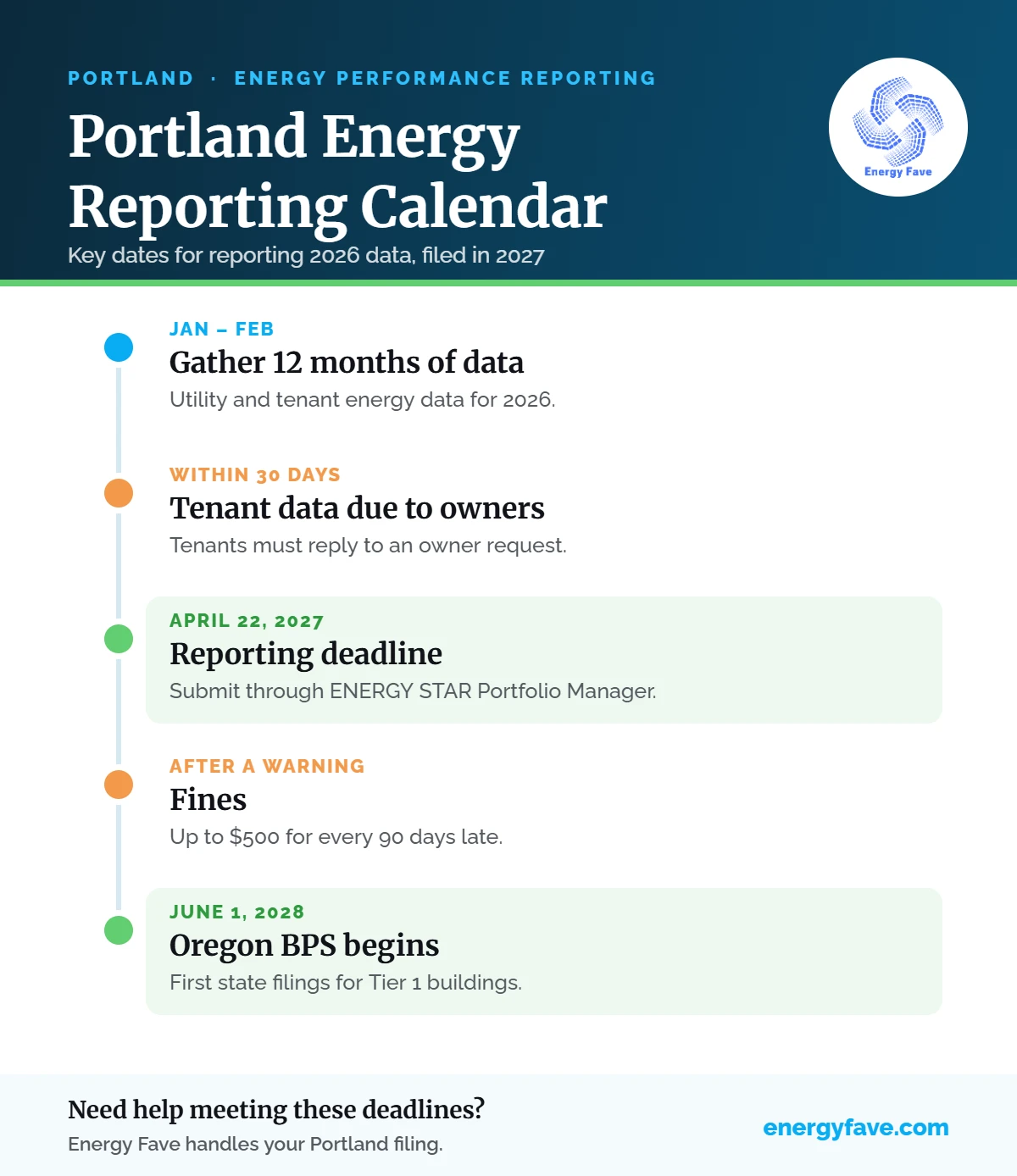
- Continued non-compliance: fines of up to $500 for every 90 days the report is late.
- Public disclosure: the City publishes each building’s compliance status and energy performance.
Owners can appeal a penalty to the Code Hearings Officer within 10 days.
What is the compliance process?
Portland owners report through ENERGY STAR Portfolio Manager. A typical filing looks like this:
- First, confirm your building is on the City’s covered building list and note its Portland Building ID.
- Next, request whole-building energy data from your utilities, such as PGE or Pacific Power for electricity and NW Natural for gas.
- If you have tenants, request their energy data. Tenants must respond within 30 days.
- Then enter 12 full months of data (January 1 to December 31) for the previous year.
- Finally, submit your report to the City through Portfolio Manager by April 22.
Your report includes the ENERGY STAR score, site and source energy use intensity (EUI), weather-normalized EUI and total greenhouse gas emissions.
What is the deadline for Portland energy reporting?
Portland energy reports are due April 22 every year, which is Earth Day. Each report covers the previous calendar year.
Next deadlineApril 22, 2027 for calendar-year 2026 data
The City publishes reported data and city-wide results by October 1 each year.
Portland policy vs. the Oregon Building Performance Standard
Many Portland buildings also fall under the statewide Oregon Building Performance Standard. The two programs are separate, so owners may need to report to both:
| Requirement | City of Portland | Oregon BPS |
|---|---|---|
| Who’s covered | Commercial buildings 20,000+ sq ft (office, retail, grocery, health care, higher ed, hotel) | Commercial buildings 20,000+ sq ft (Tier 1 is 35,000+ sq ft) |
| Reporting deadline | April 22 every year | Tier 1 from June 1, 2028; Tier 2 from July 1, 2028 |
| What it requires | Annual energy benchmarking | Benchmarking plus energy use targets (Tier 1) or an energy management plan |
| Penalty | Up to $500 per 90 days | Set by the Oregon Department of Energy |
| Reported to | City of Portland | Oregon Department of Energy |
Good to know: Both programs use ENERGY STAR Portfolio Manager, so one well-kept Portfolio Manager account can support both filings.
What utilities are required for benchmarking reporting?
- Electricity
- Natural Gas
- District Steam
- Fuel Oil
- Any other purchased energy
Water reporting is optional under the Portland policy.
What is the purpose of Portland's reporting policy?
Commercial buildings are one of Portland’s largest sources of energy use and carbon emissions. The policy supports the City’s Climate Emergency goals in two main ways:
Help owners save energy. Yearly benchmarking shows how a building compares with similar buildings and where savings are possible.
Make performance transparent. Public data helps tenants and buyers compare buildings. Many owners also pursue ENERGY STAR certification.
See our Oregon BPS guide or our full energy benchmarking compliance guide.
Frequently asked questions
Do multifamily buildings in Portland have to report?
No. Portland’s policy covers commercial buildings such as office, retail, grocery, health care, higher education and hotel buildings. Multifamily and residential buildings are not covered.
When is the Portland energy reporting deadline?
April 22 every year. The next deadline is April 22, 2027 for 2026 data.
What is the penalty for not reporting?
The City first sends a written warning. After that, fines can reach $500 for every 90 days the building stays out of compliance.
Do I also need to comply with the Oregon BPS?
Possibly. The Oregon Building Performance Standard is a separate state program for commercial buildings of 20,000 sq ft or more, with first deadlines in 2028. Many Portland buildings must report to both.
Can Energy Fave file my Portland report?
Yes. Energy Fave can gather utility and tenant data, set up Portfolio Manager and submit your Portland report, and plan ahead for Oregon BPS.
Interested in benchmarking help?
Portland Reporting at a Glance
- Who's covered
- Commercial buildings 20,000+ sq ft
- Next deadline
- April 22, 2027The 2026 report was due April 22, 2026. Not filed yet? We can file it now →
- Late penalty
- Up to $500 per 90 days
- Also applies
- Oregon BPS from 2028
- Reporting tool
- ENERGY STAR Portfolio Manager