
Oregon Building Performance Standard (BPS)
What is Oregon's Building Performance Standard?
Oregon’s Building Performance Standard (BPS), created by House Bill 3409 (2023) and adopted by the Oregon Department of Energy (ODOE) in December 2024, requires owners of larger commercial buildings to benchmark their energy use, report it to the State, and, for the largest buildings, meet an energy use intensity (EUI) target.
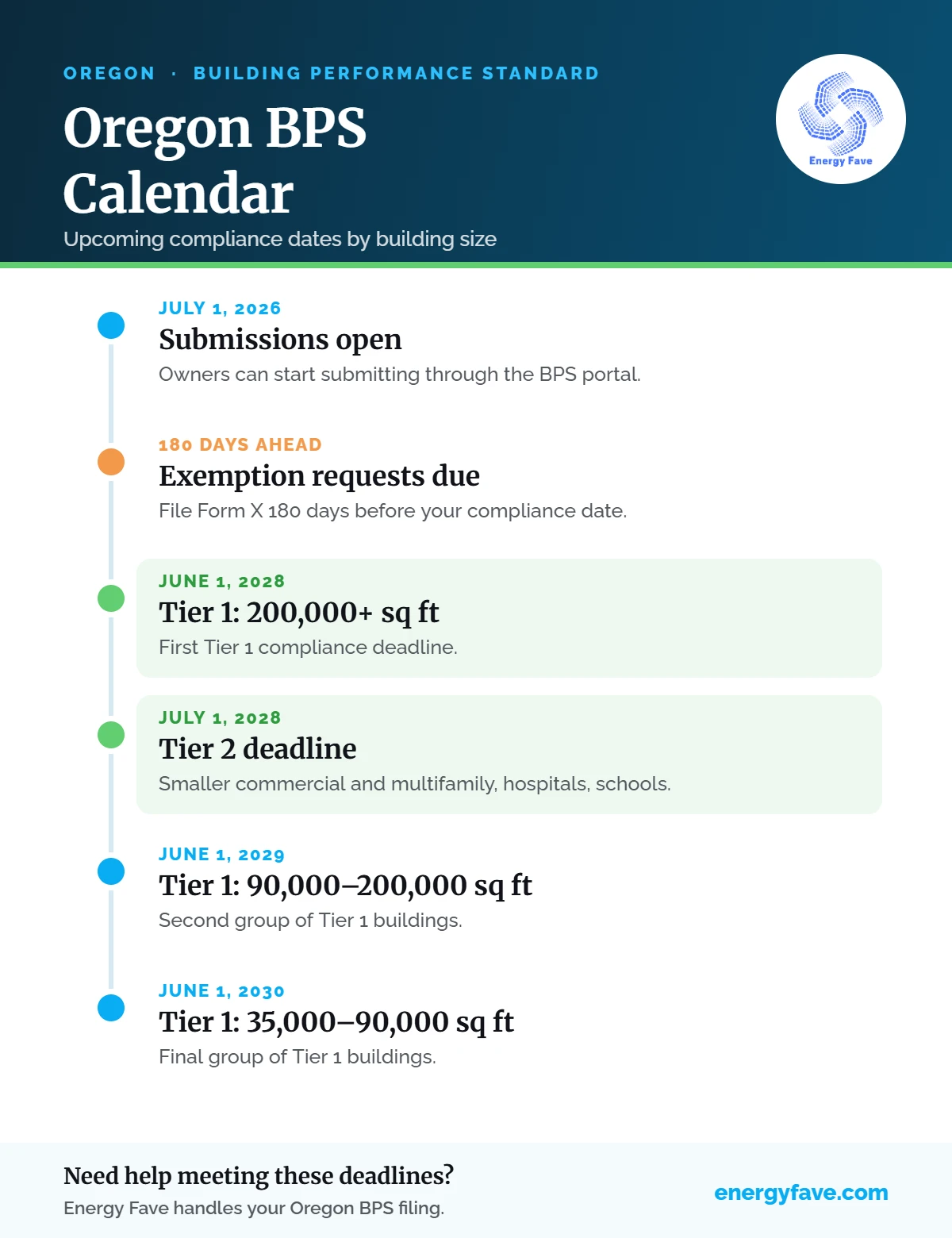
The rules took effect on January 1, 2025. Owners can start submitting on July 1, 2026, and the first compliance deadline is June 1, 2028 for the largest buildings.

What buildings must comply with Oregon BPS?
- Tier 1: buildings where hotel, motel and non-residential floor area totals 35,000 sq ft or more (excluding parking garages)
- Tier 2 (smaller commercial): hotel, motel and non-residential buildings of more than 20,000 and up to 35,000 sq ft
- Tier 2 (special uses): buildings of 35,000 sq ft or more used as multifamily housing, hospitals, schools, universities, dormitories, barracks, prisons or residential and senior care facilities
Residential condominiums do not report. Owners can apply for an exemption (Form X) for low occupancy, unconditioned or semi-heated space, industrial, manufacturing or agricultural use, or financial hardship. Exemptions must be approved by ODOE and renewed every five-year cycle.
What is the penalty for non-compliance?
- Tier 1 non-compliance: civil penalties of up to $5,000, plus up to $1 per sq ft per year.
- With an approved mitigation plan: penalties can drop to 30% of $5,000 and $0.20 per sq ft.
- Tier 2: there are currently no penalties, but Tier 2 owners must still report.
What is the compliance process?
Oregon BPS uses ENERGY STAR Portfolio Manager data and ODOE’s BPS portal, which opened for submissions in mid-2026. A typical Tier 1 filing looks like this:
- First, confirm your building and tier on ODOE’s Property Inventory List.
- Next, benchmark at least 12 months of whole-building energy data in Portfolio Manager.
- Then compare your EUI with your EUI target (Forms B and C) using ODOE’s EUI target calculator.
- Adopt an Operations and Maintenance program and an Energy and Emissions Management Plan (Tier 1 only).
- Finally, submit your forms through the BPS portal by your compliance date. If you are above your target, file Form A at least 180 days early and submit an energy audit and life cycle cost assessment.
What are the Oregon BPS deadlines?
Oregon BPS deadlines are set by building size and tier. Owners can submit early, starting July 1, 2026.
First deadlineJune 1, 2028 for Tier 1 buildings of 200,000+ sq ft
Exemption requests (Form X) are due 180 days before your compliance date. Compliance then repeats on a five-year cycle.
Oregon BPS compliance schedule
Here is when each group of buildings must first comply:
| Building size and type | Tier | Compliance date |
|---|---|---|
| Non-residential, hotel, motel: 200,000+ sq ft | Tier 1 | June 1, 2028 |
| Non-residential, hotel, motel: 90,000–200,000 sq ft | Tier 1 | June 1, 2029 |
| Non-residential, hotel, motel: 35,000–90,000 sq ft | Tier 1 | June 1, 2030 |
| Non-residential, hotel, motel: 20,000–35,000 sq ft | Tier 2 | July 1, 2028 |
| Multifamily, hospital, school and similar: 35,000+ sq ft | Tier 2 | July 1, 2028 |
Incentives: ODOE offers about $14 million in incentives, including the Building Energy Reduction Incentive (up to $100,000 per Tier 1 building and $50,000 per Tier 2 building) for buildings above their EUI target.
What utilities are required for benchmarking reporting?
- Electricity
- Natural Gas
- District Energy
- Any other purchased fuel
What is the purpose of Oregon BPS?
Commercial buildings are a major source of Oregon’s energy use and emissions. The standard serves two main goals:
Cut energy use in the least efficient buildings. Tier 1 buildings above their EUI target must find and carry out cost-effective upgrades.
Build reliable data across the state. Tier 2 reporting gives ODOE a picture of smaller and special-use buildings. Many owners also pursue ENERGY STAR certification.
Portland owners also report under the City’s own energy reporting policy. See our energy benchmarking compliance guide for every city and state.
See our guides for Portland, Washington State and Seattle, or our full energy benchmarking compliance guide.
This program includes an energy audit, assessment or tune-up requirement. Compare it with other cities in our energy audit compliance guide.
Oregon BPS FAQs
When is the first Oregon BPS deadline?
June 1, 2028, for Tier 1 non-residential, hotel and motel buildings of 200,000 sq ft or more. Tier 2 buildings report by July 1, 2028.
Do apartment buildings have to comply?
Yes. Multifamily buildings of 35,000 sq ft or more are Tier 2. They report their EUI but do not need an O&M program or energy management plan.
What happens if my building is above its EUI target?
Tier 1 owners can use a conditional compliance pathway, which requires an energy audit and cost-effective upgrades. File Form A at least 180 days before your deadline.
Are there penalties for Tier 2 buildings?
Not currently. Tier 1 buildings face penalties of up to $5,000 plus $1 per sq ft per year.
Can Energy Fave help with Oregon BPS?
Yes. Energy Fave can benchmark your building, calculate your EUI target, prepare your O&M program and management plan, and submit your forms.
Interested in benchmarking help?
Oregon BPS at a Glance
- Who's covered
- Commercial 20,000+ sq ft; special uses 35,000+ sq ft
- First deadline
- June 1, 2028 (200,000+ sq ft)
- Tier 2 deadline
- July 1, 2028
- Tier 1 penalty
- Up to $5,000 + $1/sq ft per year
- Reporting tool
- Portfolio Manager + ODOE BPS portal