
Massachusetts Large Building Energy Reporting (LBER)
What is Massachusetts Large Building Energy Reporting?
Massachusetts Large Building Energy Reporting (LBER), created by the 2022 Act Driving Clean Energy and Offshore Wind and set out in 225 CMR 27.00, requires the energy use of every building of 20,000 square feet or more to be reported to the Department of Energy Resources (DOER) each year.
Massachusetts uses a shared model: electric, gas and steam utilities report most of the data directly, and building owners report the rest, such as heating oil, propane and on-site solar. DOER then publishes each building’s energy use every October.

What buildings must comply with Massachusetts LBER?
- Any building with a gross floor area of 20,000 sq ft or more, on one or more parcels
- All property types, including commercial, multifamily and institutional buildings, unless DOER exempts a use
DOER publishes a Covered Buildings List each year by March 30. Owners can request an exemption by March 15 if the building was vacant for a full calendar year, was demolished, was vacant more than half the year due to natural causes, or the owner filed for bankruptcy.
Boston and Cambridge: owners who already report under Boston BERDO or Cambridge BEUDO can meet the state requirement by submitting the same information to DOER.
What is the penalty for non-compliance?
DOER gives written notice first, then can fine owners who still have not reported:
- Building owners: up to $150 per day if required data is still missing 30 days after notice.
- Large tenants: tenants occupying more than 5% of a building can be fined the same amount for not providing their data.
- Utilities: up to $150 per covered building per day for missing utility data.
What is the compliance process?
Owners report through ENERGY STAR Portfolio Manager or another DOER-approved tool. A typical year looks like this:
- First, check the Covered Buildings List (published by March 30) and find your building’s Unique Building Identifier (UBID).
- Next, claim your building in the LBER portal and dispute any errors by April 30.
- Then collect energy data utilities do not report: delivered fuels like oil and propane, on-site generation, and tenant data where needed.
- Submit your owner data to DOER by June 30 and self-certify that it is accurate.
- Finally, review the utility data reported for your building and submit any corrections by August 31.
What is the deadline for Massachusetts LBER?
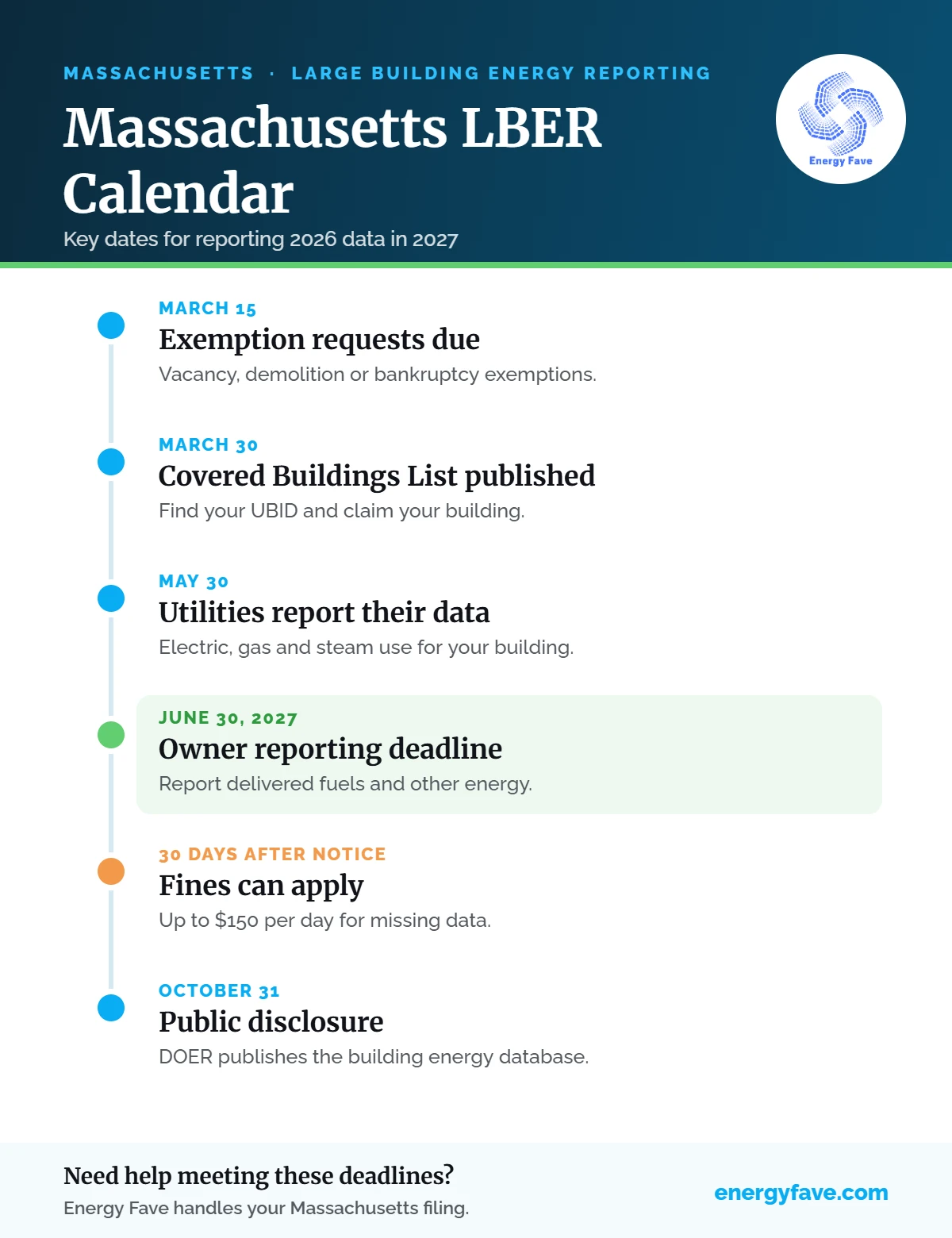
Owner energy data is due June 30 every year and covers the previous calendar year. Utilities report their data by May 30.
Next deadlineJune 30, 2027 for calendar-year 2026 data
DOER publishes the building energy database each year on October 31.
Massachusetts LBER calendar at a glance
LBER runs on the same schedule every year:
| Date | What happens |
|---|---|
| March 15 | Exemption requests due |
| March 30 | DOER publishes the Covered Buildings List |
| April 30 | Disputes, reporting-entity and tenant data requests due |
| May 30 | Utilities report electric, gas and steam data |
| June 30 | Owners report all other energy use |
| August 31 | Owners can submit corrections to utility data |
| October 31 | DOER publishes the annual disclosure report |
Good to know: owners in municipal light plant areas did not have to report MLP-supplied electricity for 2026 under a DOER waiver, but still had to report delivered fuels.
What utilities are required for benchmarking reporting?
- Electricity
- Natural Gas
- Steam
- Heating oil and propane
- On-site renewable generation
What is the purpose of Massachusetts LBER?
Large buildings are a major source of Massachusetts emissions, and the State has committed to net zero by 2050. LBER serves two main goals:
Build a statewide picture of building energy use. Utility-direct reporting gives DOER consistent data for thousands of buildings.
Make performance transparent. The public database helps tenants, cities and buyers compare buildings. Many owners also pursue ENERGY STAR certification.
See our energy benchmarking compliance guide for every city and state.
See our guides for Boston BERDO, Cambridge and Newton, or our full energy benchmarking compliance guide.
Massachusetts LBER FAQs
Do I have to report if my utility already reports my data?
Yes, if your building uses any energy the utility does not report, such as oil, propane or on-site solar. You must also self-certify your submission.
Do Boston and Cambridge buildings report to the State too?
Owners who report under Boston BERDO or Cambridge BEUDO can meet the state requirement by submitting the same information to DOER.
What are the fines for not reporting?
Up to $150 per day once data is still missing 30 days after DOER’s written notice.
When does DOER publish building data?
Every year on October 31, DOER publishes a public database and report of covered buildings’ energy use.
Can Energy Fave handle my Massachusetts reporting?
Yes. Energy Fave can claim your building, collect delivered-fuel and tenant data, submit your report and check the utility data.
Interested in benchmarking help?
Massachusetts at a Glance
- Who's covered
- Buildings 20,000+ sq ft
- Next deadline
- June 30, 2027The 2026 report was due June 30, 2026. Not filed yet? We can file it now →
- Late penalty
- Up to $150 per day
- Utilities report
- Electric, gas and steam by May 30
- Public disclosure
- October 31 each year