
Colorado Building Performance Standard (BPS)
What is the Colorado Building Performance Standard?
Building Performance Colorado, the state’s Building Performance Standard (BPS), requires owners of commercial, multifamily and public buildings of 50,000 square feet or more to benchmark their energy use every year and meet greenhouse gas or energy performance targets. The Colorado Energy Office (CEO) runs the program.
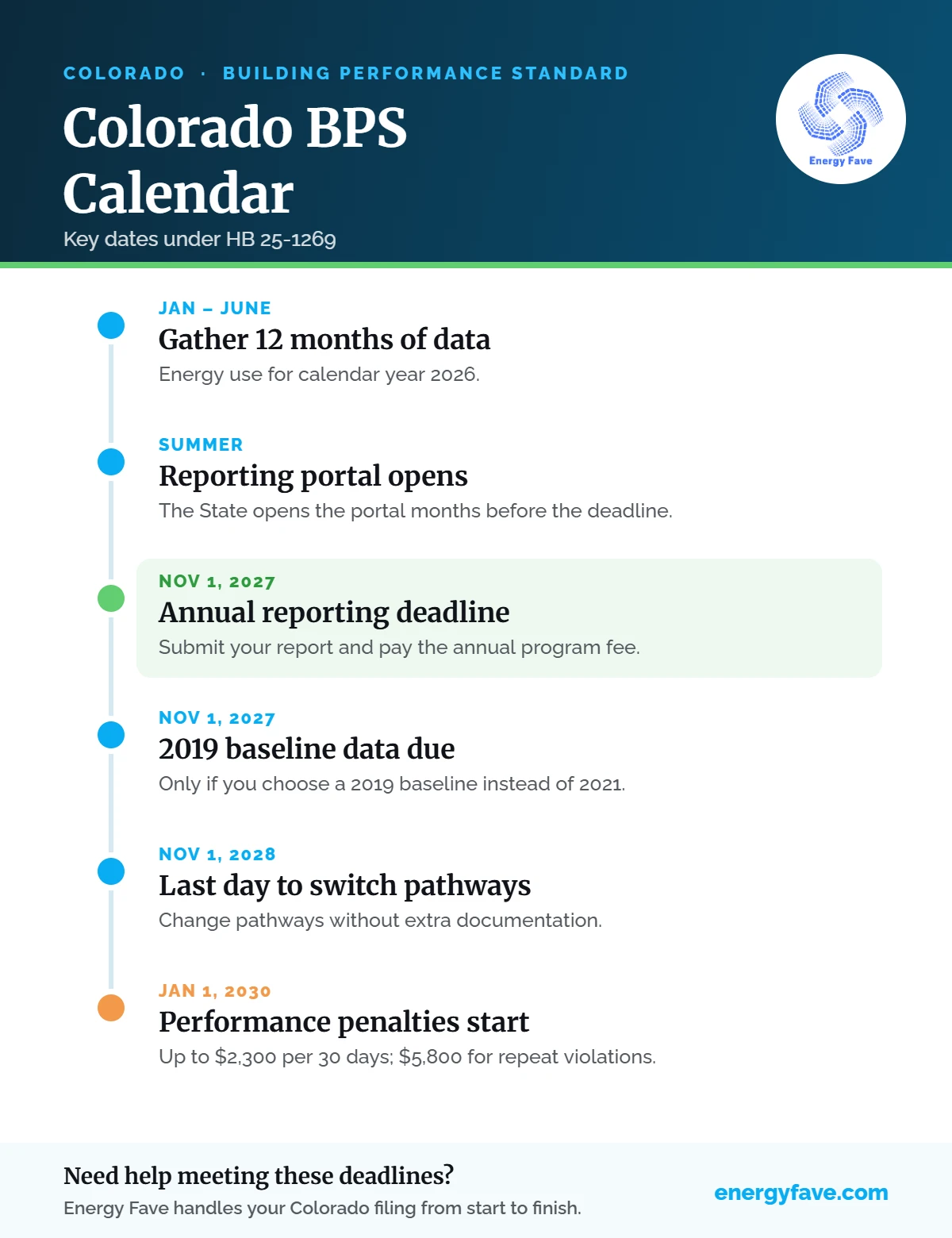
In 2025, House Bill 25-1269 made major changes: the annual reporting deadline moved to November 1, 2026 targets became goals rather than mandatory requirements, owners can choose a 2019 baseline, and performance penalties now start in 2030.

What buildings must comply with Colorado BPS?
- Commercial, multifamily and public buildings of 50,000 sq ft or more anywhere in Colorado
Owners choose a compliance pathway, such as reducing greenhouse gas emissions by a set percentage from their baseline, or meeting energy use intensity (EUI) targets for their building type by 2030. Owners can change pathways until November 1, 2028 without extra documentation.
Your building may qualify for an exemption if it was unoccupied for 30+ consecutive days, has a demolition permit, faces financial hardship, or cannot get aggregated utility data. Buildings that comply with a qualifying local program, such as Energize Denver, may be deemed compliant to avoid duplicate reporting.
What is the penalty for non-compliance?
HB 25-1269 reset the penalty schedule:
- Benchmarking violations: up to $577 for a first violation and up to $2,300 for later violations.
- 2026 targets: treated as goals, with no penalties for missing them.
- Performance targets from Jan 1, 2030: up to $2,300 per 30 days, rising to $5,800 per 30 days for repeat violations.
Penalty amounts are adjusted each year for inflation.
What is the compliance process?
Colorado owners benchmark in ENERGY STAR Portfolio Manager and report through the Building Performance Colorado portal. A typical filing looks like this:
- First, confirm your building is covered and note its Colorado Building ID.
- Next, set up or update the property in Portfolio Manager and enter 12 months of whole-building energy data for the previous year.
- Then choose or confirm your compliance pathway, and submit 2019 data by November 1, 2027 if you switch to a 2019 baseline.
- Pay the annual program fee; buildings that do not pay are not in compliance (public and federal buildings are exempt from the fee).
- Finally, submit your report through the portal by November 1.
What is the deadline for Colorado BPS reporting?
Since 2026, the annual Colorado reporting deadline is November 1. The Colorado Energy Office opens the portal several months before the deadline.
Next deadlineNovember 1, 2027 for calendar-year 2026 data
The same date is the deadline to submit 2019 data if you choose a 2019 baseline. Performance targets are measured in 2030.
What changed under HB 25-1269
HB 25-1269 changed several key parts of Building Performance Colorado. Here is a quick comparison:
| Topic | Before | Now |
|---|---|---|
| Reporting deadline | June 1, later July 1 | November 1 each year |
| 2026 targets | Mandatory interim targets | Goals only, no penalties |
| Baseline year | 2021 | 2019 or 2021 (2019 data due Nov 1, 2027) |
| Performance penalties | Applied to interim targets | Start Jan 1, 2030 |
| Local programs | Separate reporting | Buildings in qualifying local programs may be deemed compliant |
What utilities are required for Colorado benchmarking reporting?
- Electricity
- Natural Gas
- District Energy
- Any other purchased fuel
What is the purpose of the Colorado Building Performance Standard?
Large buildings are a major source of Colorado’s greenhouse gas emissions, so the State uses BPS to measure and improve how they perform. The program serves two main goals:
Cut energy use and emissions. Targets for 2030, followed by standards for 2040, push large buildings toward lower emissions.
Build reliable data. Annual benchmarking gives owners and the State a clear picture of building performance. Many owners then go further and pursue ENERGY STAR certification.
Denver owners should also see our Energize Denver guide or our energy benchmarking compliance guide.
See our guides for Energize Denver, Boulder, Fort Collins and Lakewood, or our full energy benchmarking compliance guide.
Colorado BPS FAQs
Do I still have to meet my 2026 target?
No. Under HB 25-1269, 2026 targets are goals rather than requirements, and no penalties apply. Focus on your 2030 target instead.
When is the Colorado reporting deadline?
November 1 each year, starting in 2026. Your next report, covering 2026 data, is due November 1, 2027.
Can I use 2019 as my baseline?
Yes. Owners using a percent-reduction pathway can choose 2019 instead of 2021, but must submit 2019 energy data by November 1, 2027.
Does Energize Denver count for state compliance?
Buildings in a local program that meets or exceeds state standards may be deemed compliant. Denver owners should confirm their status with the Colorado Energy Office.
Can Energy Fave help with Colorado BPS?
Yes. Energy Fave can benchmark your building, help you pick a pathway and baseline, and submit your report.
Interested in benchmarking help?
Colorado BPS at a Glance
- Who's covered
- Buildings 50,000+ sq ft statewide
- Next deadline
- Nov 1, 2027The 2026 report was due Nov 1, 2026. Not filed yet? We can file it now →
- 2026 targets
- Goals only, no penalties
- Performance penalties
- From Jan 1, 2030
- Reporting tool
- Portfolio Manager + State portal