
New York City Local Law 84 (LL84) Benchmarking
What is New York City Local Law 84?
New York City Local Law 84 (LL84) was passed in 2009 as part of the Greener, Greater Buildings Plan and expanded by Local Law 133 of 2016. It requires owners of large buildings in the five boroughs (Manhattan, Bronx, Queens, Brooklyn and Staten Island) to benchmark their energy and water use every year in ENERGY STAR Portfolio Manager and submit the results to the NYC Department of Buildings (DOB).
In addition, your LL84 data sets the building’s public energy efficiency grade under Local Law 33/95, and it underpins annual emissions reporting under Local Law 97. As a result, accurate benchmarking matters more than ever.

What buildings are required per New York City Local Law 84?
Local Law 84 applies to large buildings in the five boroughs. A property must comply if it falls into either category:
- Single buildings: buildings with more than 25,000 gross square feet
- Multiple buildings on one tax lot: two or more buildings on the same tax lot with a combined gross floor area over 100,000 square feet
DOB publishes an updated Covered Buildings List each year. Check whether your building is listed on the official NYC DOB Local Law 84 page.
What is the penalty for non-compliance?
There are penalties for failing to comply with New York City Local Law 84 (LL84). These penalties are tiered and increase the longer a building owner remains out of compliance:
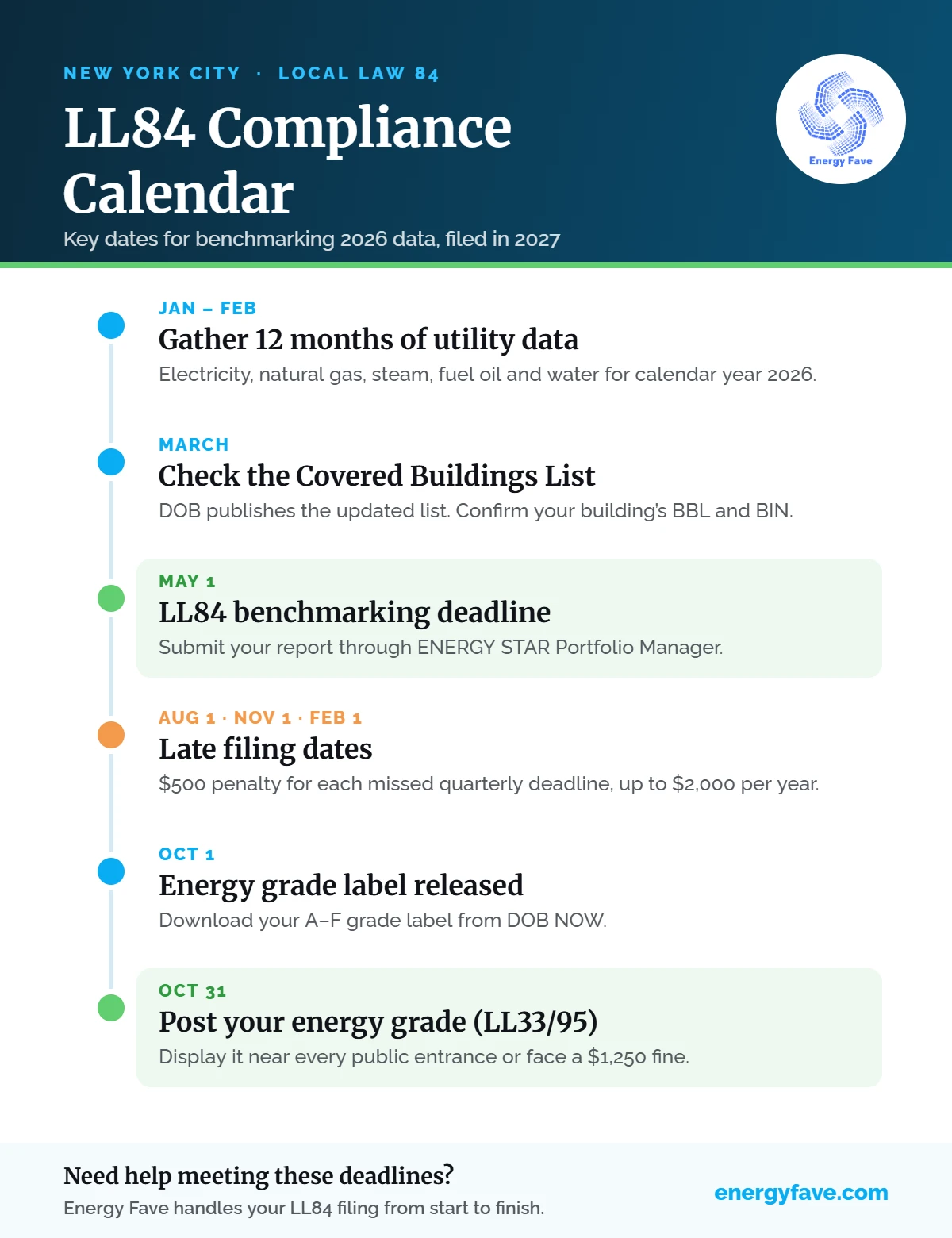
- Initial Penalty: If you miss the May 1st deadline to submit your benchmarking report, the first penalty is a fine of $500.
- Continued Non-Compliance: For each subsequent quarter that the report remains unsubmitted, an additional $500 fine is incurred.
- Maximum Penalty: The maximum penalty for failing to submit a single year’s report is $2,000. This occurs if the report isn’t submitted by the following February 1st deadline.
There’s also a separate penalty for not displaying the Building Energy Efficiency Rating Label. Failing to do so can result in a $1,250 fine.
What is the compliance process?
New York City building owners report through ENERGY STAR Portfolio Manager, the free EPA tool that compares your building’s energy performance with similar buildings nationwide. A typical LL84 filing looks like this:
- First, confirm your building is on the current Covered Buildings List and note its BBL and BIN.
- Next, set up (or update) the property in Portfolio Manager with accurate floor area and property use details.
- Then enter 12 months of whole-building energy and water data for the previous calendar year. Where tenants pay their own utilities, request aggregated data from the utility.
- Submit the report to the City through the NYC benchmarking data request in Portfolio Manager by May 1.
- Finally, post the energy efficiency grade label DOB issues for your building near each public entrance.
What is the deadline for New York City Local Law 84?
LL84 benchmarking reports are due May 1 every year and cover the previous calendar year’s energy and water use. For filing year 2026, DOB confirmed that reports (covering 2025 data) were due May 1, 2026, and that the deadline extensions granted in 2025 do not carry over.
Next deadlineMay 1, 2027 for calendar-year 2026 data
If you miss May 1, you can still submit by August 1, November 1, or February 1 of the following year, but a penalty applies for each missed quarterly deadline. We recommend starting to collect utility data in February so you have time to fix data gaps before the deadline.
Local Law 84 vs. Local Law 97, Local Law 33 and Local Law 87
LL84 is one of several NYC building energy laws, and they all build on the same benchmarking data. Here is how they fit together:
| Law | What it requires | Who must comply | Deadline & penalty |
|---|---|---|---|
| Local Law 84Benchmarking | Annual energy and water benchmarking in Portfolio Manager | Buildings over 25,000 sq ft, or multiple buildings on one lot over 100,000 sq ft | May 1 each year $500 per missed quarter, up to $2,000/year |
| Local Law 33/95Energy grades | Post the A–D, F or N grade label at each public entrance | Buildings covered by LL84 | October 31 (labels out October 1) $1,250 fine |
| Local Law 97Carbon limits | Annual emissions report and carbon caps | Most buildings over 25,000 sq ft | May 1 (in 2026, extension to Aug 29 if requested by June 30) $268 per ton over the limit |
| Local Law 87Audits | Energy audit and retro-commissioning every 10 years | Buildings over 50,000 sq ft | Assigned year by the last digit of the tax block (blocks ending in 6: due Dec 31, 2026; ending in 7: due in 2027) $3,000 first year, $5,000/year after |
How your energy grade is set: DOB converts your ENERGY STAR score into a letter grade. A score of 85 or higher earns an A, 70–84 a B, and 55–69 a C, while anything below 55 is a D. Buildings that fail to benchmark receive an F, and exempt buildings receive an N. In other words, a missed LL84 filing also means posting an F on your front door.
What utilities are required for benchmarking reporting?
- Water
- Electricity
- Natural Gas
- District Energy
- Any other purchased fuel
What is the purpose for New York City Local Law 84?
Buildings produce most of New York City’s greenhouse gas emissions, so the City uses Local Law 84 to measure how they perform. The law serves two main goals:
Cut emissions and energy waste. When owners track energy and water use every year, they can spot inefficiencies, measure progress, and plan upgrades. The same data now drives Local Law 97 carbon limits, so benchmarking is the first step toward avoiding emissions penalties.
Make building performance transparent. The City publishes benchmarking results, and owners post a letter grade at each entrance. As a result, tenants, buyers and lenders can compare buildings, and owners have a clear reason to improve. Many owners go a step further and pursue ENERGY STAR certification once their score reaches 75 or higher.
Overall, LL84 is the foundation of NYC’s building climate laws. To see how other cities handle benchmarking, visit our energy benchmarking compliance guide.
See our guides for New Jersey and Philadelphia, or our full energy benchmarking compliance guide.
This program includes an energy audit, assessment or tune-up requirement. Compare it with other cities in our energy audit compliance guide.
Local Law 84 FAQs
Do condos and co-ops have to comply with Local Law 84?
Yes. A co-op or condo building over 25,000 gross square feet must benchmark like any other building. In addition, two or more condo buildings governed by the same board of managers must comply if they total more than 100,000 square feet.
What if my building is on the Covered Buildings List by mistake?
If the square footage or number of buildings on your lot is wrong, contact the NYC Department of Finance at sustainablebuildings@finance.nyc.gov. You can also file a Covered Buildings List dispute through DOB’s BEAM portal. Until DOB approves the dispute, plan to file on time.
Can I get an extension on the May 1 deadline?
Usually not. DOB granted special extensions in 2025, but it confirmed those extensions did not carry over to 2026. Therefore, plan for May 1 every year.
Who can submit the LL84 report?
The owner is legally responsible, but a property manager or a benchmarking provider such as Energy Fave can collect the data and submit the report on the owner’s behalf.
Is Local Law 84 the same as Local Law 97?
No. LL84 requires you to report energy and water use, while LL97 limits your building’s carbon emissions and fines you for going over. However, both rely on the same Portfolio Manager data, so a clean LL84 filing makes LL97 compliance much easier.
Interested in benchmarking help?
LL84 at a Glance
- Who's covered
- Buildings over 25,000 sq ft
- Next deadline
- May 1, 2027The 2026 report was due May 1, 2026. Not filed yet? We can assist with your compliance submission →
- Late penalty
- $500 per quarter, up to $2,000 a year
- Reporting tool
- ENERGY STAR Portfolio Manager
- Data needed
- 12 months of energy and water use