
New Jersey Energy and Water Benchmarking
What is New Jersey's energy and water benchmarking program?
New Jersey’s Energy and Water Benchmarking program, created by the Clean Energy Act of 2018 and run by the New Jersey Board of Public Utilities (NJBPU), requires owners of commercial buildings over 25,000 square feet to benchmark their energy and water use every year.
Owners report through ENERGY STAR Portfolio Manager using each building’s New Jersey Unique Building Identifier (UBID). The first reports were due in 2023, and the program supports the State’s Energy Master Plan goal of cutting building energy use.

What buildings must comply with New Jersey benchmarking?
- Commercial buildings over 25,000 sq ft (tax class 4A)
- Apartment buildings with five or more units over 25,000 sq ft (tax class 4C)
- Certain State-owned properties over 25,000 sq ft
- Stand-alone parking garages over 25,000 sq ft; attached garages count toward the main building
Industrial buildings, homes of up to four units, condominiums, public and non-profit schools, county and local government property, and houses of worship are not covered. Owners can request an exemption for a building that was unoccupied for a full year, is being demolished, or is in foreclosure or bankruptcy. Check the NJBPU Covered Buildings List to confirm whether your building is included.
What is the penalty for non-compliance?
New Jersey does not currently fine owners for missing the deadline. However, non-compliance has visible consequences:
- Public listing: buildings that do not report can be listed as non-responsive in the State’s public benchmarking database.
- Notices: NJBPU notifies owners who miss the deadline.
- Future rules: NJBPU said it will review compliance rates, so a clean reporting history keeps you ahead of any future enforcement.
What is the compliance process?
New Jersey owners report through ENERGY STAR Portfolio Manager. A typical filing looks like this:
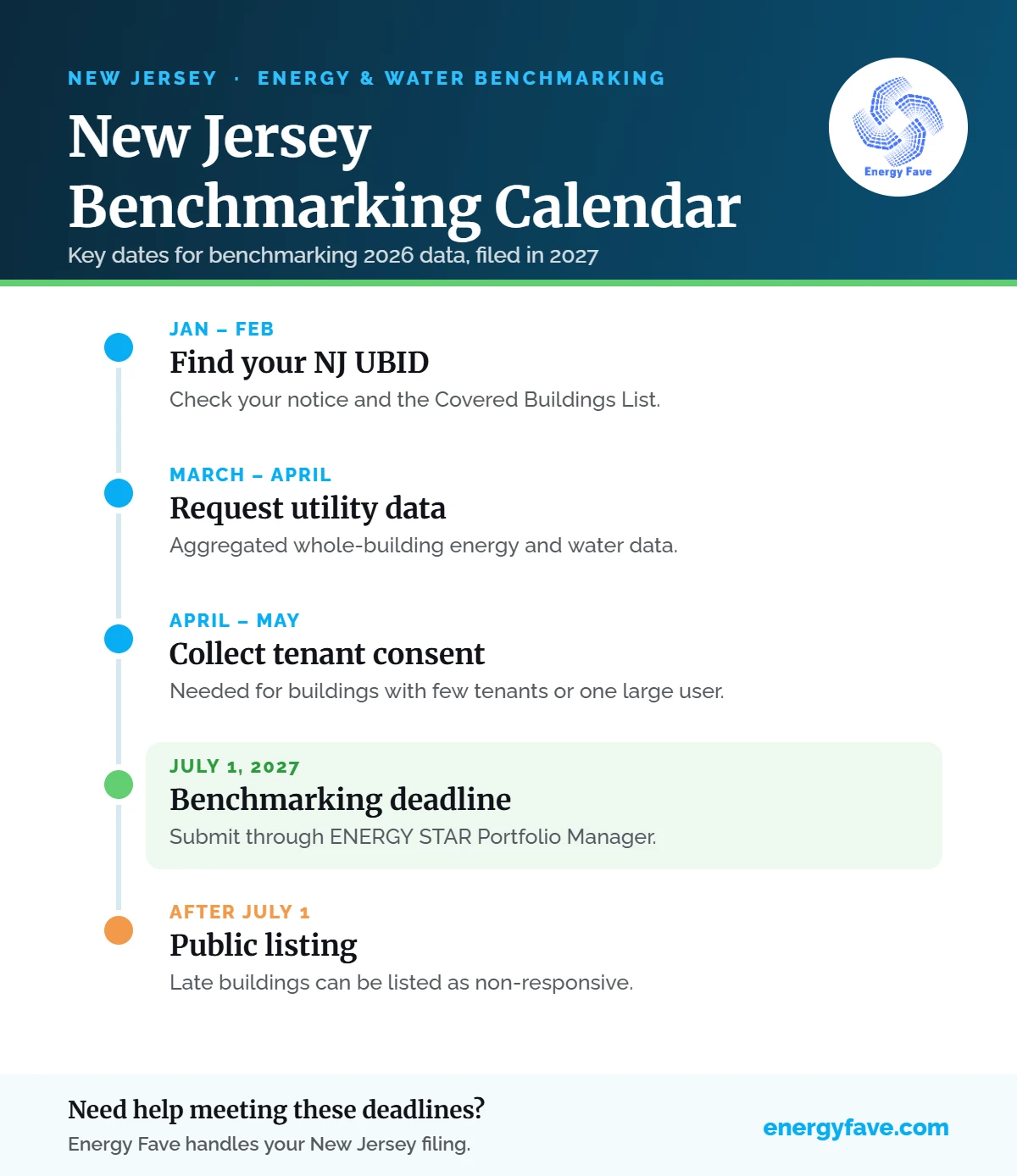
- First, find your building’s New Jersey UBID in your NJBPU notification letter or on the Covered Buildings List.
- Next, request aggregated whole-building energy and water data from your utilities, which must provide it through a data access service.
- Get written tenant consent if your building has fewer than four tenants or one tenant uses more than half of the energy or water.
- Enter 12 months of data (January 1 to December 31) in Portfolio Manager.
- Finally, submit your report to NJBPU by July 1. Owners with several buildings can also use the optional BEAM building owner portal.
What is the deadline for New Jersey benchmarking?
New Jersey benchmarking reports are due July 1 every year and cover the previous calendar year. For the 2026 season, 2025 data was due July 1, 2026.
Next deadlineJuly 1, 2027 for calendar-year 2026 data
Utility data requests can take several weeks, so we recommend requesting data in early spring.
New Jersey benchmarking at a glance
Here is a quick summary of the program:
| Requirement | Details |
|---|---|
| Who | Commercial buildings and apartment buildings (5+ units) over 25,000 sq ft |
| What | 12 months of whole-building energy and water use |
| When | July 1 each year |
| How | ENERGY STAR Portfolio Manager with your NJ UBID |
| Enforcement | No fines; non-reporting buildings can be listed publicly |
What utilities are required for benchmarking reporting?
- Water
- Electricity
- Natural Gas
- District Energy
- Any other purchased fuel
What is the purpose of New Jersey's benchmarking program?
Commercial buildings are a major source of New Jersey’s energy use and emissions. The program serves two main goals:
Cut energy and water use. Benchmarking shows owners where they waste resources and supports the State’s Energy Master Plan.
Make performance transparent. NJBPU’s public database lets tenants and buyers compare buildings. Buildings that score 75 or higher can also earn ENERGY STAR certification.
Many New Jersey owners also have buildings in New York City; see our NYC Local Law 84 guide or our energy benchmarking compliance guide.
New Jersey benchmarking FAQs
Do apartment buildings have to benchmark in New Jersey?
Yes. Apartment buildings with five or more units over 25,000 sq ft are covered. Condominiums are not.
Are there fines for missing the New Jersey deadline?
Not currently. Buildings that do not report can be listed as non-responsive in the State’s public database.
What is a UBID?
The New Jersey Unique Building Identifier is the number NJBPU uses to track each covered building. You need it to submit your report.
Do I need tenant consent to get utility data?
Only if your building has fewer than four tenants, or if one tenant uses more than half of the energy or water.
Can Energy Fave file my New Jersey report?
Yes. Energy Fave can request utility data, set up Portfolio Manager and submit your report to NJBPU.
Interested in benchmarking help?
New Jersey at a Glance
- Who's covered
- Commercial & apartments 25,000+ sq ft
- Next deadline
- July 1, 2027The 2026 report was due July 1, 2026. Not filed yet? We can file it now →
- Penalty
- No fines; public listing
- Data needed
- 12 months of energy and water
- Reporting tool
- Portfolio Manager + NJ UBID