
Minneapolis Energy Benchmarking Ordinance
What is Minneapolis's energy benchmarking ordinance?
Minneapolis’s Building Energy and Water Rating and Disclosure Policy requires owners of large commercial and multifamily buildings to benchmark their energy and water use every year and report it to the City.
The City publishes the results each summer, so tenants, buyers and lenders can compare buildings. Since 2025, Minnesota also has a statewide benchmarking law (Minn. Stat. 216C.331) for buildings of 50,000 sq ft or more, which builds on programs like Minneapolis’s.

What buildings must comply with Minneapolis benchmarking?
- Commercial buildings of 50,000 sq ft or more
- Multifamily residential buildings of 50,000 sq ft or more (added in 2019)
- City-owned buildings of 25,000 sq ft or more
Your building may qualify for an exemption if it faces financial distress (for example, a tax lien sale or receivership), had no certificate of occupancy for the full year, was less than 50% occupied, or was recently occupied for the first time.
What is the penalty for non-compliance?
Minneapolis uses an escalating fine system:
- First citation: a $200 fine and two weeks to submit your data or request an extension.
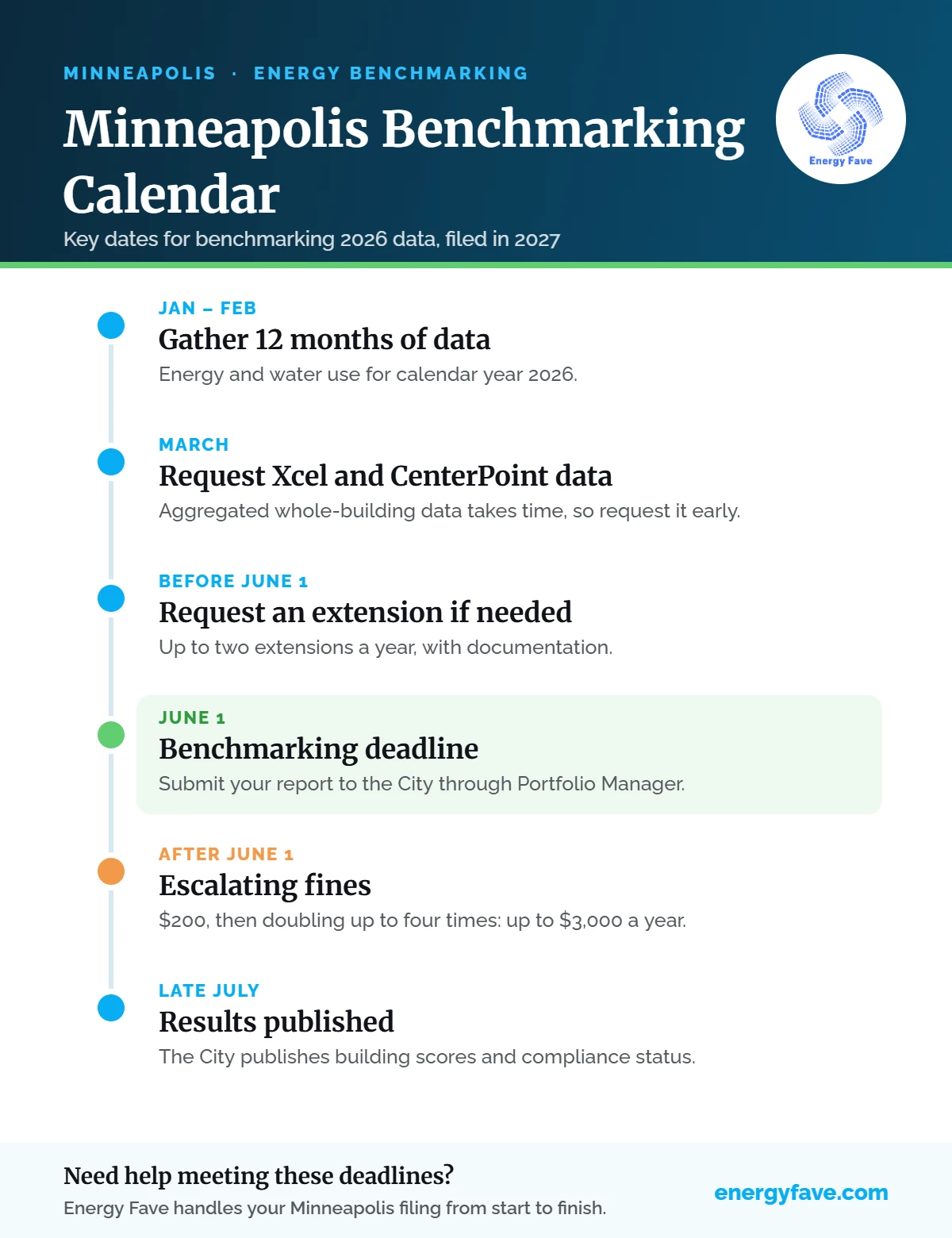
- Repeat citations: the fine doubles each time, up to four citations a year ($200, $400, $800, $1,600), for a total of up to $3,000.
- Unpaid fines: added to your property taxes, which can create a lien.
What is the compliance process?
Minneapolis owners report through ENERGY STAR Portfolio Manager. A typical filing looks like this:
- First, check the City’s Must Comply list and note your building’s Minneapolis Building ID.
- Next, set up or update the property in Portfolio Manager with accurate floor area and use details.
- Then enter 12 months of whole-building energy and water data. Request aggregated data from Xcel Energy and CenterPoint Energy where tenants are separately metered.
- Submit your report to the City through Portfolio Manager by June 1, or request an extension before the deadline.
- Finally, if your ENERGY STAR score is low, be ready for a possible City energy evaluation.
What is the deadline for Minneapolis energy benchmarking?
Minneapolis benchmarking reports are due June 1 every year and cover the previous calendar year. Owners may request up to two extensions a year, with documentation, before the deadline.
Next deadlineJune 1, 2027 for calendar-year 2026 data
The City then publishes compliance results in late July. We recommend starting your data collection in February.
Minneapolis vs. Minnesota statewide benchmarking
Minneapolis buildings now sit under both a city ordinance and a state law. Here is how they compare:
| Program | Who must comply | Deadline |
|---|---|---|
| Minneapolis ordinanceCity | Commercial and multifamily 50,000+ sq ft; City-owned 25,000+ sq ft | June 1 each year |
| Minnesota statewide lawPhase 1 | Buildings of 100,000+ sq ft across the state | Reporting began 2025 |
| Minnesota statewide lawPhase 2 | Buildings of 50,000–100,000 sq ft | Reporting began 2026 |
Good to know: the state law allows stricter local programs, so Minneapolis rules remain your primary obligation. Check with the Minnesota Department of Commerce if you own buildings elsewhere in the state.
What utilities are required for benchmarking reporting?
- Water
- Electricity
- Natural Gas
- District Energy
- Any other purchased fuel
What is the purpose of Minneapolis's benchmarking ordinance?
Large buildings are a major source of Minneapolis’s energy use and emissions, so the City uses benchmarking to measure and improve how they perform. The policy serves two main goals:
Cut energy and water use. Annual data shows owners where they waste resources and highlights low-performing buildings that would benefit from an energy evaluation.
Make performance transparent. Because the City publishes the results, tenants and buyers can compare buildings, and owners have a clear reason to improve. Buildings that score 75 or higher can also earn ENERGY STAR certification.
To see how other cities handle benchmarking, visit our energy benchmarking compliance guide.
See our guides for Minnesota, Saint Paul and Edina, or our full energy benchmarking compliance guide.
Minneapolis energy benchmarking FAQs
How much are Minneapolis benchmarking fines?
The first citation is $200, and the fine doubles with each repeat citation, up to four a year, for a total of up to $3,000. Unpaid fines are added to property taxes.
Can I get an extension?
Yes. Owners can request up to two extensions a year, with documentation, before the June 1 deadline.
Do I also have to report under Minnesota’s statewide law?
The state law covers buildings of 50,000 sq ft or more and permits stricter local programs. Minneapolis requirements remain your primary obligation, but owners with buildings elsewhere in Minnesota should check the state program.
Is Minneapolis benchmarking data public?
Yes. The City publishes building results each summer, so tenants and buyers can compare performance.
Can Energy Fave file my Minneapolis report?
Yes. Energy Fave can collect Xcel Energy and CenterPoint data, set up Portfolio Manager and submit your report on your behalf.
Interested in benchmarking help?
Minneapolis at a Glance
- Who's covered
- Commercial & multifamily 50,000+ sq ft
- Next deadline
- June 1, 2027The 2026 report was due June 1, 2026. Not filed yet? We can file it now →
- Late penalty
- $200, doubling to up to $3,000
- Extensions
- Up to 2 per year
- Reporting tool
- ENERGY STAR Portfolio Manager