
Orlando Energy Benchmarking Ordinance
What is Orlando's Building Energy and Water Efficiency Strategy (BEWES)?
Orlando’s Building Energy and Water Efficiency Strategy (BEWES), passed unanimously by City Council in 2016 (Ordinance 2016-64), requires owners of large buildings to benchmark their energy and water use every year and report it to the City.
BEWES has two parts:
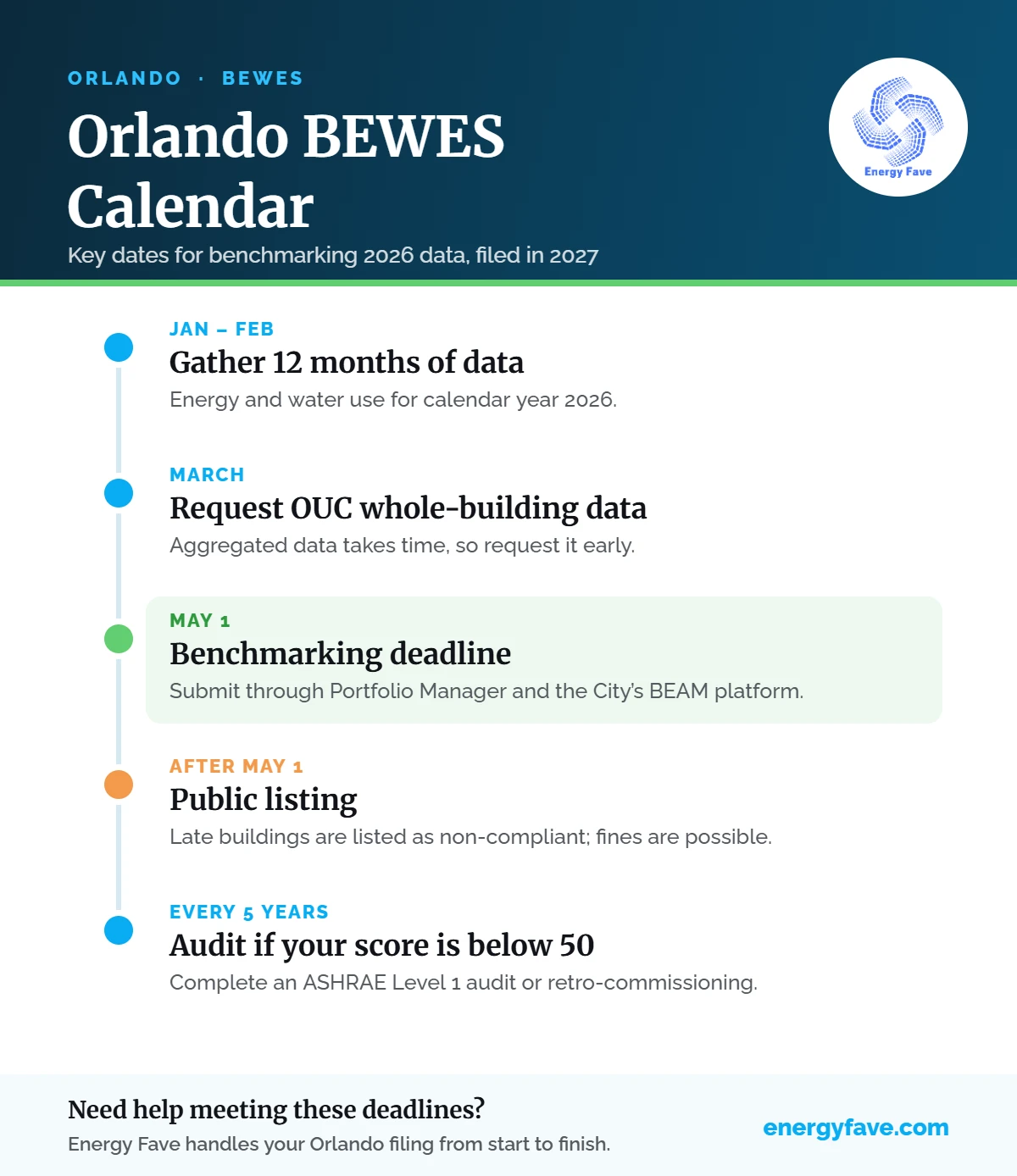
- Annual benchmarking: covered buildings report 12 months of data in ENERGY STAR Portfolio Manager by May 1.
- Audits for low performers: buildings with an ENERGY STAR score below 50 must complete an energy audit or retro-commissioning once every five years until they score above 50.
The City publishes results in its annual report and online transparency map, so tenants and investors can compare buildings.

What buildings must comply with Orlando BEWES?
- Commercial and multifamily buildings over 50,000 gross sq ft
- City-owned buildings over 10,000 sq ft
Your building may qualify for an exemption if it faces financial hardship, is used for industrial or manufacturing purposes, is a theme park or certain telecom infrastructure, or cannot obtain whole-building utility data. The City may also grant an exemption for special circumstances unique to a building.
What is the penalty for non-compliance?
Orlando relies mainly on public disclosure, with fines possible for continued non-compliance:
- Public listing: buildings that miss the deadline are identified as non-compliant in the City’s annual report and transparency map.
- Fines: the City can assess fines for continued non-compliance, set case by case.
- Mandatory audits: buildings that score below 50 must pay for an energy audit or retro-commissioning every five years.
What is the compliance process?
Orlando owners report through ENERGY STAR Portfolio Manager, which connects to the City’s BEAM compliance platform. A typical filing looks like this:
- First, confirm your building is covered and note its Orlando Building ID from your City notice.
- Next, set up or update the property in Portfolio Manager with accurate floor area and use details.
- Then enter 12 months of whole-building energy and water data for the previous calendar year. Request aggregated data from OUC where tenants are separately metered.
- Submit your report to the City through Portfolio Manager and BEAM by May 1.
- Finally, if your ENERGY STAR score is below 50, schedule an ASHRAE Level 1 audit or retro-commissioning.
What is the deadline for Orlando energy benchmarking?
Orlando BEWES reports are due May 1 every year and cover the previous calendar year’s energy and water use.
Next deadlineMay 1, 2027 for calendar-year 2026 data
Buildings scoring below 50 must also complete an audit or retro-commissioning once every five years. We recommend starting your data collection in February.
Orlando BEWES requirements at a glance
BEWES combines annual reporting with targeted audits for low performers:
| Requirement | Who must comply | Deadline |
|---|---|---|
| Annual benchmarkingEvery year | Commercial and multifamily 50,000+ sq ft; City-owned 10,000+ sq ft | May 1 each year |
| Energy audit or RCxEvery 5 years | Buildings with an ENERGY STAR score below 50 | Once every five years until the score exceeds 50 |
| Audit levelBy owner | Private buildings: ASHRAE Level 1; City buildings: ASHRAE Level 2 | With your audit cycle |
What utilities are required for benchmarking reporting?
- Water
- Electricity
- Natural Gas
- District Energy
- Any other purchased fuel
What is the purpose of Orlando BEWES?
An ENERGY STAR score works like a miles-per-gallon rating for buildings: it gives tenants and investors a simple way to compare performance. Orlando uses BEWES to serve two main goals:
Cut energy and water use. Benchmarking shows owners where they waste resources, and audits help low performers find cost-effective upgrades.
Make performance transparent. Because the City publishes results, tenants and buyers can compare buildings, and owners have a clear reason to improve. Buildings that score 75 or higher can also earn ENERGY STAR certification.
To see how other cities handle benchmarking, visit our energy benchmarking compliance guide.
See our guides for Miami BE305, Atlanta and New Orleans, or our full energy benchmarking compliance guide.
This program includes an energy audit, assessment or tune-up requirement. Compare it with other cities in our energy audit compliance guide.
Orlando energy benchmarking FAQs
Does my building need an energy audit under BEWES?
Only if its ENERGY STAR score is below 50. Those buildings must complete an audit or retro-commissioning once every five years until they score above 50.
Are there fines for missing the Orlando deadline?
The City can assess fines for continued non-compliance, but its main tool is public disclosure in the annual report and transparency map.
What is BEAM?
BEAM is the City’s compliance platform. It connects to Portfolio Manager so owners can submit reports and receive City communications.
Do multifamily buildings have to comply?
Yes. Multifamily buildings over 50,000 gross sq ft must benchmark every year.
Can Energy Fave handle my Orlando BEWES filing?
Yes. Energy Fave can collect OUC data, submit your benchmarking report and coordinate an audit if your score is below 50.
Interested in benchmarking help?
Orlando at a Glance
- Who's covered
- Commercial & multifamily 50,000+ sq ft
- Next deadline
- May 1, 2027The 2026 report was due May 1, 2026. Not filed yet? We can file it now →
- Penalty
- Public listing; fines possible
- Audit
- Every 5 years if score is below 50
- Reporting tool
- Portfolio Manager + City BEAM platform