
Maryland Building Energy Performance Standards (BEPS)
What are the Maryland Building Energy Performance Standards?
Maryland’s Building Energy Performance Standards (BEPS), created by the Climate Solutions Now Act of 2022 and set out in COMAR 26.28, require owners of large buildings to benchmark their energy use every year and report it to the Maryland Department of the Environment (MDE).
Benchmarking began in 2025. Starting in 2030, covered buildings must also cut their net direct greenhouse gas emissions, reaching net zero direct emissions by 2040. MDE also plans to adopt a site energy use intensity (EUI) standard in 2027.

What buildings must comply with Maryland BEPS?
- Commercial buildings of 35,000 sq ft or more (gross floor area, excluding parking garages)
- Multifamily residential buildings of 35,000 sq ft or more
- State-owned buildings of 35,000 sq ft or more
- Groups of buildings that together reach 35,000 sq ft and share an electric or gas meter or a heating or cooling system
Some building types can request an exemption, including historic properties, elementary and secondary schools, manufacturing, agricultural, federal and hospital buildings. Owners can also request a yearly exemption for financial distress, an unoccupied building or demolition. Exemption requests are due before June 1.
Montgomery County: buildings in Montgomery County follow the County’s own benchmarking and BEPS program instead of the statewide program.
What is the penalty for non-compliance?
MDE reviews violations case by case, and enforcement can range from warnings to fees:
- Missed benchmarking report: a violation of COMAR 26.28, with enforcement decided by MDE.
- Missed emissions standard (from 2030): owners can make an Alternative Compliance Payment of $230 per metric ton of excess CO2e (in 2020 dollars, adjusted for inflation), rising by $4 each year.
- Unpaid reporting fee: the annual $100 fee per building is part of compliance.
What is the compliance process?
Maryland owners benchmark in ENERGY STAR Portfolio Manager and use the MDE BEPS Portal. A typical filing looks like this:
- First, find your building’s Unique Building Identifier (UBID) on the BEPS Portal covered buildings list.
- Next, enter 12 months of whole-building energy data (January 1 to December 31) in Portfolio Manager, including electricity, natural gas, delivered fuels, steam and on-site solar.
- Then pay the $100 annual reporting fee per building through the BEPS Portal.
- In verification years, have a qualified third party (such as a PE, licensed architect or Certified Energy Manager) verify your data.
- Finally, submit your report to MDE through Portfolio Manager by June 1.
What is the deadline for Maryland BEPS benchmarking?
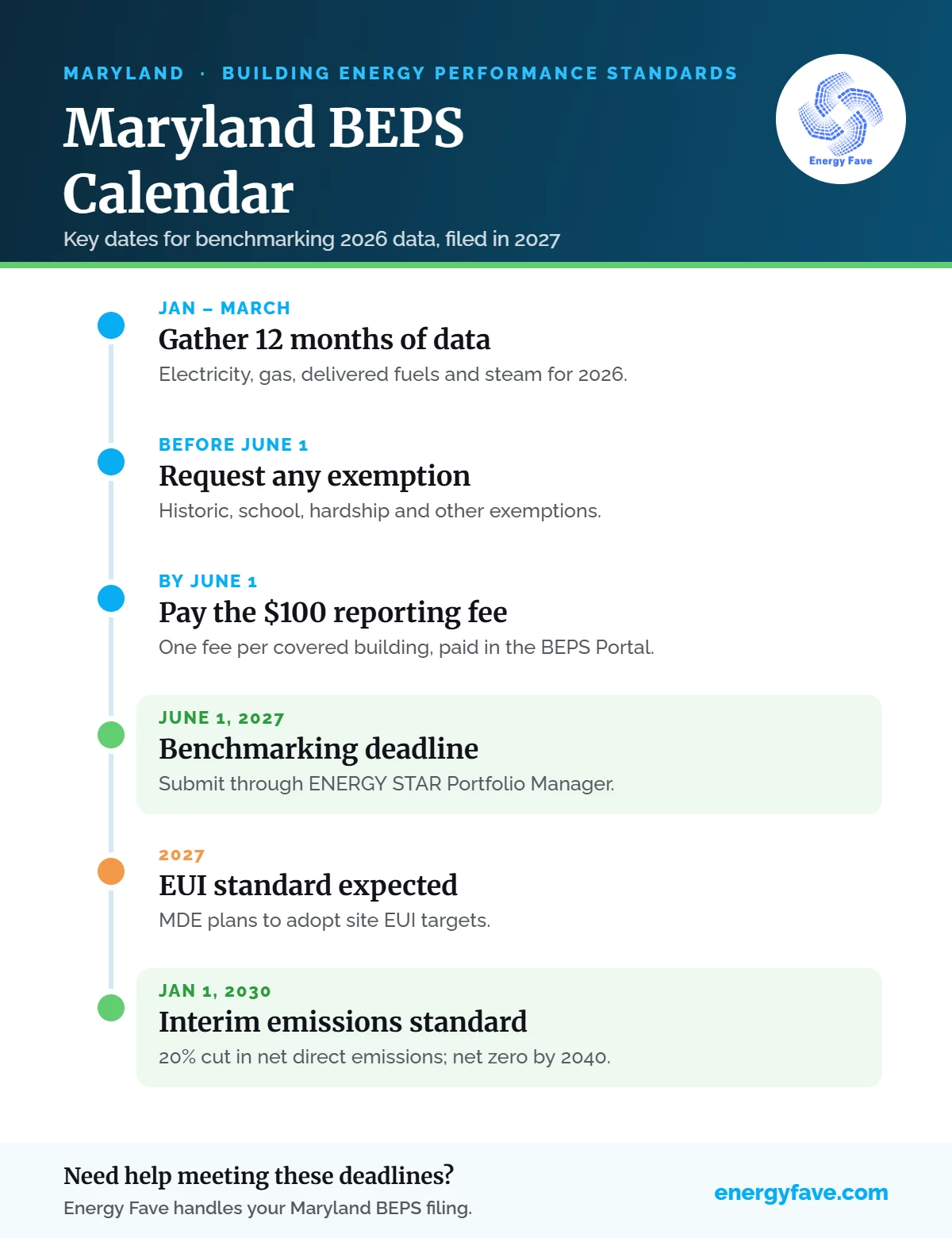
Maryland benchmarking reports are due June 1 every year and cover the previous calendar year. The $100 reporting fee is also due by June 1.
Next deadlineJune 1, 2027 for calendar-year 2026 data
Third-party verification was first required in 2026 and repeats every five years, so the next verification year is 2031.
Maryland BEPS timeline
Maryland BEPS phases in over several years:
| Milestone | What is required | When |
|---|---|---|
| BenchmarkingEvery year | Report 12 months of energy data | June 1 each year (since 2025) |
| VerificationEvery 5 years | Third-party verified benchmarking data | 2026, then 2031 |
| EUI standardPlanned | MDE expects to adopt site EUI targets | 2027 |
| Interim emissions standard | 20% cut in net direct emissions | January 1, 2030 |
| Final standard | Net zero direct emissions | January 1, 2040 |
Good to know: Maryland BEPS covers energy only. Water and waste data are not required, so you can ignore Portfolio Manager alerts about missing water meters.
What utilities are required for benchmarking reporting?
- Electricity
- Natural Gas
- District Energy
- Delivered fuels (oil, propane)
- On-site solar
What is the purpose of Maryland BEPS?
Buildings are one of Maryland’s largest sources of greenhouse gas emissions, so the State uses BEPS to measure and cut them. The standards serve two main goals:
Reach net zero building emissions by 2040. Annual benchmarking sets the baseline, and emissions standards push buildings to electrify and become more efficient.
Give owners reliable data. Benchmarking shows where buildings waste energy. Many owners also pursue ENERGY STAR certification.
To see how other states and cities handle benchmarking, visit our energy benchmarking compliance guide.
Need a verifier? Our Professional Engineers and Certified Energy Managers provide third-party verification services.
Maryland BEPS FAQs
Does Maryland BEPS apply to buildings in Montgomery County?
No. Montgomery County runs its own benchmarking and BEPS program, and County buildings comply with that program instead of the statewide one.
Is there a fee to report under Maryland BEPS?
Yes. Owners pay a $100 annual reporting fee per covered building through the BEPS Portal by June 1.
When do I need third-party verification?
Verification was first required in 2026 and repeats every five years, so the next verification year is 2031.
Do I need to report water use?
No. Maryland BEPS covers energy use and direct greenhouse gas emissions only.
Can Energy Fave handle my Maryland BEPS reporting?
Yes. Energy Fave can collect your utility data, submit your Portfolio Manager report, coordinate verification and help you plan for the 2030 standard.
Interested in benchmarking help?
Maryland BEPS at a Glance
- Who's covered
- Buildings 35,000+ sq ft
- Next deadline
- June 1, 2027The 2026 report was due June 1, 2026. Not filed yet? We can file it now →
- Reporting fee
- $100 per building per year
- Verification
- Every 5 years (next 2031)
- Emissions standard
- From 2030; net zero 2040