
Portland, Maine Energy Benchmarking Ordinance
What is Portland, Maine's energy benchmarking ordinance?
Portland benchmarking is required by the City’s Energy Benchmarking Ordinance (City Code Chapter 6, Article X), adopted November 7, 2016 and amended in 2018 and 2019.
Portland requires owners of covered buildings to benchmark energy and water use in ENERGY STAR Portfolio Manager and share it with the City by May 1 each year for the prior calendar year. Today this applies to City buildings of 5,000+ sq ft and single-tenant non-residential buildings over 20,000 sq ft. Multi-tenant non-residential buildings over 20,000 sq ft and residential buildings with 50+ units phase in one year after the City certifies that utilities provide whole-building data.
Owners use ENERGY STAR Portfolio Manager to benchmark their energy use. Not sure if your building is covered? Check it in our compliance finder.

What buildings must comply in Portland?
- Single-tenant non-residential properties over 20,000 sq ft (one tenant uses 90%+ of floor area): reporting since May 1, 2020
- City-owned buildings of 5,000 gross sq ft or more: reporting since May 1, 2019
- Multi-tenant non-residential properties over 20,000 sq ft: due one year after the City certifies utility whole-building data is available
- Residential properties with 50 or more units (rental or condo): due one year after the same certification
Exemptions:
- Buildings without 12 months of data due to new construction or significant renovation (comply May 1 of the following year)
- Owners who cannot obtain tenant authorization for utility data despite a good-faith effort
- Disclosure that would reveal trade secret information
- Single-family and two-family homes, and standalone buildings with ten or fewer units
What is the penalty for non-compliance?
- First violation: may receive a written warning
- Later or continuing violations: fine of up to $20 per day under Chapter 1, Section 1-15
- Misrepresentation: it is unlawful to misrepresent any material fact in a required document
- Tenants: tenants who fail to provide required information within 30 days may also face penalties
What is the compliance process?
A typical filing looks like this:
- Create an ENERGY STAR Portfolio Manager account and set up the property (UBID, year built, gross floor area)
- Gather monthly energy and water data from Central Maine Power, Unitil, Portland Water District and any delivered fuels
- Enter data covering every day of the year and run the Data Quality Checker
- Share the property with the City of Portland with read-only access (one-time setup)
- Keep bills and records for three years; the City pulls the data by May 1
Verification: no third-party verification is required. The City reviews the data it pulls from Portfolio Manager and may audit owner records.
What is the deadline for Portland, Maine benchmarking?
Portland benchmarking data is due May 1 every year and covers the previous calendar year.
Next deadlineMay 1, 2027 for calendar-year 2026 data
May 1, 2027 for calendar-year 2026 data. The City's 2023 report expected multi-tenant reporting to begin around 2026; confirm your building's status with the Sustainability Office (benchmarking@portlandmaine.gov).
Portland key dates and requirements
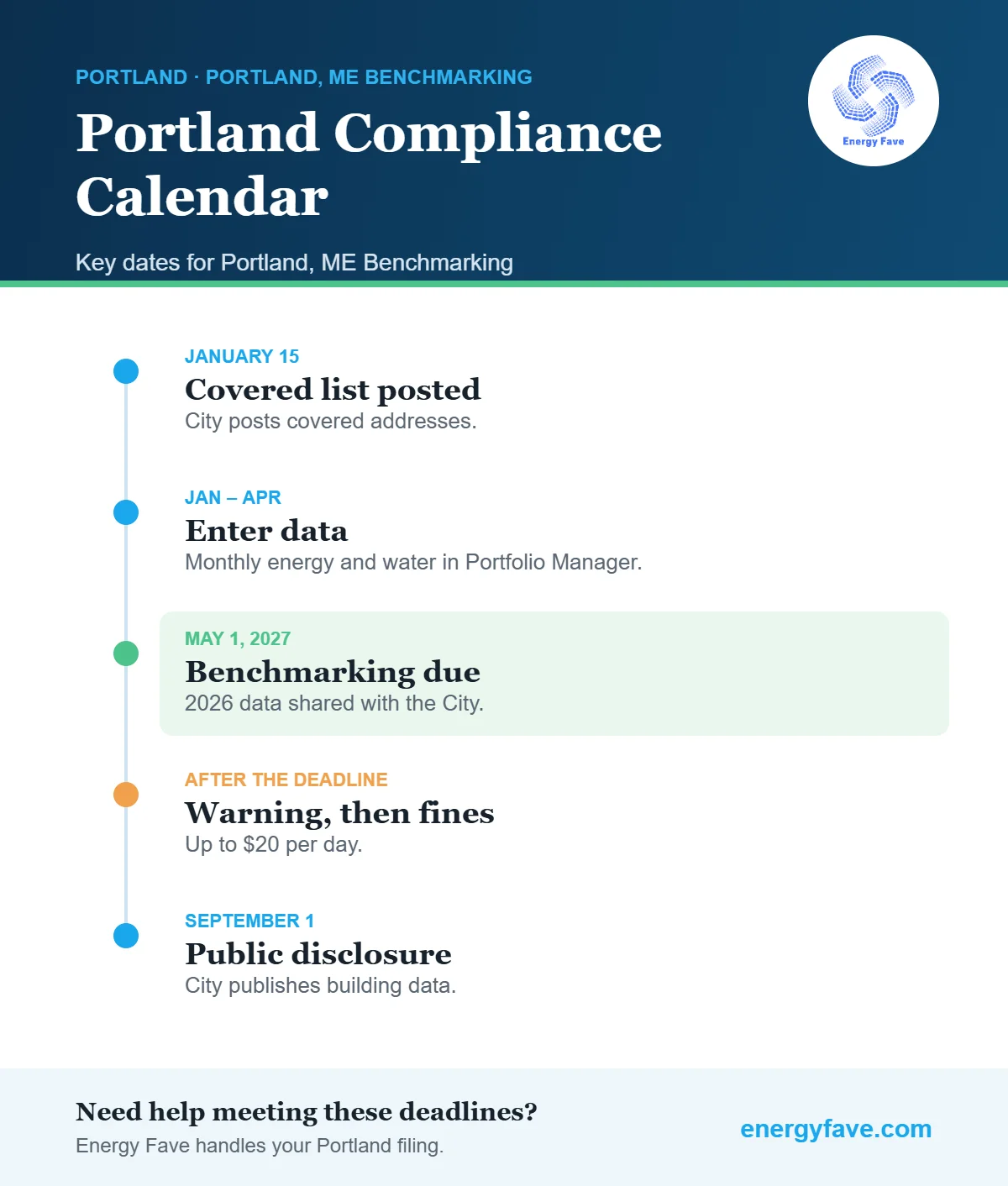
| When | What | Details |
|---|---|---|
| Sept 1 – Dec 1 | City notices | City notifies covered owners of their benchmarking obligations. |
| January 15 | Covered list posted | City posts covered property addresses online. |
| January–April | Enter data | Enter prior-year monthly energy and water data in Portfolio Manager. |
| May 1 | Benchmarking due | Prior-year data must be complete and shared with the City. |
| September 1 | Public disclosure | City publishes building data. |
What utilities are required for benchmarking reporting?
- Electricity
- Natural Gas
- Water
- Propane, kerosene and heating oil
What is the purpose of Portland's ordinance?
The ordinance aims to encourage efficient use of energy and water and to reduce greenhouse gas emissions. It lets the City collect usage data to inform city planning and the real estate market.
Frequently asked questions
Which Portland, Maine buildings must benchmark now?
City buildings of 5,000+ sq ft and single-tenant non-residential buildings over 20,000 sq ft, where one tenant uses at least 90% of the space.
When do multi-tenant and large residential buildings have to report?
One year after the City certifies that utilities provide whole-building data. Check with the Sustainability Office for the current status.
When is the deadline?
May 1 each year for the previous calendar year. The next deadline is May 1, 2027 for 2026 data.
What is the penalty?
A first violation may get a written warning. Later or continuing violations can be fined up to $20 per day.
How do I submit?
Share your property in ENERGY STAR Portfolio Manager with the City (read-only). The City pulls the data directly.
Can I get an exemption?
Yes, for missing data due to new construction or major renovation, inability to get tenant data after a good-faith effort, or trade secrets.
Can Energy Fave help with Portland compliance?
Yes. Energy Fave sets up Portfolio Manager, collects utility data, checks data quality and files your Portland report on time.
Official sources:
Interested in benchmarking help?
Portland, ME at a Glance
- Who's covered
- Single-tenant non-residential 20,000+ sq ft
- Next deadline
- May 1, 2027The 2026 report was due May 1, 2026. Not filed yet? We can assist with your compliance submission →
- Late penalty
- Warning, then up to $20 per day
- Coming next
- Multi-tenant and 50+ unit residential
- Reporting tool
- ENERGY STAR Portfolio Manager