
West Hollywood Equitable Building Performance Standards (EBPS)
What is West Hollywood's Building Performance Program?
West Hollywood benchmarking is required by the Equitable Building Performance Standards. Ordinance No. 25-20, adopted by the West Hollywood City Council on December 1, 2025; adds Chapter 15.100 and Section 9.25.020 to the West Hollywood Municipal Code. Effective 30 days after adoption.
West Hollywood's EBPS requires owners of existing buildings of 20,000 square feet or more to benchmark energy use every year in ENERGY STAR Portfolio Manager and submit it to the City, with third-party data verification in set years. Starting in 2028, most covered buildings must also meet energy use or greenhouse gas intensity targets that tighten in 2032 and 2036. Residential condominiums benchmark and verify but are exempt from the performance targets.
Owners use ENERGY STAR Portfolio Manager to benchmark their energy use. Not sure if your building is covered? Check it in our compliance finder.
What buildings must comply in West Hollywood?
- Existing buildings with 20,000 sq ft or more of gross floor area that have a certificate of occupancy
- Commercial, multifamily (5+ units) and mixed-use buildings at or above the threshold
- City-owned buildings at or above the threshold
- New buildings, starting the first full calendar year after the certificate of occupancy is issued
- Residential condominiums 20,000+ sq ft (benchmarking, verification and sale disclosure only; exempt from performance standards)
Exemptions:
- Buildings under 20,000 sq ft
- One- and two-family dwellings and their accessory structures
- Multifamily properties with four or fewer units
- Broadcast antennas and utility pumping stations
- Buildings with a full demolition permit issued and demolition begun before the next interim performance deadline
- Buildings owned by public entities other than the City
- Other buildings the Department Director determines do not meet the chapter's purpose
- Performance-standard exemptions or adjustments (benchmarking still required): residential condominiums, financial hardship, no certificate of occupancy for more than half the baseline year, fully vacant for more than half the year, and cultural resources (historic) adjustments; applications due at least 180 days before the relevant performance deadline
What is the penalty for non-compliance?
- Notice first: no penalty until 30 days after the owner receives a notice of violation; correcting the violation within 30 days avoids the penalty
- Failure to benchmark or meet annual reporting: citation and fine up to $1,000 per instance (plus a $75 admin fee per the City FAQ)
- Incomplete report or missing required verification: up to $1,000 plus a $75 admin fee (City FAQ)
- Inaccurate report: or more than 50% discrepancy between verified and self-reported data, a $1,000 fine
- Missed performance standard without an approved action plan: fine equal to the Social Cost of Carbon per unachieved metric ton CO2e, set by Fee Resolution ($190 per metric ton CO2e for 2026 per the City FAQ, plus $75 admin fee), paid annually until compliance
- No report, no standard and no action plan: penalty up to $10 per sq ft of gross floor area, paid annually until compliance or an approved action plan
What is the compliance process?
A typical filing looks like this:
- Confirm the building is on the City's Covered Buildings List and note its West Hollywood Building ID
- Create or use an ENERGY STAR Portfolio Manager property, add the Building ID as a Standard ID, and enter 12 months of whole-building energy data (request aggregated data from SCE and SoCalGas)
- Run the Portfolio Manager Data Quality Checker and fix errors
- Register on the West Hollywood Building Performance Platform, claim the building, and connect/share the Portfolio Manager property with the City
- In required years, have a qualified Energy Professional verify the data, then submit through the Platform under My Buildings > Submit
Verification: A qualified Energy Professional (e.g., PE, RA, CEM, BEAP, EMP or other Department-recognized credential) must verify benchmarking data, submitted through the City platform with the benchmarking report. Per the City FAQ, verification is required in 2026 and again in 2028, 2032 and 2036, not in other years. New buildings verify by May 15 of their first full calendar year after the certificate of occupancy. Energy Fave provides third-party data verification.
What is the deadline for West Hollywood benchmarking?
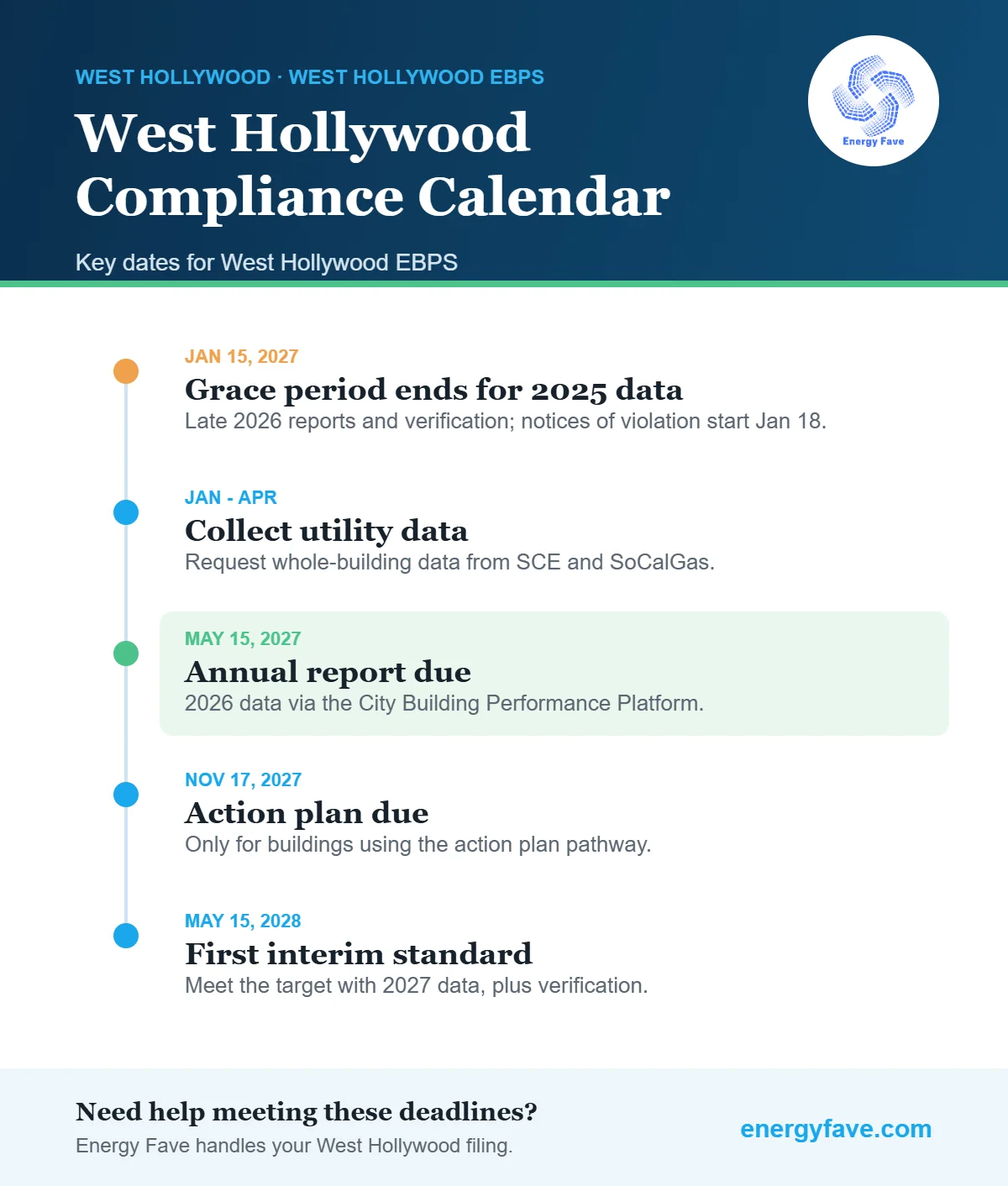
May 15 every year (first-year 2026 deadline was September 15, 2026)
Next deadlineMay 15, 2027 for calendar-year 2026 data
May 15, 2027 for calendar-year 2026 data.
2026 enforcement update: the first-year report and third-party verification were due September 15, 2026. The City is giving late filers a one-time grace period to January 15, 2027 and intends to issue notices of violation from January 18, 2027. This is an enforcement deferral, not an extension.
West Hollywood performance standards and key dates
Performance standards: Goal: at least 80% aggregate GHG reduction from covered properties by 2035. Targets use site EUI and/or GHG emissions intensity by property type (pro rata for mixed use); numeric values are set in the Administrative Guidelines. First Interim Standard due May 15, 2028 (2027 data); Second Interim due May 15, 2032 (2031 data); Final due May 15, 2036 (2035 data), maintained thereafter. Two pathways: Building Performance Pathway (meet the target) or, for interim standards only, a Building Performance Action Plan (BPAP) due November 17, 2027 (first interim) and November 17, 2031 (second interim). A BPAP includes retrofit measures and timelines, a cost-benefit analysis, an ASHRAE Level II audit or retrocommissioning report, and a distributed energy resources opportunity report. The final standard cannot be met with a BPAP.
| When | What | Details |
|---|---|---|
| Jan-Mar | Collect utility data | Request prior-year whole-building data from SCE and SoCalGas and gather tenant data. |
| Mar-Apr | Update Portfolio Manager | Enter 12 months of data and run the Data Quality Checker. |
| Verification years | Third-party verification | Required in 2026, 2028, 2032 and 2036 by a qualified Energy Professional. |
| May 15 | Annual report due | Submit via the West Hollywood Building Performance Platform. |
| Nov 17 (2027, 2031) | Action plan due | BPAP submissions for buildings using the action plan pathway for interim targets. |
What utilities are required for benchmarking reporting?
- Electricity
- Natural Gas
- Any other fuel used in the building
In West Hollywood, whole-building data comes from Southern California Edison and SoCalGas.
What is the purpose of West Hollywood's program?
The City states that EBPS aims to reduce climate pollution from buildings, lower long-term energy costs, and improve indoor comfort and health, while offering flexible compliance pathways and prioritizing support for under-resourced buildings and tenants. The ordinance targets at least an 80% aggregate reduction in greenhouse gas emissions from covered properties by 2035, supporting the City's carbon neutrality goal.
Frequently asked questions
Which buildings must comply with West Hollywood EBPS?
Existing buildings with 20,000 sq ft or more of gross floor area, excluding one- and two-family homes, multifamily properties with four or fewer units, and certain other exemptions. The City publishes a Covered Buildings List.
When is the benchmarking report due?
May 15 each year for the prior calendar year's data. The first report, for 2025 data, was due September 15, 2026, with a one-time enforcement grace period to January 15, 2027.
Do condominiums have to comply?
Residential condominiums of 20,000+ sq ft must benchmark, verify data and make sale disclosures, but are exempt from the performance targets.
How often is third-party verification required?
According to the City FAQ, a qualified Energy Professional must verify data in 2026, 2028, 2032 and 2036. Verification is not required in other years.
When do performance targets start?
The first interim target is due May 15, 2028 based on 2027 data, followed by a second interim target in 2032 and a final target in 2036. Owners who cannot meet an interim target can submit a Building Performance Action Plan by November 17, 2027 (or November 17, 2031).
What are the penalties?
Missed reporting can bring fines up to $1,000 per instance. Missing a performance target without an approved action plan brings fines based on the Social Cost of Carbon ($190 per metric ton CO2e for 2026), and the ordinance allows penalties up to $10 per sq ft annually.
Can Energy Fave help with West Hollywood compliance?
Yes. Energy Fave sets up Portfolio Manager, collects utility data, checks data quality, provides third-party verification and files your West Hollywood report on time.
Official sources:
Interested in benchmarking help?
West Hollywood EBPS at a Glance
- Who's covered
- Buildings 20,000+ sq ft
- Next deadline
- May 15, 2027The 2026 report was due Sept 15, 2026. Not filed yet? We can assist with your compliance submission →
- Late penalty
- Up to $1,000 per violation
- Verification
- 2026, 2028, 2032, 2036
- Performance targets
- From 2028