
Milwaukee Efficient Buildings Benchmarking Ordinance
What is Milwaukee's benchmarking ordinance?
Milwaukee benchmarking is required by the Milwaukee Efficient Buildings Benchmarking Program, created by an ordinance the Common Council passed 14–0 in July 2024. It requires owners of large buildings of 50,000 square feet or more to benchmark their energy use every year and share it with the City’s Environmental Collaboration Office (ECO).
City and Milwaukee Public Schools buildings began reporting in 2025, and private buildings followed. The City set September 30 as the reporting date for the 2025 and 2026 cycles.

What buildings must comply in Milwaukee?
- Commercial buildings of 50,000 sq ft or more
- Large residential buildings of 50,000 sq ft or more, under the ordinance
- City of Milwaukee and Milwaukee Public Schools buildings of 10,000 sq ft or more
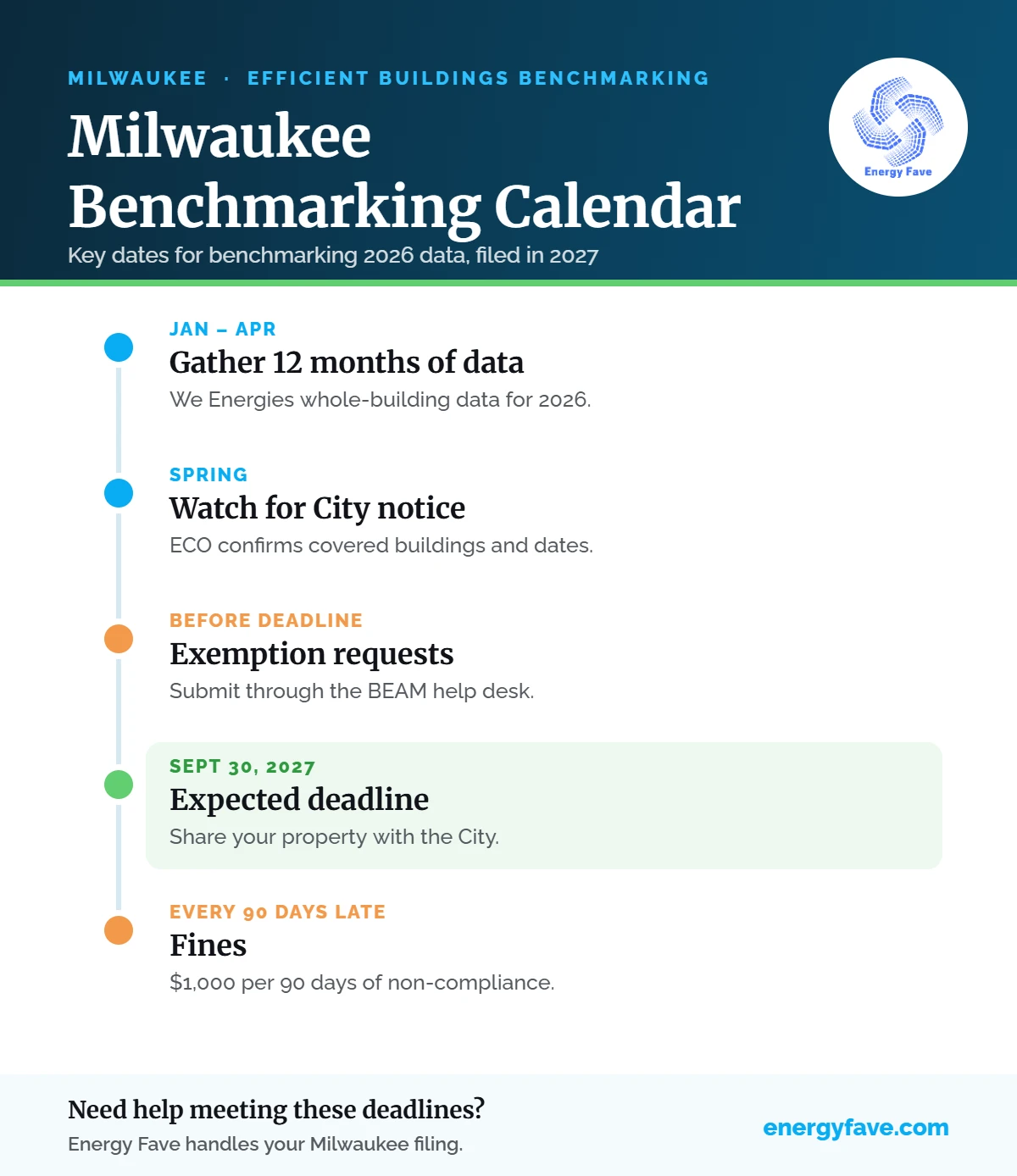
Covered buildings make up about two-thirds of the city’s building floor area. Check the City’s Covered Buildings List to confirm your status. Buildings that are at least 50% vacant may be exempt, as may buildings with fewer than four tenants that cannot get master-meter data. Exemption requests go through the City’s BEAM help desk.
What is the penalty for non-compliance?
- Late or missing reports: fines of $1,000 for every 90 days a building is out of compliance.
- Falsified data: knowingly reporting false information brings additional fines.
- Public data: benchmarking results are intended to be made public.
What is the compliance process?
Milwaukee owners report through ENERGY STAR Portfolio Manager. A typical filing looks like this:
- First, find your Milwaukee Benchmarking Building ID on the Covered Buildings List and add it in Portfolio Manager under Unique Identifiers.
- Next, get whole-building data from We Energies. Buildings with four or more tenants can use the We Energies Landlord-Tenant Portal for aggregated data.
- Then enter 12 full months of energy data for the previous calendar year and run the Data Quality Checker.
- Connect to the “City-of-Milwaukee” account in Portfolio Manager and share your property.
- Finally, submit your report by the City’s deadline and keep your confirmation.
First-time benchmarkers may qualify for Focus on Energy incentives of up to $200 per month for six months.
What is the deadline for Milwaukee benchmarking?
Milwaukee’s ordinance requires annual reporting. For the last two cycles, the City set the deadline at September 30.
Expected next deadlineSeptember 30, 2027 for calendar-year 2026 data
Confirm the exact date in the City’s annual compliance notice, as ECO sets each year’s schedule.
Milwaukee benchmarking timeline
Here is how Milwaukee’s reporting schedule has worked so far:
| Reporting year | Data year | Deadline |
|---|---|---|
| 2025 | 2024 | September 30, 2025 |
| 2026 | 2025 | September 30, 2026 |
| 2027 | 2026 | Expected September 30, 2027 |
Need help? The City runs a free help desk through its BEAM platform, with a knowledge base and an optional Building Owner Portal.
What utilities are required for benchmarking reporting?
- Electricity
- Natural Gas
- District Steam
- District Chilled Water
- Any other purchased fuel
Water reporting is not required under the Milwaukee ordinance.
What is the purpose of Milwaukee's ordinance?
Buildings are one of the largest sources of greenhouse gas emissions in Milwaukee. The ordinance supports the City’s Climate and Equity Plan, which aims to cut community-wide emissions 45% by 2030 and reach net zero by 2050, in two main ways:
Help owners save energy. Benchmarking shows how a building compares with similar buildings and where savings are possible.
Build better data. Citywide data helps target incentives and track progress. Efficient buildings can also earn ENERGY STAR certification.
See our Madison guide for Wisconsin’s other benchmarking city, or our full energy benchmarking compliance guide.
Frequently asked questions
When is the Milwaukee benchmarking deadline?
The City set September 30 for the 2025 and 2026 cycles. 2026 data is expected to be due September 30, 2027. Watch for the City’s compliance notice.
What size buildings are covered?
Private buildings of 50,000 sq ft or more, plus City and Milwaukee Public Schools buildings of 10,000 sq ft or more.
How much are the fines?
$1,000 for every 90 days of non-compliance, with additional fines for falsified data.
Is water data required?
No. Milwaukee requires energy data only.
Can Energy Fave file my Milwaukee report?
Yes. Energy Fave can request We Energies data, set up Portfolio Manager and submit your Milwaukee report on time.
Interested in benchmarking help?
Milwaukee at a Glance
- Who's covered
- Buildings 50,000+ sq ft
- Expected deadline
- Sept 30, 2027The 2026 report was due Sept 30, 2026. Not filed yet? We can file it now →
- Late penalty
- $1,000 per 90 days
- Water
- Not required
- Reporting tool
- Portfolio Manager + Milwaukee ID