
San Francisco Existing Buildings Energy Ordinance
What is San Francisco's Existing Buildings Energy Ordinance?
San Francisco’s Existing Buildings Energy Performance Ordinance (Environment Code Chapter 20) requires owners of larger buildings to benchmark their energy use every year and report it to the San Francisco Environment Department (SFE).
The ordinance has three parts:
- Annual benchmarking: covered buildings report energy use in ENERGY STAR Portfolio Manager by May 1.
- Energy audits: non-residential buildings complete an energy audit every five years.
- 100% renewable electricity: commercial buildings of 50,000 sq ft or more must switch to renewable power on a phased schedule ending December 31, 2030.
SFE publishes the results on DataSF, so buyers, tenants and lenders can compare buildings.

What buildings must comply with San Francisco's ordinance?
Coverage is based on conditioned (heated or cooled) floor area:
- Non-residential buildings: 10,000 sq ft or more
- Multifamily residential buildings: 50,000 sq ft or more
Your building may be exempt from reporting if:
- it received its Certificate of Occupancy within two years of the benchmarking deadline, or
- it has fewer than one full-time occupant.
What is the penalty for non-compliance?
SFE can fine owners who miss the benchmarking or audit requirements. Fines are charged per day and capped at 25 days a year:
- Buildings 50,000 sq ft or larger: $100 per day, up to $2,500 a year.
- Buildings under 50,000 sq ft: $50 per day, up to $1,250 a year.
- Missed energy audit: daily fines also apply until the audit report is filed.
What is the compliance process?
San Francisco owners report through ENERGY STAR Portfolio Manager, the EPA’s free benchmarking tool. A typical filing looks like this:
- First, confirm your building is covered and find its Assessor Parcel Number (APN), which identifies your property in the City’s records.
- Next, set up or update the property in Portfolio Manager with accurate floor area and use details.
- Then enter 12 months of whole-building energy data for the previous calendar year. Where tenants are separately metered, request aggregated data from PG&E or the SFPUC.
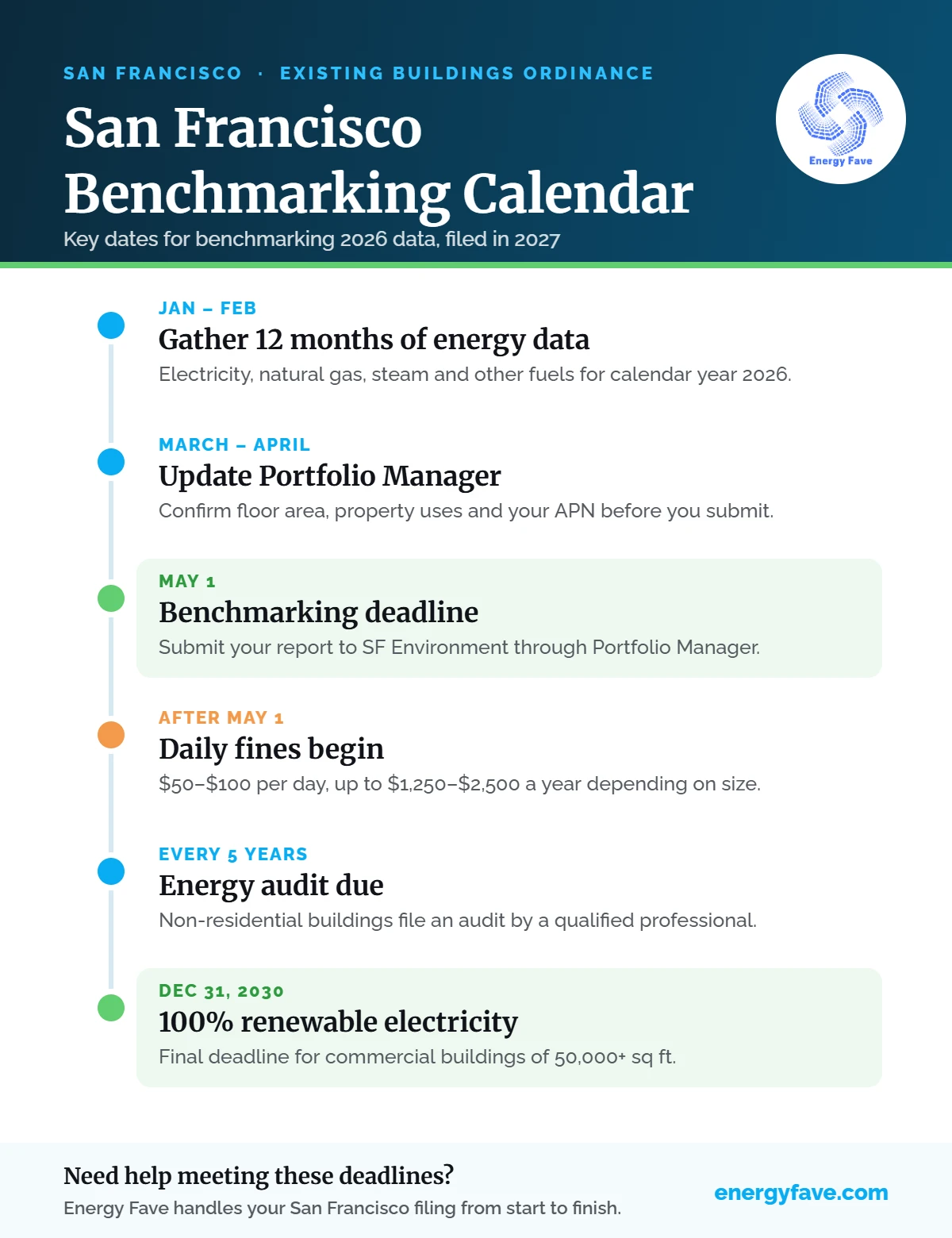
- Submit the report to SFE through the City’s benchmarking data request by May 1.
- Finally, for non-residential buildings, file an energy audit by a qualified professional every five years.
What is the deadline for San Francisco energy benchmarking?
San Francisco benchmarking reports are due May 1 every year and cover the previous calendar year’s energy use.
Next deadlineMay 1, 2027 for calendar-year 2026 data
Energy audits follow a separate five-year cycle, and the final renewable electricity deadline for commercial buildings of 50,000 sq ft or more is December 31, 2030. We recommend starting your data collection in February so there is time to resolve utility data gaps.
San Francisco requirements at a glance: benchmarking, audits and renewable power
San Francisco combines three requirements under its existing buildings rules. Here is who each one applies to and when it is due:
| Requirement | Who must comply | Deadline |
|---|---|---|
| Annual benchmarkingEvery year | Non-residential 10,000+ sq ft; multifamily 50,000+ sq ft | May 1 each year |
| Energy auditEvery 5 years | Non-residential 10,000+ sq ft | Once every five years |
| 100% renewable electricityPhase 1–2 | Commercial buildings 250,000+ sq ft | Dec 31, 2022 (500,000+ sq ft) and Dec 31, 2024 (250,000+ sq ft) |
| 100% renewable electricityPhase 3 | Commercial buildings 50,000+ sq ft | Dec 31, 2030; documentation due April 2031 |
How to meet the renewable requirement: owners can enroll in CleanPowerSF SuperGreen, buy SFPUC Hetch Hetchy Power, join PG&E Solar Choice, use a Direct Access provider, or install on-site solar.
What utilities are required for benchmarking reporting?
- Electricity
- Natural Gas
- District Energy
- Any other purchased fuel
What is the purpose of San Francisco's Existing Buildings Ordinance?
Buildings are one of San Francisco’s largest sources of greenhouse gas emissions, so the City uses this ordinance to measure and improve how they perform. It serves two main goals:
Cut energy use and emissions. Annual benchmarking and regular audits show owners where they waste energy, and the renewable electricity requirement moves large buildings to clean power.
Make performance transparent. Because SFE publishes the data, tenants and buyers can compare buildings, and owners have a clear reason to improve. Many owners then go further and pursue ENERGY STAR certification.
To see how other cities handle benchmarking, visit our energy benchmarking compliance guide.
This program includes an energy audit, assessment or tune-up requirement. Compare it with other cities in our energy audit compliance guide.
San Francisco benchmarking FAQs
Do multifamily buildings need an energy audit in San Francisco?
No. Multifamily buildings of 50,000 sq ft or more must benchmark every year, but the five-year energy audit applies to non-residential buildings.
Is San Francisco benchmarking data public?
Yes. SFE publishes building energy data on DataSF, so tenants, buyers and lenders can compare how buildings perform.
What is an APN and why do I need it?
The Assessor Parcel Number identifies your property in City records. You enter it in Portfolio Manager so SFE can match your report to your building.
Do I also have to report to the State of California?
Generally no. California’s statewide benchmarking program (AB 802) exempts buildings that already report under a qualifying local ordinance such as San Francisco’s. Check with the California Energy Commission if you are unsure.
Can Energy Fave file my San Francisco report?
Yes. The owner is responsible for compliance, but a benchmarking provider such as Energy Fave can collect the utility data and submit the report on your behalf.
Interested in benchmarking help?
SF Benchmarking at a Glance
- Who's covered
- Non-residential 10,000+ sq ft; multifamily 50,000+ sq ft
- Next deadline
- May 1, 2027The 2026 report was due May 1, 2026. Not filed yet? We can file it now →
- Late penalty
- $50–$100 per day, up to $2,500 a year
- Energy audit
- Every 5 years (non-residential)
- Reporting tool
- ENERGY STAR Portfolio Manager