
Cambridge Building Energy Use Disclosure Ordinance (BEUDO)
What is Cambridge's Building Energy Use Disclosure Ordinance?
Cambridge’s Building Energy Use Disclosure Ordinance (BEUDO) requires owners of large properties to benchmark their energy and water use every year and report it to the City’s Office of Sustainability.
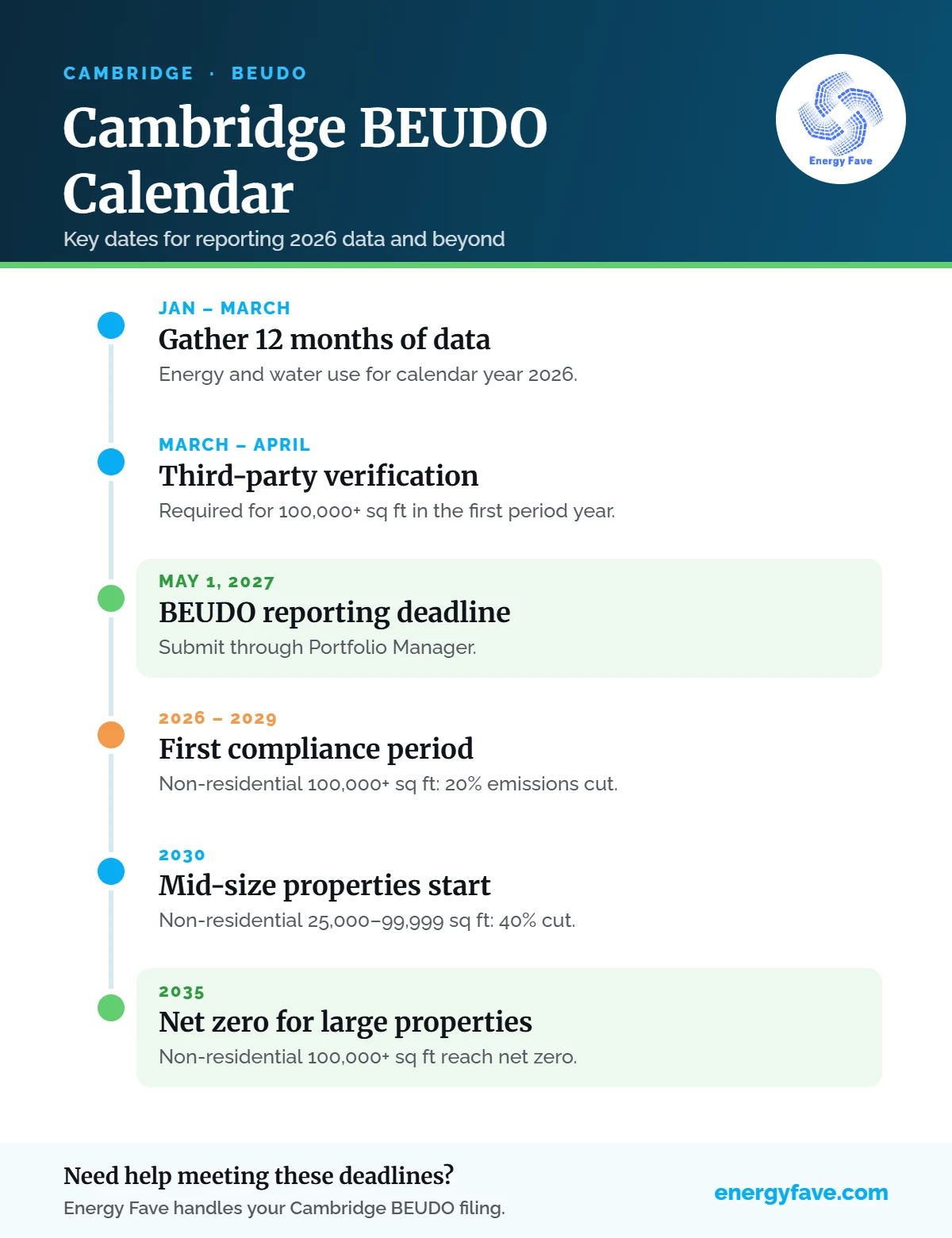
Since the 2023 amendments, BEUDO also requires large non-residential properties to cut greenhouse gas emissions. Properties of 100,000+ sq ft entered their first compliance period in 2026 and must reach net zero by 2035; properties of 25,000–99,999 sq ft follow from 2030 and reach net zero by 2050.
What buildings must comply with Cambridge BEUDO?
- Commercial building(s) where such building(s) singly or together contain 25,000 or more Covered Square Feet.
- Residential building(s) that singly or together contain 50 or more residential Dwelling Units.
- Municipal buildings over 25,000 square feet
Your building may qualify for an exemption from reporting if:
- Building Under Construction or Renovation: The building was under construction or renovation during the reporting year and did not have a valid Certificate of Occupancy.
- Building Demolition: The building is scheduled for demolition and a permit has been issued.
- Multifamily Housing – No Electricity Data Aggregation: For multifamily buildings only: Electricity data cannot be aggregated from individual units, and there is no master meter for the entire building.
- Commercial Building – Limited Control Over Electricity: For commercial buildings only: Electricity data cannot be aggregated, there is no master meter, and the building owner does not control or maintain the electrical equipment.
- Financial Hardship:
- No Utility Services: The building has no active utility services (electricity, gas, etc.) during the reporting year.
Does BEUDO require emissions reductions?
Yes. BEUDO measures emissions against a baseline (by default, the average of 2018 and 2019) and sets reductions in five-year compliance periods:
- Non-residential 100,000+ sq ft: 20% reduction in 2026–2029, 40% in 2030–2034, and net zero from 2035.
- Non-residential 25,000–99,999 sq ft: stay below baseline until 2030, then 40% by 2030, 60% by 2035, 80% by 2040, 90% by 2045, and net zero from 2050.
- Residential properties with 50+ units: report only, with no reduction requirement.
Non-residential properties must have their data verified by a third party for the baseline years and the first year of each compliance period.
What is the penalty for non-compliance?
- Missed reporting: a written warning, followed by fines of up to $300 per day.
- Missed emissions targets: owners must make up the gap through reductions or other approved compliance options.
- Inaccurate data: third-party verification years catch errors that could affect your baseline.
What is the compliance process?
Cambridge owners report through ENERGY STAR Portfolio Manager. A typical filing looks like this:
- First, confirm your covered property (a parcel may include several buildings) and its BEUDO ID.
- Next, enter 12 months of whole-building energy and water data. Request aggregated data from Eversource and your gas supplier where tenants are separately metered.
- Then confirm your baseline years and compliance period.
- In verification years, have a third party verify your emissions and water data.
- Finally, submit your report to the City through Portfolio Manager by May 1.
What is the deadline for Cambridge BEUDO?
BEUDO reports are due May 1 every year and cover the previous calendar year.
Next deadlineMay 1, 2027 for calendar-year 2026 data
For properties of 100,000+ sq ft, 2026 is the first year of the first compliance period, so the 2027 report is a verification year.
BEUDO emissions targets by property type
Here is how BEUDO emissions requirements phase in:
| Property type | First requirement | Net zero |
|---|---|---|
| Non-residential 100,000+ sq ft | 20% cut in 2026–2029 | 2035 |
| Non-residential 25,000–99,999 sq ft | Stay below baseline, then 40% by 2030 | 2050 |
| Residential 50+ units | Annual reporting only | Not required |
What utilities are required for benchmarking reporting?
- Water
- Electricity
- Natural Gas
- District Energy
- Any other purchased fuel
What is the purpose of Cambridge BEUDO?
Buildings produce most of Cambridge’s greenhouse gas emissions, so the City uses BEUDO to measure and cut them. The ordinance serves two main goals:
Reach net zero buildings. Emissions limits push large properties to net zero by 2035 or 2050.
Make performance transparent. Public data helps buyers and tenants compare buildings. Many owners also pursue ENERGY STAR certification.
Boston owners should see our BERDO 2.0 guide, or visit our energy benchmarking compliance guide.
Need a verifier? Our Professional Engineers and Certified Energy Managers provide third-party verification services.
Cambridge BEUDO FAQs
When do BEUDO emissions requirements start?
For non-residential properties of 100,000+ sq ft, the first compliance period began in 2026. Properties of 25,000–99,999 sq ft face their first reduction in 2030.
Do residential buildings have to cut emissions?
No. Residential properties with 50 or more units must report every year, but they have no reduction requirement.
What is my BEUDO baseline?
By default, the average of 2018 and 2019 emissions. Buildings built or renovated after 2018 use their first two years after receiving a Certificate of Occupancy.
When is third-party verification required?
For non-residential properties, in the baseline years and the first year of each compliance period.
Can Energy Fave help with BEUDO?
Yes. Energy Fave can submit your report, confirm your baseline and coordinate third-party verification.
Interested in benchmarking help?
Cambridge BEUDO at a Glance
- Who's covered
- Non-residential 25,000+ sq ft; residential 50+ units
- Next deadline
- May 1, 2027The 2026 report was due May 1, 2026. Not filed yet? We can file it now →
- Late penalty
- Up to $300 per day
- Emissions
- 20% cut for 100,000+ sq ft from 2026
- Net zero
- 2035 or 2050, by size