
Berkeley Building Emissions Saving Ordinance (BESO)
What is Berkeley's Building Emissions Saving Ordinance?
Berkeley’s Building Emissions Saving Ordinance (BESO), adopted in 2015, requires building owners to benchmark their energy use, complete energy assessments and publicly report the results, so buyers, tenants and the City understand how buildings perform.
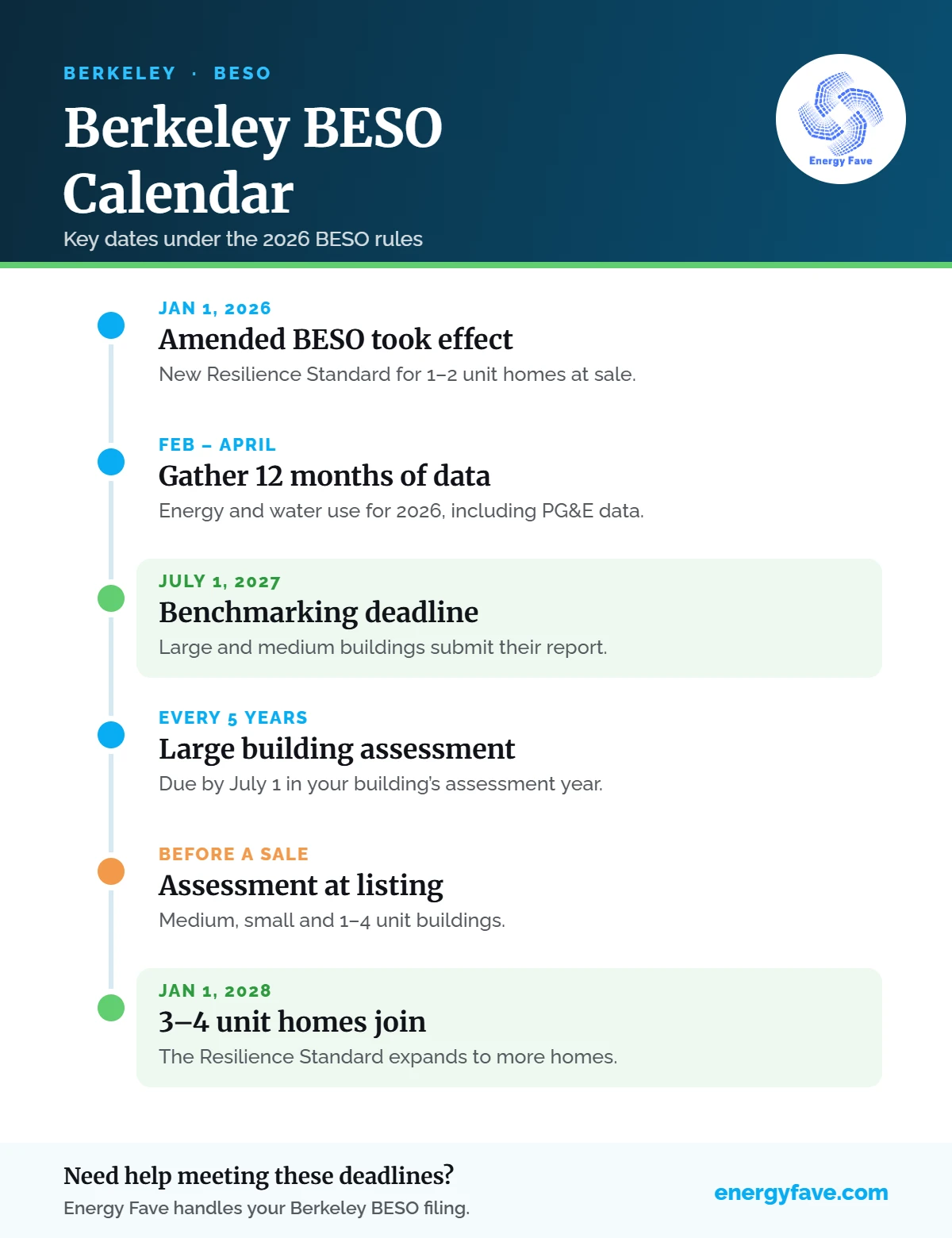
Berkeley amended BESO in 2025 (Ordinance 7,953-N.S.), and the new rules took effect on January 1, 2026. Large buildings still benchmark every year and assess every five years, while homes of one to four units must now meet a Resilience Standard when they are sold.

What buildings must comply with Berkeley BESO?
- Large buildings (25,000+ sq ft): annual ENERGY STAR benchmarking report, plus an energy assessment every five years
- Medium buildings (15,000–24,999 sq ft): annual benchmarking report, plus an energy assessment before listing for sale
- Small buildings (under 15,000 sq ft): energy assessment before listing for sale
- Homes with 1–4 units: energy assessment at sale, plus Resilience Upgrades to earn a BESO Certificate of Compliance (from 2026 for one- and two-unit homes, and from 2028 for three- and four-unit homes)
Berkeley’s program is approved by the State, so Berkeley buildings report locally instead of to California’s AB 802 program.
What is the penalty for non-compliance?
BESO penalties depend on which requirement you miss:
- Late assessment at sale: an $85 administrative late fee on top of the filing fee, plus possible administrative citations.
- No BESO Certificate at transfer (1–4 units): the seller makes a $2,500 Resilience Upgrade Payment, or the buyer leaves a $2,500 deposit that is forfeited if upgrades are not completed within two years.
- Missing Energy Report: an administrative fee set by City code.
What is the compliance process?
Berkeley owners benchmark through ENERGY STAR Portfolio Manager. A typical large-building filing looks like this:
- First, confirm your building’s size category and its BESO ID.
- Next, set up or update the property in Portfolio Manager and enter 12 months of whole-building energy data. Request aggregated data from PG&E where tenants are separately metered.
- Then submit your ENERGY STAR Performance Report to the City by July 1.
- Every five years, have a Registered Service Provider prepare your energy assessment report.
- Finally, if you plan to sell, schedule the assessment (and, for 1–4 unit homes, the Resilience Upgrades) before you list.
What is the deadline for Berkeley BESO?
Large and medium buildings must submit their benchmarking report by July 1 every year. Large buildings also submit an energy assessment every five years by July 1.
Next deadlineJuly 1, 2027 for calendar-year 2026 data
Smaller buildings and homes complete their assessment before listing for sale.
BESO requirements by building size (2026 rules)
Here is what each size category must do under the amended ordinance:
| Building size | Benchmarking | Energy assessment |
|---|---|---|
| Large25,000+ sq ft | July 1 every year | Every 5 years |
| Medium15,000–24,999 sq ft | July 1 every year | Before listing for sale |
| SmallUnder 15,000 sq ft | Not required | Before listing for sale |
| Homes1–4 units | Not required | At sale, plus Resilience Upgrades |
What utilities are required for benchmarking reporting?
- Water
- Electricity
- Natural Gas
- District Energy
- Any other purchased fuel
What is the purpose of Berkeley BESO?
Buildings are a major source of Berkeley’s greenhouse gas emissions, so the City uses BESO to measure and improve how they perform. The ordinance serves two main goals:
Increase transparency. Buyers see energy information before they purchase, and sellers can highlight efficient buildings.
Cut energy use and emissions. Assessments and the new Resilience Standard turn data into upgrades. Many commercial owners also pursue ENERGY STAR certification.
See our California AB 802 guide or our energy benchmarking compliance guide.
This program includes an energy audit, assessment or tune-up requirement. Compare it with other cities in our energy audit compliance guide.
Berkeley BESO FAQs
What changed in BESO in 2026?
The 2025 amendments took effect on January 1, 2026. The biggest change is a Resilience Standard for homes of one to four units, which must earn credits through upgrades at the time of sale.
When is the Berkeley benchmarking deadline?
July 1 every year for large and medium buildings. The next deadline is July 1, 2027, for 2026 data.
Do Berkeley buildings also report to the State?
No. Berkeley’s program is approved by the State, so buildings report locally instead of to California’s AB 802 program.
What happens if I sell a home without a BESO Certificate?
The seller pays a $2,500 Resilience Upgrade Payment, or the buyer leaves a $2,500 deposit that is forfeited if upgrades are not completed within two years.
Can Energy Fave handle my Berkeley BESO filing?
Yes. Energy Fave can submit your benchmarking report and coordinate your five-year energy assessment.
Interested in benchmarking help?
Berkeley BESO at a Glance
- Who's covered
- Benchmarking for 15,000+ sq ft
- Next deadline
- July 1, 2027The 2026 report was due July 1, 2026. Not filed yet? We can file it now →
- Large buildings
- Assessment every 5 years
- Homes (1–4 units)
- Resilience Standard at sale
- Reporting tool
- ENERGY STAR Portfolio Manager