
Pittsburgh Building Benchmarking Ordinance
What is Pittsburgh's Building Benchmarking Ordinance?
Pittsburgh’s Building Benchmarking Ordinance (City Code Chapter 629), adopted in 2016, requires owners of large non-residential buildings to benchmark their energy and water use every year and report it to the City.
The City publishes each covered building’s status as “participating” or “eligible and non-participating,” so tenants, buyers and lenders can see who reports. Benchmarking also supports the City’s Climate Action Plan and the voluntary Pittsburgh 2030 District, which targets a 50% reduction in building energy and water use.

What buildings must comply with Pittsburgh benchmarking?
- Non-residential buildings with 50,000 sq ft or more of indoor floor space
- Mixed-use buildings where at least 50,000 sq ft is devoted to non-residential use (the non-residential portion must report)
- City-owned facilities where the City pays the energy or water bills
Your building may qualify for an exemption if it did not have a certificate of occupancy for all 12 months, if demolition has begun, if average occupancy was below 50%, or if it is used primarily for manufacturing. Exemption requests are due by April 2, 60 days before the deadline.
What is the penalty for non-compliance?
Pittsburgh’s ordinance does not currently impose direct financial penalties. However, non-compliance still carries real costs:
- Public listing: the City publishes buildings as “eligible and non-participating” when they do not report.
- Leasing and due diligence: tenants, buyers and lenders increasingly check compliance status and building performance.
- Future rules: cities that started with benchmarking, such as Philadelphia and St. Louis, later added performance requirements, so a clean data history puts you ahead.
What is the compliance process?
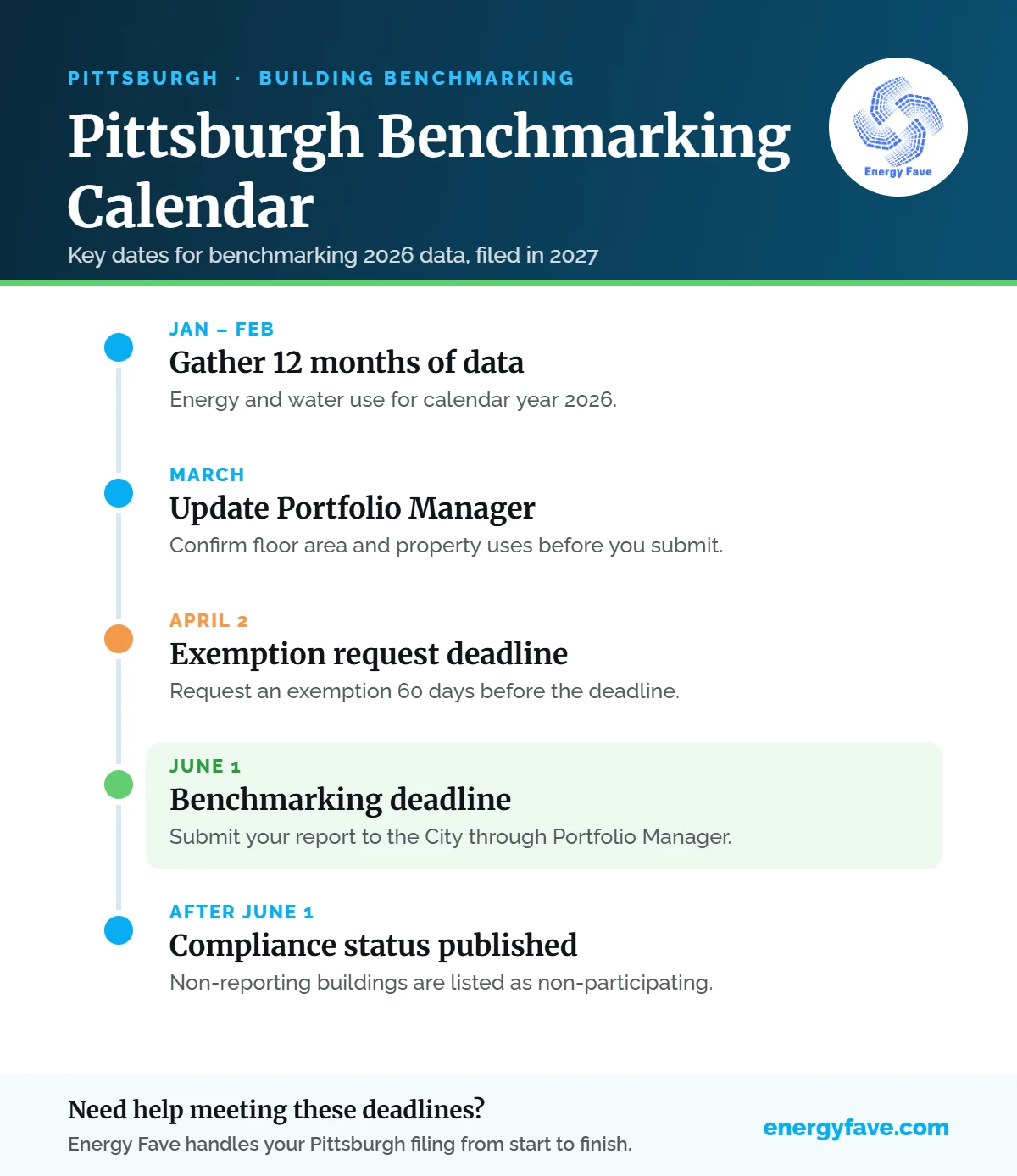
Pittsburgh owners report through ENERGY STAR Portfolio Manager. A typical filing looks like this:
- First, confirm your building is on the City’s covered list and note its Pittsburgh Building ID.
- Next, set up or update the property in Portfolio Manager with accurate floor area and use details.
- Then enter 12 months of whole-building energy and water data for the previous calendar year. Request aggregated data from Duquesne Light, your gas utility and Pittsburgh Water where tenants are separately metered.
- If you need an exemption, request it by April 2.
- Finally, submit your report to the City through Portfolio Manager by June 1.
What is the deadline for Pittsburgh building benchmarking?
Pittsburgh benchmarking reports are due June 1 every year and cover the previous calendar year’s energy and water use. Exemption requests are due 60 days earlier, on April 2.
Next deadlineJune 1, 2027 for calendar-year 2026 data
We recommend starting your data collection in February so there is time to request utility data and file any exemption request.
Pittsburgh benchmarking requirements at a glance
Pittsburgh keeps its program simple. Here is what covered owners need to do each year:
| Requirement | Who must comply | Deadline |
|---|---|---|
| Exemption requestIf needed | Covered buildings that qualify for an exemption | April 2 each year |
| Annual benchmarkingEvery year | Non-residential 50,000+ sq ft, including non-residential portions of mixed-use buildings | June 1 each year |
| Public disclosureAfter filing | All covered buildings | City lists each building as participating or non-participating |
What utilities are required for benchmarking reporting?
- Water
- Electricity
- Natural Gas
- District Energy
- Any other purchased fuel
What is the purpose of Pittsburgh's benchmarking ordinance?
Large buildings account for much of Pittsburgh’s energy use and emissions, so the City uses benchmarking to measure how they perform. The ordinance serves two main goals:
Cut energy and water use. Annual data shows owners where they waste resources, supporting the Pittsburgh 2030 District goal of a 50% reduction below baseline.
Make performance transparent. Because the City publishes compliance status, tenants and buyers can compare buildings, and owners have a clear reason to improve. Many owners then go further and pursue ENERGY STAR certification.
To see how other cities handle benchmarking, visit our energy benchmarking compliance guide.
Pittsburgh building benchmarking FAQs
Are there fines for missing the Pittsburgh benchmarking deadline?
Not currently. The ordinance does not impose direct financial penalties, but the City publicly lists buildings that do not report.
Do multifamily buildings have to benchmark in Pittsburgh?
No. The ordinance covers non-residential buildings and the non-residential portions of mixed-use buildings of 50,000 sq ft or more.
When are exemption requests due?
Exemption requests are due 60 days before the June 1 deadline, which is April 2.
What is the Pittsburgh 2030 District?
It is a voluntary partnership of building owners working toward a 50% reduction in energy and water use. It is separate from the ordinance, but benchmarking data supports it.
Can Energy Fave file my Pittsburgh report?
Yes. Energy Fave can collect your utility data, set up Portfolio Manager and submit your report on your behalf.
Interested in benchmarking help?
Pittsburgh at a Glance
- Who's covered
- Non-residential 50,000+ sq ft
- Next deadline
- June 1, 2027The 2026 report was due June 1, 2026. Not filed yet? We can file it now →
- Exemption requests
- Due April 2
- Penalty
- No fines; public listing if you miss it
- Reporting tool
- ENERGY STAR Portfolio Manager