
Boulder Building Performance Ordinance
What is Boulder's Building Performance Ordinance?
Boulder’s Building Performance Ordinance (Ordinance 8071), adopted in 2015, requires owners of existing commercial and industrial buildings to benchmark their energy use every year and take action to improve efficiency.
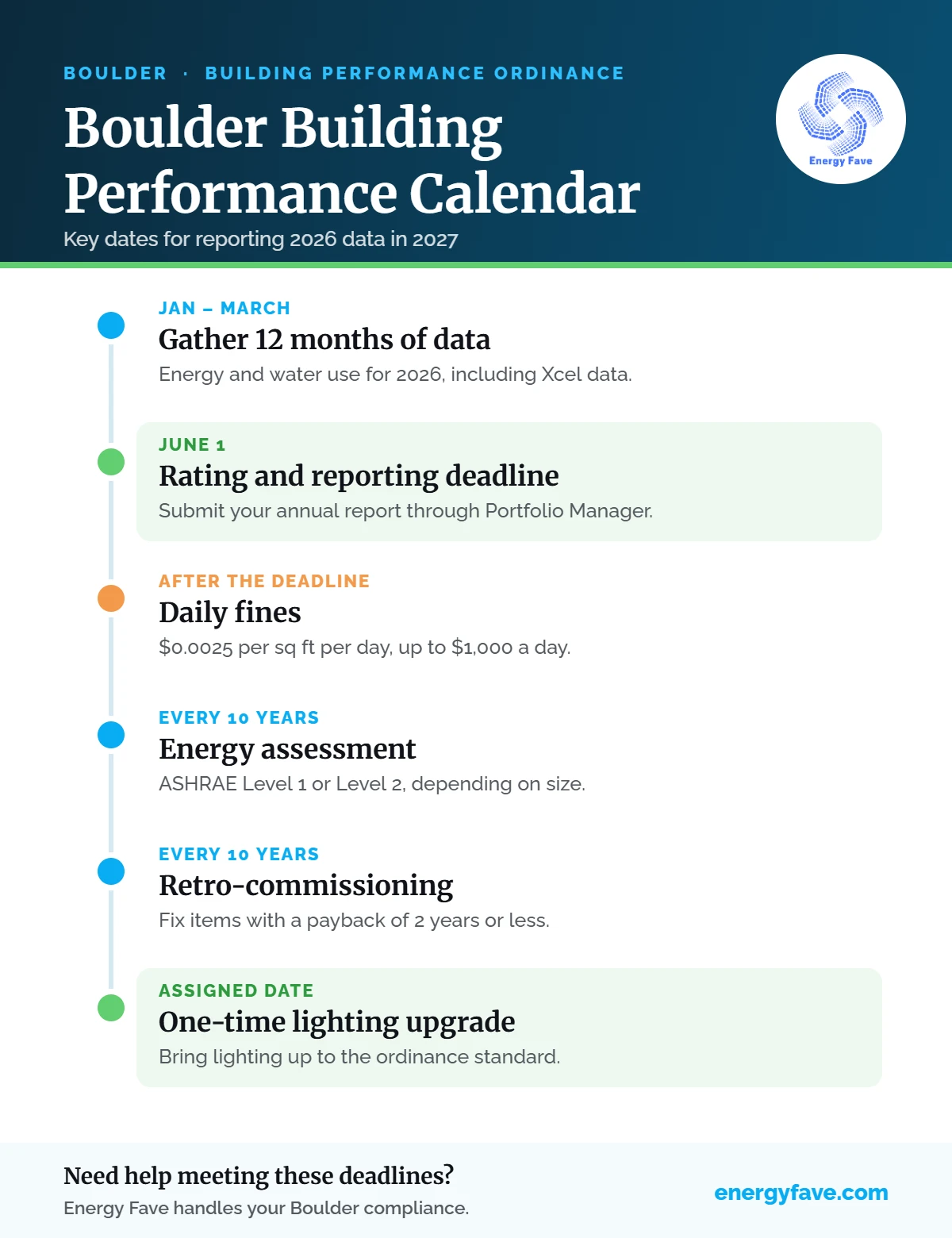
The ordinance combines four requirements: annual rating and reporting, an energy assessment every 10 years, retro-commissioning every 10 years, and a one-time lighting upgrade. Commercial and industrial buildings produce more than half of Boulder’s greenhouse gas emissions, so these steps are central to the City’s climate goals.

What buildings must comply with the Boulder ordinance?
- Existing commercial and industrial buildings over 20,000 sq ft
- New construction over 10,000 sq ft
- City-owned buildings over 5,000 sq ft
- Large industrial campuses (three or more buildings, partly used for manufacturing, served by a central plant or single utility meter)
Covered buildings also complete a one-time lighting upgrade by their assigned due date if their lighting does not already meet the requirements. Buildings of 50,000 sq ft or more are also covered by the statewide Colorado Building Performance Standard.
What are the energy assessment and retro-commissioning requirements?
Every 10 years, covered buildings must complete an energy assessment meeting ASHRAE 211 standards. Buildings under 50,000 sq ft qualify for a free ASHRAE Level 1 assessment through Xcel Energy; buildings 50,000 sq ft and larger need an ASHRAE Level 2 assessment from a qualified provider. Owners must also complete retro-commissioning every 10 years and implement (or document) any identified fix with a 2-year-or-less payback within 2 years of the study.
What is the penalty for non-compliance?
- Missed deadlines: fines of $0.0025 per square foot per day.
- Daily cap: up to $1,000 per day of non-compliance.
- Applies to every requirement: rating and reporting, assessments, retro-commissioning and lighting upgrades.
What is the compliance process?
Boulder owners report through ENERGY STAR Portfolio Manager. A typical year looks like this:
- First, confirm your building is covered and note its Boulder Building ID.
- Next, enter 12 months of whole-building energy and water data in Portfolio Manager. Request aggregated data from Xcel Energy where tenants are separately metered.
- Submit your annual report to the City by June 1.
- In your assessment year, complete an ASHRAE 211 energy assessment (free Level 1 through Xcel Energy for buildings under 50,000 sq ft).
- Finally, complete retro-commissioning and carry out fixes with a payback of two years or less within two years of the study.
What is the deadline for Boulder energy reporting?
Covered buildings must submit their rating and reporting by June 1 every year.
Next deadlineJune 1, 2027 for calendar-year 2026 data
Energy assessments and retro-commissioning follow a 10-year cycle, and the lighting upgrade has its own one-time due date.
Boulder requirements at a glance
Boulder goes beyond reporting. Here is what covered buildings must do:
| Requirement | What is required | How often |
|---|---|---|
| Rating and reporting | Benchmark energy and water in Portfolio Manager | Every year by June 1 |
| Energy assessment | ASHRAE 211 Level 1 (under 50,000 sq ft) or Level 2 (50,000+ sq ft) | Every 10 years |
| Retro-commissioning | Study plus fixes with a payback of 2 years or less | Every 10 years |
| Lighting upgrade | Bring lighting up to the ordinance standard | Once, by your assigned date |
What utilities are required for benchmarking reporting?
- Water
- Electricity
- Natural Gas
- District Energy
- Any other purchased fuel
What is the purpose of Boulder's Building Performance Ordinance?
Commercial and industrial buildings are responsible for 53% of Boulder’s greenhouse gas emissions, so the City uses this ordinance to cut energy use. It serves two main goals:
Cut energy use and emissions. Assessments, retro-commissioning and lighting upgrades turn benchmarking data into real savings.
Improve buildings for tenants. Efficient buildings cost less to run and are more comfortable. Many owners then go further and pursue ENERGY STAR certification.
To see how other cities handle benchmarking, visit our energy benchmarking compliance guide.
This program includes an energy audit, assessment or tune-up requirement. Compare it with other cities in our energy audit compliance guide.
Boulder Building Performance Ordinance FAQs
How often do I need an energy assessment in Boulder?
Every 10 years. Buildings under 50,000 sq ft can get a free ASHRAE Level 1 assessment through Xcel Energy; larger buildings need a Level 2 assessment.
What are the fines for non-compliance?
$0.0025 per square foot per day, up to $1,000 per day.
Does Colorado’s statewide standard also apply?
Buildings of 50,000 sq ft or more are also covered by Building Performance Colorado. See our Colorado guide for details.
What is retro-commissioning?
A study that checks whether a building’s systems run as intended. Boulder requires owners to fix issues with a payback of two years or less within two years.
Can Energy Fave help with Boulder compliance?
Yes. Energy Fave can submit your annual report and coordinate your energy assessment and retro-commissioning.
Interested in benchmarking help?
Boulder at a Glance
- Who's covered
- Commercial & industrial 20,000+ sq ft
- Next deadline
- June 1, 2027The 2026 report was due June 1, 2026. Not filed yet? We can file it now →
- Late penalty
- $0.0025/sq ft per day (max $1,000/day)
- Assessment & RCx
- Every 10 years
- Reporting tool
- ENERGY STAR Portfolio Manager